
How to stop repeated failures from becoming a lifestyle brand.
Failure, risk, and improvement methods help you understand why something went wrong, what could go wrong next, and how to test improvements without betting the farm, the barn, and three goats on one heroic guess.
This page covers Five Whys, fishbone diagrams, PDSA/PDCA cycles, after-action reviews, FMEA, fault-tree analysis, bow-tie analysis, and resilience thinking. Use these tools when problems repeat, failures surprise people, processes break down, risks accumulate, or a team keeps “fixing” the same issue with the same solution-shaped superstition.

Quick navigation
Best used for
- Repeated failures.
- Process breakdowns.
- Risk reduction.
- Small tests of improvement.
- Learning from mistakes without making blame the entire management strategy.

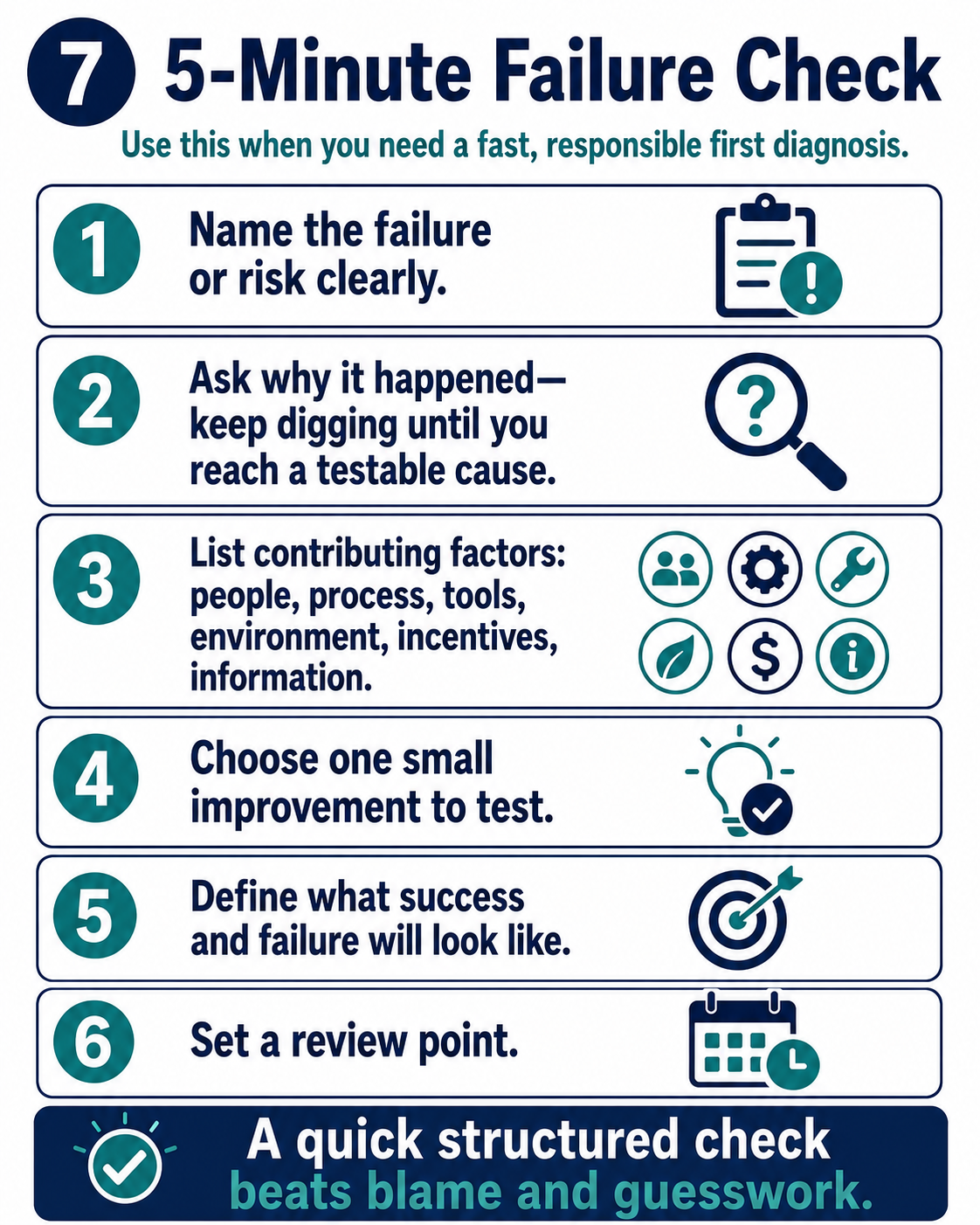
5-minute version
Use this when the problem is pressing and you need the fastest responsible version of the method. Not perfect, but better than sprinting into a decision while waving a flaming assumption.
- Name the failure or risk clearly.
- Ask why it happened at least five times, but stop when you reach a testable cause rather than a philosophical swamp.
- List contributing factors: people, process, tools, environment, incentives, information.
- Choose one small improvement to test.
- Define what success and failure will look like.
30-minute careful version
Use this when the issue matters enough to deserve a slower look. Thirty minutes of structured thinking can prevent thirty months of cleanup, which is apparently a bargain humans keep trying to avoid.
- Run a fishbone diagram to map contributing causes.
- Use Five Whys to trace one causal chain deeply.
- Run an after-action review: What was expected? What happened? Why? What will we change?
- Use FMEA to list possible failure modes, severity, likelihood, and detectability.
- Use fault-tree analysis for serious failures with multiple causal paths.
- Use bow-tie analysis for major risks: causes on one side, consequences on the other, controls in the middle.
- Run a PDSA cycle: plan a small test, do it, study results, act on what you learn.
- Strengthen resilience: redundancy, buffers, monitoring, recovery capacity, and learning loops.

Vignette: The organization that kept fixing the symptom
A volunteer group keeps missing deadlines. Each time, they send a stern email about responsibility. This produces exactly enough guilt to fuel one week of improvement, then the deadline monster returns wearing sunglasses.
A fishbone diagram shows unclear ownership, late approvals, weak onboarding, no backup reviewer, and too many last-minute changes. A PDSA test assigns a single project owner and a backup reviewer for one small project. The next deadline is met. The solution was not “care more.” It was redesign the failure pathway.
Practice: apply this to one of your three current problems
Write down your three most important current problems. Pick one. Then apply the prompts below. Do not merely admire the tool from a safe distance like a museum visitor staring at a fire extinguisher.
- Pick a repeated failure.
- Write what happened and what should have happened.
- Run Five Whys on one causal path.
- Create a fishbone list of contributing factors.
- Choose one small testable change.
- Write what you will measure and when you will review it.

Common mistakes
- Stopping at “human error” instead of asking what conditions made the error likely.
- Making the test too big.
- Punishing people before understanding the process.
- Confusing severity with likelihood.
- Not reviewing whether the improvement worked.

AI Prompt Support Module
Use AI as a thinking partner, not as a priest, judge, or magical vending machine for certainty. First write your own answer. Then ask AI to challenge, improve, and stress-test it.
Run Five Whys
Help me run a Five Whys analysis on this repeated failure: [describe]. Do not stop at blame. Keep looking for process, incentive, communication, resource, or system causes.
Create a fishbone analysis
Create a fishbone diagram in text form for this problem: [describe]. Use categories such as people, process, tools, environment, information, incentives, resources, and external constraints.
Run a PDSA plan
Create a small PDSA test for this improvement idea: [idea]. Include plan, do, study, act, measurement, timeline, and what we will do if the test fails.
Risk analysis
For this risk: [describe], create a bow-tie style analysis with causes, preventive controls, central event, consequences, recovery controls, and early warning signs.
FAQ
Is Five Whys always exactly five whys?
No. Five is a guideline. The goal is to reach a useful, testable cause, not to perform a ritual.
What is the difference between FMEA and fault-tree analysis?
FMEA starts with possible ways a process could fail. Fault-tree analysis starts with a bad outcome and works backward through causal paths.
Why use small tests?
Because small tests let you learn quickly and safely. Large untested changes are how organizations turn hope into expensive rubble.
Glossary
- Five Whys: A root-cause technique that repeatedly asks why a failure occurred.
- Fishbone diagram: A cause-mapping tool that groups contributing factors by category.
- PDSA: Plan-Do-Study-Act, a small-cycle improvement method.
- FMEA: Failure Mode and Effects Analysis, a method for identifying possible failures and ranking their seriousness.
- Bow-tie analysis: A risk method that maps causes, preventive controls, consequences, and recovery controls around a central risk event.
References and bibliography
These sources are included so readers can go deeper, check the intellectual foundations, and avoid treating this guide like it descended from the clouds on a glowing clipboard.
- Institute for Healthcare Improvement, “Model for Improvement.” IHI resource.
- International Organization for Standardization, ISO 31000:2018, “Risk management — Guidelines.” ISO overview.
- Richards J. Heuer Jr., Psychology of Intelligence Analysis, CIA Center for the Study of Intelligence. CIA PDF.
Next: Design Thinking and Creative Problem Entry
The next page shifts from diagnosing failure to designing better solutions. Once you understand what is broken, you still need to avoid solving the wrong problem beautifully.
Design thinking and creative problem entry help you listen to users, reframe the challenge, generate options, prototype, test, and use early intuition without letting it seize the steering wheel.
Do you like this page?
