
Think clearly. Understand complex problems. Build better possibilities.

The Universe Institute is a nonpartisan, publicly funded nonprofit think tank founded in 2011. We research complex global problems and develop practical tools that help people test evidence, understand systems, improve judgment, use artificial intelligence more wisely, and design better solutions.
Our purpose is not simply to describe what is going wrong. It is to help people see reality more accurately, learn faster, correct mistakes, understand difficult systems, and expand the possibilities for wiser decisions and more effective action.
The 60-second version
The Universe Institute is the Think Clearly part of FACTNet's connected public-education pathway. We study the global polycrisis, teach rational thinking and metacognition, use systems thinking and DMAP for complex problems, research limited progressive evolution, examine repeating civilization-scale disfunction and injustice causes and solutions, and explore better ways to train, supervise, and use AI. Our work is designed to help people move from information to better understanding, better judgment, and better problem-solving.
Quick navigation:
What we do | How we think | DMAP | Limited progressive evolution | AI work | The four-site pathway | Evolutioneers | Where to start | FAQ | Glossary
What the Universe Institute Does
We investigate questions where ordinary single-discipline thinking is often not enough. Many of today's hardest problems involve interacting systems, changing conditions, uncertainty, delayed effects, feedback loops, competing values, and consequences that spread across social, ecological, economic, political, technological, and cultural boundaries.

Our main work includes:
- Global polycrisis research. We examine how major global risks interact, amplify one another, and create consequences that cannot be understood well in isolation.
- Rational thinking and metacognition education. We develop beginner-to-advanced guides for evidence testing, logic, probability, causality, bias checking, forecasting, systems thinking, decision-making, and thinking about your own thinking.
- Advanced complex-problem analysis. We use DMAP, systems thinking, causal analysis, red teaming, and related methods to search for missing contexts, relationships, changing conditions, failure modes, and better solution options.
- Civilization-scale research. We investigate recurring causes of dysfunction, injustice, catastrophic failure, resilience, cooperation, and civilizational collapse.
- Limited progressive evolution research. We study conditional patterns such as cooperation, coordination, cumulative learning, integration, information processing, adaptability, and conflict regulation, while also examining regression, fragmentation, maladaptation, collapse, and extinction.
- AI reasoning, safety, supervision, and training. We examine how better human reasoning methods can improve the way people use and supervise AI, and how advanced reasoning frameworks may contribute to safer and more capable AI systems.
- Public research and education. We publish white papers, articles, analytical frameworks, educational guides, and research tools for people who want to think more accurately about difficult problems.
Explore Universe Institute papers and research →

Our basic rule: ask first, What is true, what is uncertain, what is missing, and what would change our conclusion? Only after that should we ask what a person, institution, or society might wisely do.

How We Think and Test Our Work
No person, institution, research method, or AI system is free of error. So our goal is not to claim perfect objectivity. Our goal is to make our evidence, assumptions, uncertainty, methods, and value judgments as visible and testable as possible.
Our analysis draws, as appropriate, on scientific methods, logic, probability, statistics, causal analysis, systems thinking, complexity thinking, source evaluation, forecasting, metacognition, DMAP, and adversarial or Red Team review.
We also use AI as a research, comparison, organization, and challenge tool. We do not treat AI as an oracle. Important claims should be checked against credible evidence, alternative explanations, and the possibility that the human analyst or the AI has missed something important.
Whenever possible, we distinguish among:
- Established evidence or strong scientific findings
- Emerging evidence that is promising but not yet settled
- Informed interpretation based on available evidence
- DMAP-derived hypotheses that need further testing
- Precautionary forecasts used when uncertainty and potential consequences are both high
- Ethical or value judgments that cannot honestly be disguised as scientific facts
- Philosophical or speculative ideas when they are discussed at all
See our analysis process →
See how we evaluate evidence and missing data →

DMAP: Advanced Thinking for Complex, Changing Problems
DMAP stands for Dialectical Metasystemic Analysis and Problem-Solving. At the Universe Institute, DMAP is an advanced analysis framework based on Otto Laske's 28 dialectical thought forms.
DMAP is not a replacement for logic, evidence, statistics, scientific reasoning, or systems thinking. It works best when those foundations are already strong. Its practical purpose is to make an analyst examine a problem from more perspectives, especially its context, relationships, processes of change, contradictions, and the larger systems in which it is embedded.
This is especially useful for complex adaptive systems, where changing one part can affect many other parts, produce delays or feedback, trigger unexpected adaptations, or create consequences far from the original intervention.
Learn what DMAP is and how it is used →

The Global Polycrisis: Understanding the Whole System
The Universe Institute studies the global polycrisis because today's major risks do not stay politely inside separate academic departments. Climate change, ecological degradation, resource pressure, economic fragility, inequality, political instability, conflict, public-health threats, infrastructure weakness, misinformation, and rapidly changing technologies can interact through feedback loops and shared vulnerabilities.
The purpose of polycrisis analysis is not to make the future sound hopeless. It is to see more of the system early enough to reduce avoidable harm, improve preparation, identify leverage points, and create better options.
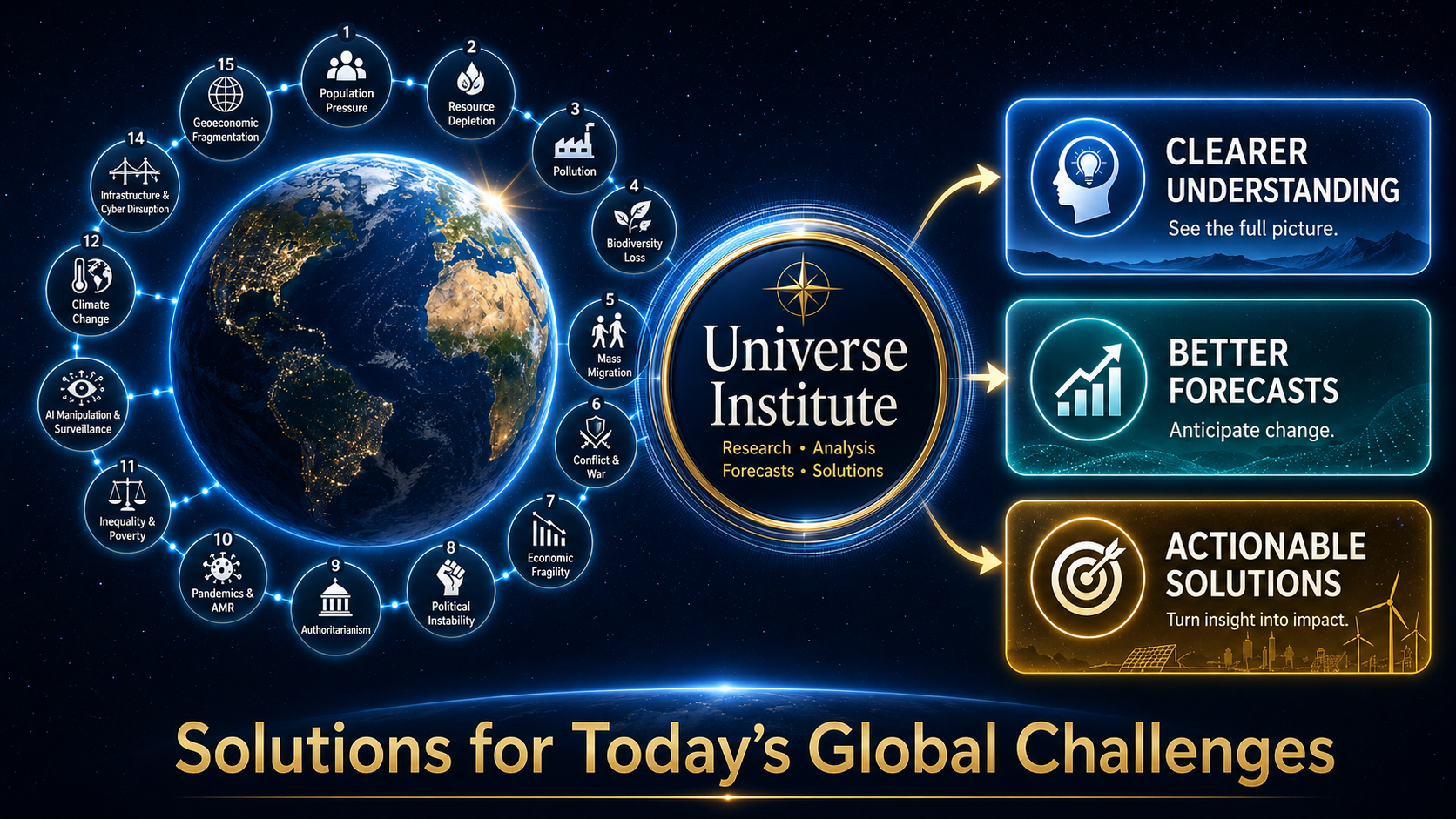
Explore the global polycrisis →
Read The 10,000-Year Trap research project →
Limited Progressive Evolution: Studying Possibility Without Pretending Progress Is Guaranteed
The Universe Institute is the primary research home in the FACTNet network for limited progressive evolution.
This work studies specific, conditional patterns in biological and cultural evolution, including increases in cooperation, coordination, division of labor, cumulative learning, information storage and transmission, adaptability, integration, resilience, and the regulation of destructive internal conflict.
The word limited matters. We do not claim that evolution as a whole always progresses, that human history inevitably improves, that greater complexity is always better, or that the universe has a scientifically demonstrated destination. Evolution can also simplify, fragment, become maladaptive, collapse, or end in extinction.
When evolutionary research is used to inform action, we also keep facts and values separate. Facts can reveal consequences, constraints, and conditions. They do not automatically create moral commands. Practical recommendations should therefore state the values or goals being protected and remain conditional, testable, and revisable.
Explore limited progressive evolution research →

AI: Use It, Test It, Supervise It
Artificial intelligence can greatly accelerate research, comparison, drafting, modeling, and problem-solving. It can also accelerate mistakes, hidden assumptions, fabricated information, bias, and false confidence.
That is why the Universe Institute treats stronger human reasoning as more important in the AI era, not less important. Our rational-thinking and metacognition guides are designed to help people question AI output, verify important claims, compare alternatives, examine uncertainty, identify missing evidence, and keep human responsibility in charge of consequential decisions.
We are also researching how advanced reasoning, metacognition, developmental models, systems thinking, and DMAP may contribute to improved AI training, reasoning, supervision, and safety.
Explore the Universe Institute's AI work →
Start with the three rational-thinking and metacognition guides →
How the Universe Institute Fits Into FACTNet's Broader Vision
The Universe Institute is one part of FACTNet's connected public-education pathway. Each website has a different job, so visitors do not have to force climate preparation, research, philosophy, spirituality, and organizational work into one giant intellectual junk drawer.

A simple division of labor is:
- Job One for Humanity — Survive and Stabilize. Climate reality, preparation, adaptation, resilience, migration guidance, and climate action.
- Universe Institute — Think Clearly. Polycrisis research, rational thinking, metacognition, systems analysis, DMAP, limited progressive evolution, AI reasoning and safety, and advanced problem-solving.
- The Way of the Universe — Live Wisely. A secular, science-grounded practical philosophy focused on right action, right attitudes, cooperation, responsibility, ecological realism, and constructive renewal.
- Universe Spirit — Explore Meaning and Inner Resilience. A voluntary, non-coercive path for exploring meaning, consciousness, spiritual experience, existential questions, and inner resilience without required doctrine or surrender of judgment.
FACTNet connects and supports the whole system. Its larger framework is: See Clearly → Prepare Wisely → Protect What Matters → Build What Works.
The positive public invitation for this larger work is Our Next Bold Adventure. The crises themselves are not the adventure. The adventure is what people learn, protect, repair, discover, test, improve, and build in response.
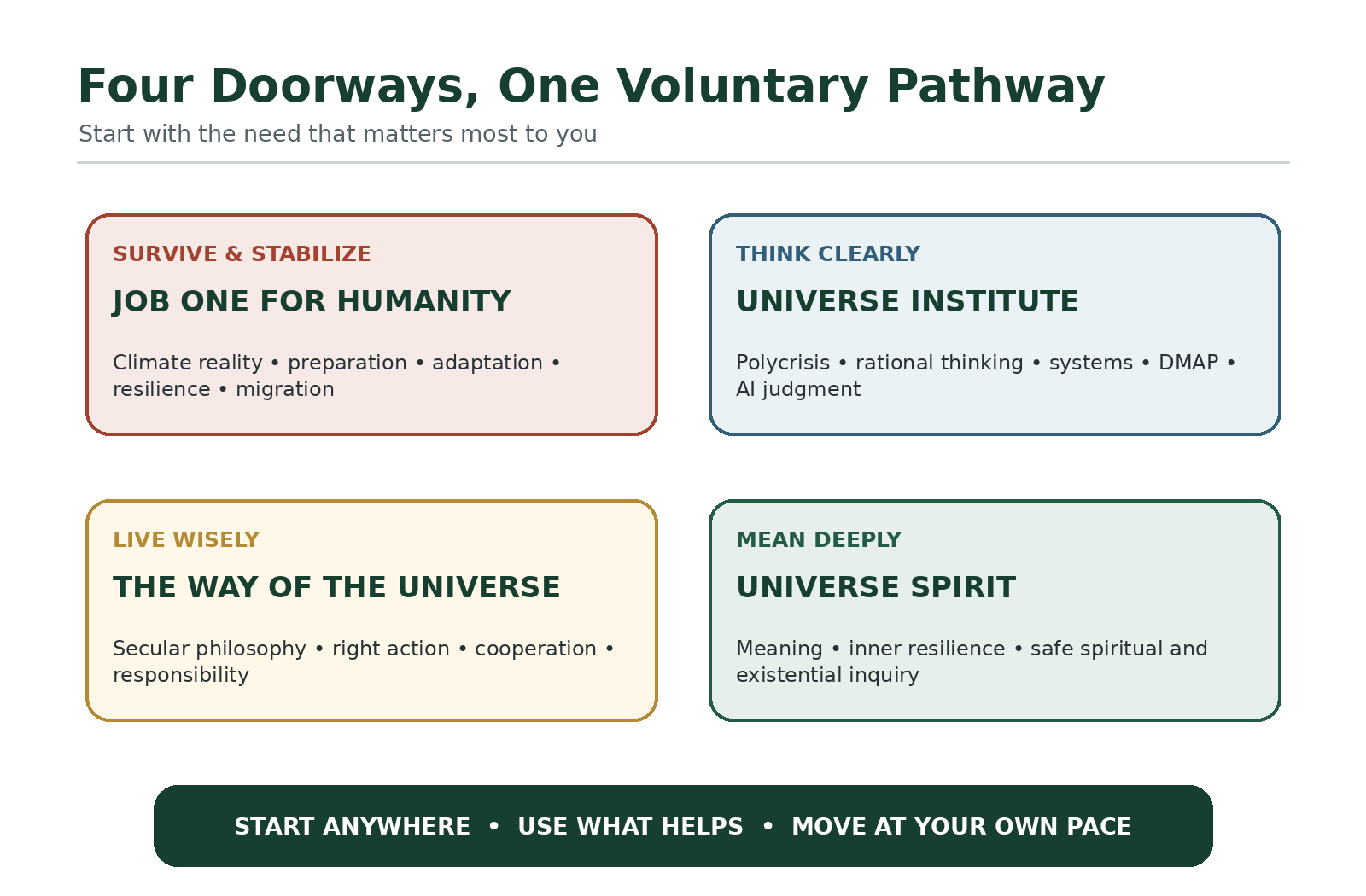
Explore FACTNet's full connected vision and Our Next Bold Adventure →
Evolutioneers and the Universe Institute
Some people who use our four-site pathway may voluntarily identify as Evolutioneers. The identity is optional. It is not a claim of superiority, a membership rank, a religion, or a requirement for using any FACTNet website.
At the Universe Institute, the Evolutioneer path emphasizes learning how to see more clearly: test claims, recognize bias, understand systems, use uncertainty honestly, supervise AI, examine assumptions, correct errors, and apply better analysis to real problems.
You do not need to adopt the identity to benefit from the methods. The useful test is simpler: Are your thinking and decisions becoming more accurate, self-correcting, and effective?
Learn about the Evolutioneer identity in the broader FACTNet pathway →
What Belongs Here, and What Belongs on Our Other Sites
Keeping clear boundaries makes all four websites more credible and easier to use.
- The Universe Institute investigates. Its central question is: What is true, what is uncertain, how does the system work, and what solutions appear most credible?
- Job One for Humanity prepares. It focuses on climate risk reduction, preparedness, adaptation, resilience, and migration.
- The Way of the Universe guides practical philosophy and action. It asks how people might live, cooperate, choose, and act wisely.
- Universe Spirit explores meaning. It provides a bounded place for spiritual, existential, and consciousness-related exploration.
- FACTNet connects and administers the broader nonprofit system.
This boundary does not prevent collaboration. It prevents category confusion. Research can inform action without pretending that science alone settles every ethical question. Philosophy can use evidence without pretending to be laboratory science. Spiritual exploration can remain voluntary without being smuggled into factual claims. Humans have spent several thousand years mixing those categories, with predictably theatrical results.
See the Universe Institute's publication selection criteria →
Where to Start
You do not need to read the entire website. Start with the doorway that matches your need.
- I want to improve my thinking and decisions: Start with the three rational-thinking and metacognition guides.
- I want to understand interacting global risks: Start with the global polycrisis overview.
- I work with complex systems: Explore DMAP.
- I want the deeper civilization-level research: Read The 10,000-Year Trap.
- I am interested in evolution and future possibilities: Explore limited progressive evolution.
- I want to understand the larger four-site project: Visit FACTNet.
Start with one real problem. Use one better thinking tool. Test the result. Correct what fails. Keep what works.

Support Independent Public-Interest Research
The Universe Institute's work depends on public support. Donations help sustain research, educational materials, analysis, website publication, and the continuing development of public tools for rational thinking and complex problem-solving.
Frequently Asked Questions
Is the Universe Institute a university?
No. The Universe Institute is a nonprofit think tank and public-education organization. FACTNet separately plans to rebuild Universe College as a noncredit educational platform. It should not be confused with an accredited degree-granting university.
Is the Universe Institute politically partisan?
No. The Institute describes itself as nonpartisan. It may study politics, governance, public policy, power, institutions, and social systems because those are important parts of complex global problems. The goal is to test claims and consequences rather than require loyalty to a political party or ideology.
Do I have to agree with the Institute's conclusions?
No. Disagreement, criticism, correction, and competing explanations are part of serious inquiry. The Institute's work should be treated as material to examine, test, improve, and revise when better evidence appears.
Do I need DMAP training to use this website?
No. DMAP is an advanced method. Most people should begin with the basic and intermediate rational-thinking tools, then add systems thinking and DMAP as the problems they face become more complex.
Does limited progressive evolution mean evolution inevitably gets better?
No. It means that particular forms of cooperation, coordination, learning, integration, adaptability, or other capacities can increase under some conditions. Evolution can also reverse, simplify, fragment, become maladaptive, collapse, or end in extinction.
Does the Universe Institute trust AI to make important decisions?
No. AI can be useful for research and analysis, but consequential claims and decisions still require evidence checking, uncertainty awareness, context, ethical judgment, and accountable human supervision.
How is the Universe Institute different from the other FACTNet sites?
Universe Institute focuses on research, evidence, thinking methods, systems analysis, DMAP, limited progressive evolution, AI, and complex problem-solving. Job One for Humanity focuses on climate preparation and resilience. The Way of the Universe focuses on secular practical philosophy and right action. Universe Spirit focuses on meaning and inner resilience. FACTNet connects the overall system.
Mini-Glossary
Complex adaptive system: A system with many interacting parts that change and adapt over time, often producing outcomes that cannot be understood by examining each part separately.
DMAP: Dialectical Metasystemic Analysis and Problem-Solving, an advanced framework used to examine context, relationships, change processes, contradictions, perspectives, and whole systems.
Evolutioneer: An optional identity for a person who keeps learning, thinks carefully, prepares responsibly, protects life and dignity, contributes useful work, and learns from results while participating in Our Next Bold Adventure.
Limited evolutionary normativity: A careful way of connecting facts to action. Reliable facts can help reveal what may be necessary to achieve an explicitly stated value or goal, but the facts do not create the value by themselves.
Limited progressive evolution: The study of specific, conditional evolutionary patterns in which capabilities such as cooperation, learning, coordination, integration, or adaptability increase, without claiming that evolution as a whole inevitably progresses.
Metacognition: Thinking about, observing, testing, and improving your own thinking.
Our Next Bold Adventure: FACTNet's positive invitation to learn, protect, repair, discover, test, improve, and build better possibilities in response to a changing world.
Polycrisis: A condition in which multiple major crises interact so that their combined effects may be greater, faster, or less predictable than their separate effects.
Red Team review: A deliberate effort to challenge an analysis, plan, or conclusion by searching for counterevidence, weak assumptions, failure modes, unintended consequences, and missing information.

Key Universe Institute Links
Please note: This nonprofit website is still under construction. We are still fixing links, upgrading language, and editing materials. But the website is in good enough shape for you to learn about us. If you like what you see, you can sign up for our email list, volunteer, and even donate during this construction period. This website is being reorganized around a new vision and an integrated four-website pathway, which we call Our Next Bold Adventure, and the developing Shared Quest Network. To see our new vision, click here. You will be taken to the Factnet main website, where you will also find the estimated timeframe for this website's completion and public launch.