
Last updated 6.14.26. This is the most current and comprehensive climate change temperature and time-frame forecast ever produced by our climate change think tank.
1. Prologue
Here are five things you should know before you read the new climate change forecast in this article:
1. You are about to read what every well-funded intelligence agency, military organization, and top-tier risk assessment firm charging billionaires and the world's wealthiest corporations sky-high monthly fees already know but keep as a tightly held secret. They keep the most accurate information confidential because it gives them significant strategic, economic, corporate, military, or national advantages.
Another reason this uncensored climate change forecast is kept from the public is that if the public truly understood the danger they were in because of government inaction and incompetency, and the decades of the global fossil fuel cartel's financial influence, deception, and disinformation also contributing to serious underestimation of the UN, IPCC climate change consequence and timeframe forecasts and summary reports, there would be widespread public panic.
At the Universe Institute and Job One For Humanity, we believe that every citizen should have the same access to information essential to their survival as our government agencies and the privileged ultra-wealthy organizations do. Consequently, we provide the general public worldwide with uncensored, unedited climate change information. (Accordingly, please distribute this article, or any pages from our website, to everyone you believe should receive them for their protection.)
2. To give you a simple starting point for the depth of this underestimation problem, we only need to mention that the IPCC has, for decades, been telling the general public through worldwide media that humanity should not reach an average global temperature increase over pre-industrial levels of 2°C until about 2100. Our new, uncensored forecasts below indicate that humanity is poised to reach an average global temperature increase of 2°C above pre-industrial levels, possibly as early as the 2030s to the 2050's. That is a very dangerous 50- 70-year climate change forecast error prediction gap.
3. The article's forecast methodology (that we have also provided below) allows any individual or group with good mathematical skills to duplicate the same calculations, procedures, and processes we used, and that major intelligence agencies and risk analysis firms also used to produce a far more accurate and honest climate change forecasts than what the public is being given by the IPCC, your government, or the fossil fuel cartel heavily influenced media.
4. In the forecast below, we use some climate change terminology that may be unfamiliar; however, you should still be able to quickly grasp the key points, and many terms include links to more detailed explanations. If some of the climate science and terminology seem a bit much, simply compare the first two illustrations on the page to our four final illustrations on the page, sections two through eight. You will quickly learn everything you need to know about how soon and how much climate change is going to accelerate and adversely affect your life, family, business, and nation.
5. If you're one of those individuals who wants to get to the rising temperature and timeframe bottom line right away, then compare the green rising temperature line found on the third graphic illustration on this page below to the yellow or blue rising temperature line on the UN IPCC's fourth graphic illustration below. You will instantly see the differences in temperature and time frames between our forecast and the IPCC forecast.
Section Overview
Sections 1-10 are essential reading for everyone. Sections 11-15 are geared more toward other climate change researchers and individuals who want to verify the accuracy of the very unsettling new forecasts of climate change consequences and timeframes. The sections below discuss various aspects of climate change forecasts, including the processes involved, the unique contexts in which they're created, the relationships within the climate system and within the organizations that produce them, and the transformations that result from these factors.
1. Prologue
2. How to compare our new forecasts with the United Nations' Intergovernmental Panel on Climate Change's (the IPCC) current climate change temperature and timetable forecasts from now until 2100.
3. Critical information about our four new climate change temperature and timeframe forecast graphs to help you grasp the seriousness of the IPCC's current forecasting inaccuracy problem.
4. Our 2026 new low, medium, and high (worst-case) scenario climate change temperature and timeframe forecasts.
5. Things to notice when comparing the IPCC's two graphs to our four graphs and the very significantly different forecasts we have produced.
6. Three additional forecast graphs showing the difference as global fossil fuel use increases by 1, 2, or 3 percent annually.
7. A critical time frame review of the most destructive tipping points, feedback loops, and non-linear reactions which are likely to unfold within the climate and its subsystems. (These relate directly to your future wellbeing and survival, and our new temperature in the timetable forecasts below.)
8. What does our new forecast mean to your future finances, businesses, personal goals, and survival?
9. Nine things you can do about this climate change consequence and temperature forecast nightmare.
10. Contrarian good news about the future of climate change, humanity, and a special Mother Nature's surprise support and assistance.
11. Why are our climate change temperature and timeframe forecasts so different from the IPCC's forecasts?
12. Conclusion and Final Polycrisis Shocker Adjusted Time Frames
13. More technical information, including the criteria, formulas, definitions, and methodology we used in our forecasts, so that anyone can independently verify our newest forecasts.
14. Bibliography, additional methods, and sources.
15. Additional technical notes.
16. Useful additional reading and links.
2. How to compare our new forecasts with the United Nations IPCC's current climate change, temperature, and timetable forecasts from now until 2100
In this article, you will find considerable criticism of the United Nations Intergovernmental Panel on Climate Change (IPCC) and its administrators and authors of its summary reports. Please do not conflate or confuse any administrative criticism of the IPCC with any criticism of the independent climate change scientists and researchers who submit their honest work, based on their own climate system or subsystem specialties, to the IPCC for evaluation and use. These independent scientists and researchers have no real control over how IPCC administrators and summary report writers alter, omit, or change critical new climate science under the tremendous political pressures they face. Unfortunately, the IPCC's summary reports remain the world's leading source of accurate information on climate change.
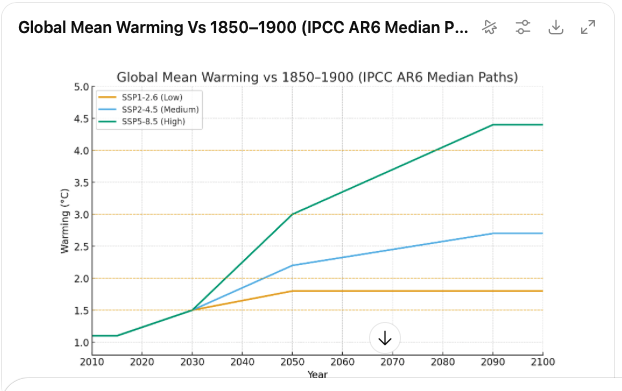
Below are the United Nations Intergovernmental Panel on Climate Change (IPCC) forecasts and our forecasts of average global temperature increases relative to pre-industrial levels, along with approximate timelines for reaching these temperatures. The first two sets of forecasts (charts) below are from the United Nations Intergovernmental Panel on Climate Change (IPCC). The IPCC's forecasts cover low, medium, and high scenarios for climate change, temperature, and timelines, and are used by most governments, corporations, and nonprofit educational organizations worldwide.
Review these IPCC scenarios first, as they are currently the most used and trusted worldwide. Reviewing the IPCC scenarios first will also help you understand the key differences in our latest forecasts, which incorporate all factors the IPCC's AR6 report omitted, miscalculated, or overlooked, whether intentionally or unintentionally.
Please also keep in mind that if the IPCC's baseline temperature and timeframe calculations are significantly incorrect or underestimated, (as we will demonstrate to you in our newest forecasts and in our forecast verification notes in sections 11 and 12 below), this will also mean that the climate change solutions that the IPCC is putting forward for the correct annual amount of global fossil fuel use reductions, and the date we must reach those emission reductions (or net zero carbon emissions) will also be incorrect and significantly underestimated. That, of course, also means that all international climate conferences and current international agreements aimed at reducing global fossil fuel use, based on the IPCC's forecasts, are significantly flawed and significantly underestimate the correct solution for reducing global fossil fuel use. If the IPCC's forecasts are seriously underestimated, as we will attempt to show below, it also removes the critical public urgency to address the climate change emergency that would naturally arise if people understood its seriousness.
Here are the IPCC low, medium, and high forecasts:
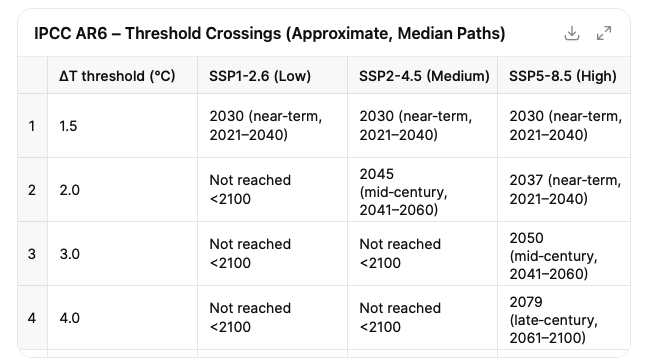
3. Critical information about our four new climate change temperature and timeframe forecast graphs below is so much worse than the IPCC's Forecasts
The following will also help you grasp the seriousness of the IPCC's current underestimation of forecasts. Our temperature and timetable forecasts below show what now underestimated-corrected climate change temperatures and timeframes look like when you remove incorrect climate change critical factors, correct process errors, and add missing factors that include the following:
1. The UN IPCC is using a severely underestimated calculation constant (the ECS) in its climate change severity forecasts, its timetables, and in its solutions and targets for global fossil fuel reductions. The IPCC does not use James Hansen's far more accurate estimate of 4.5 for the climate sensitivity constant (ECS). The IPCC uses the significantly underestimated, constant value of 3.0 for climate sensitivity. This is one of the largest factors behind the IPCC's underestimation of the consequences, timelines, and solutions of climate change. (Understanding the climate sensitivity constant (ECS) is a bit complicated, but if you click here, you will find a good illustrated explanation of the science for why it is one of the largest factors in the IPCC's 20-40% underestimation in their climate change summary reports.)
2. You remove all of the false and unachievable new technology carbon capture allowances and calculations for future mechanical carbon capture removal that were backed into the climate calculations done by the IPCC. There is no reliable science on new-technology carbon capture today, nor is there a scalable approach that is economically or logistically feasible to achieve the IPCC's projected targets for new-technology carbon capture removal. The IPCC incorrectly included, in the two illustrations above, future large-scale carbon removals from the atmosphere by the new carbon capture technology. The IPCC literally "cooked the books" on this with just plain fossil fuel cartel-favoring accounting. Click here for the full story on the mechanical carbon capture new-technology delusion.
3. You always include calculations for the cooling effect of aerosols. Several studies failed to account for the cooling effects of aerosols, which would be eliminated when global greenhouse gas emissions are finally reduced. Including the removal of atmospheric aerosols in climate calculations is crucial because many human-made aerosols, especially sulfate pollution, have been temporarily masking part of the warming caused by greenhouse gases by reflecting sunlight and making some clouds brighter, so if you leave that out, you can badly underestimate how much warming is already “in the pipeline.” The IPCC says observed warming from human activities has been partly masked by aerosol cooling, and NASA explains that aerosols can cool the climate both by scattering sunlight and by changing cloud properties. That means when countries clean up air pollution, which is absolutely good for health, some of that hidden warming can show up more clearly, and temperatures can rise faster in the short term unless greenhouse gases fall fast too.
4. You add in reasonable, defensible calculations for the almost always unaccounted-for or significantly underestimated effects of the Climageddon Feedback Loop, which includes all climate change system-triggered tipping points, activated positive feedback loops, and activated non-linear reactions within the climate and its subsystems occurring over the displayed time periods. You do this because many of these climate change tipping points, feedback loops, and non-linear reactions are already occurring within the climate system, and are accelerating quickly. Even though the current average global temperature increase is not at our forecast levels below, it will rise quickly to near or at those levels during the time periods described in this article because many more tipping points, feedback loops, and nonlinear reactions will accelerate into a cascade of ever-worsening climate change consequences, pushing the temperatures higher faster and faster. (See footnote one.)
It is critical to understand the Climageddon Feedback Loop description because it is the main reason why average global temperatures will rise far faster than the predictions you are being given. Unfortunately, it is difficult to visualize the hundreds of complex interactions occurring at these levels within the climate system and its subsystems. This page's many illustrations of the Climageddon Feedback Loop will help you visualize this and understand how, once this feedback loop hits its own internal tipping point, climate change consequences, including rising heat, will happen so fast that it will be unadaptable for the many individuals, corporations, and nations currently using IPCC forecasts that are about 20 to 40% underestimated. At this point, all you have to remember is that the Climageddon Feedback Loop will be a fundamental and dominant reason that humanity will experience rises in average global temperature far faster and far beyond what we are being told by our governments or the IPCC.
Please note that the IPCC issues low, medium, and high climate change forecasts every 3 to 5 years. The low forecasts are extremely conservative and include very few of the thousands of climate change tipping points, positive feedback loops, or non-linear reactions within the climate and its subsystems. The medium-level forecasts include a small number more of tipping points, feedback loops, and nonlinear reactions. The high or worst-case IPCC forecasts contain more tipping points, feedbacks, and non-linear reactions than the low or medium-report forecasts, but nowhere near the thousands of climate change tipping points, positive feedback loops, and nonlinear reactions that are or will occur within the climate system and its subsystems.
Consequently, these IPCC forecasts should be viewed as various levels of "perfect day" forecasting. (A perfect day forecast is when none of those uncounted for climate change system or subsystem tipping points, positive feedback loops, or non-linear reactions occur or begin to occur.) Once the hundreds and hundreds of climate change system and subsystem tipping points, feedback loops, and non-linear reactions that are not accounted for in IPCC forecasts begin to occur, global temperatures will rise far faster than even their worst-case current projections.
5. You create projections for three scenarios of realistic annual global fossil fuel use. The graphs below also present low-, medium-, and high-projection scenarios for annual growth in global fossil fuel use of 1%, 2%, and 3%. Assumptions that global fossil fuel use will remain constant or drop have not occurred for decades. Current estimates of the actual annual increase in global fossil fuel use run about 1% to 2%. With the US new administration and their "drill baby drill" policies and the rest of the fossil fuel producing nations quickly following in a race to get their wealth out of the ground before a major global climate calamity makes it more difficult to keep promoting fossil fuel, it is possible that over the next several years we may see up to a 3% annual increase in global fossil fuel use.
6. You remove or make calculation allowances for the other numerous errors and omissions of the IPCC in their summary reports, like AR6 described here. Additionally, our first forecast graph below illustrates how the IPCC's original forecast should have been adjusted if you had compensated for the following well-known "contextual" influences and pressures on the final IPCC summary reports. Understanding the prior context surrounding decades of gross underestimation of public climate change forecasts is critically important. Prior or existing context typically constrains the upper and lower bounds of any action permitted or underway within the specific context. (When you read this influence, misinformation, and disinformation of the global fossil fuel cartel link, you will understand how a corrupted context has produced decades of corrupted climate change forecasts.)
Here are additional well-known "contextual" influences and pressures corrupting the final IPCC summary reports.
a. the invisible influence, misinformation, and disinformation of the global fossil fuel cartel.
b. the politicization of climate science.
(Section 11, further below, explains the two critical contextual influences and differences mentioned above in greater detail.)
Finally, to create our four forecasts shown below, we relied solely on the most recent peer-reviewed climate change research cited in the United Nations IPCC's AR6 summary report. This means that anyone who wishes to challenge our new forecasts below must also use only the original IPCC AR6 peer-reviewed research studies and their numbers, then plug in the calculations, variables, and methodologies we fully disclose in section 12 near the bottom of this article to repeat our calculations. They will then be able to see for themselves how we came to the numbers used in our four new forecasts below.
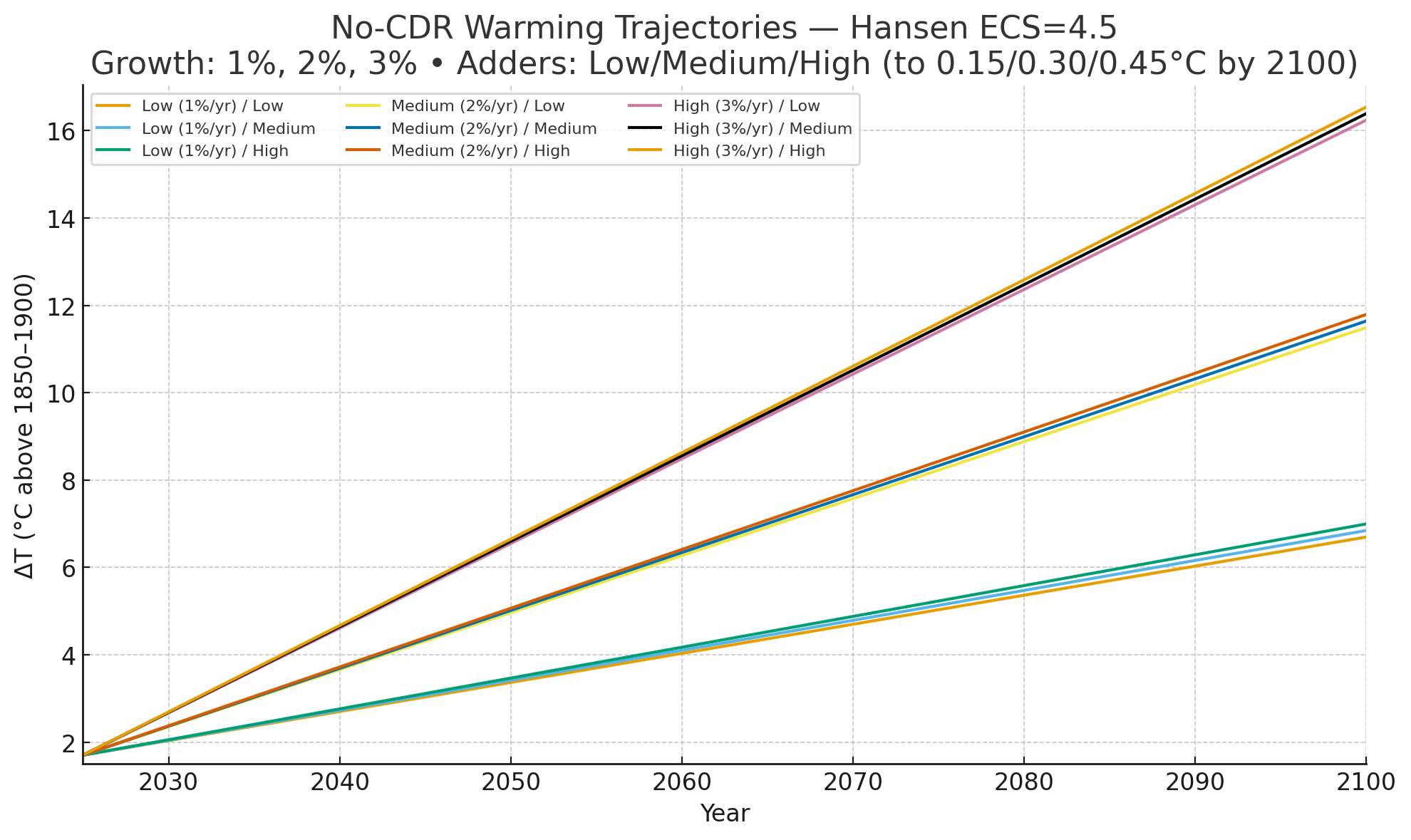
4. Here are our 2025 new low, medium, and high (worst-case) scenario climate change temperature and timeframe forecasts.
Our forecasts are significantly different than what the IPCC is putting out because of the six factors you have just read. (We do repeat the IPCC's low, medium, and high (worst-case) scenarios a little farther down the page so you can easily compare just how different they are at a glance.)
The big climate change survival takeaway from this new climate change temperature and timeframe graph
For now, please focus only on the green line's temperature and timeline from the graph above as the most likely climate change-related temperatures and time frames humanity will face in the future. They are already so bad that we recommend you not focus on our mid-level and high-level forecasts above.
The green line projections for future temperature and timeframe include compensatory calculations and allowances for all six factors of underestimation errors, etc., as described in a few sections above. It is the most reasonable forecast to base emergency preparation, adaptation, and resilience-building on for your family, business, and nation.
Now compare the Job One green line rising temperature line above to the yellow or blue rising temperature line on the UN IPCC's graphic illustration below. Be sure to notice the different temperature scales in Celsius on each of the two graphic illustrations. The Job One graph goes much higher than the IPCC graph, so you will have to consider that as you look at the two lines: they are not apples-to-apples on the same graph, but you will get the idea.
You will instantly see the differences in temperature and time frames between the two sets of forecasts. Whichever forecast is closer to correct is your climate change future. This is because global warming also means that the primary and secondary consequences of climate change will increase in severity, frequency, and scale in near-perfect lockstep as temperatures continue to rise.
Using the green line, we do not believe you will be caught nearly as unprepared as many others worldwide will be, using the significantly underestimated IPCC temperature and timeframe calculations. These green line temperature and timeframe calculations are important primarily because they determine the severity, frequency, and scale of the primary and secondary consequences of climate change. The hotter it gets, and the sooner it gets hot, the more severe, frequent, and widespread the consequences of climate change will become.
That is why having a realistic forecast that includes all factors is critical for long-term survival! Do yourself a favor and only use the green line above for all your climate change planning.
For perspective, reaching about 2°C in average global temperature by about 2030 is bad! Reaching near a 3° increase by about 2040 is far worse. Reaching near a 4° increase by 2050 signals the beginning of "Hell on Earth." A 5° increase by 2070 would mean a massive die-off for humanity. There could be as few as 2 billion people left on Earth after 2070.
Just prepare for and adapt to the green line in the graft above. On its own, it is a momentous and challenging task. Preparing for the other red and orange (high and mid-range) scenarios on the graph above will quickly become nearly impossible. (If you have not read about the Climageddon Feedback Loop, please do it now because it brilliantly illustrates what the causes will be behind why our average global temperatures will rise far faster and sooner than they have ever done so before, as illustrated in the green line above.)
For a quick, easy comparison with our graph above, the IPCC three-scenario graph is shown below.
Notice how different those predictions are. If you prepare for what we believe are significantly underestimated temperatures in time forecasts, you will likely wait too long and be caught in a nightmare of accelerating climate change consequences.
5. Critical things to notice when comparing the IPCC's very significantly different forecast two graphs --- to our one graph above
A. By 2030, the IPCC is still forecasting a 1.5°C average global temperature increase beyond pre-industrial levels. By 2030, we forecast a 2°C, 2.5°C, or, in our worst-case scenario, a 3°C increase in global temperatures. (Just a 2°C increase in the average global temperature above pre-industrial levels is a nightmare and is predicted to eventually kill up to 2 billion people. We will cross many more tipping points, trigger feedback loops, and produce numerous nonlinear responses within the climate and its subsystems once we cross the 2°C threshold. These crossed tipping points and triggered feedback loops and nonlinear reactions are part of what creates the significant differences in temperature and timeframes from the IPCC forecast, as illustrated in our forecast chart above.)
B. The IPCC's worst-case scenario barely comes close to our lowest best-case scenario. In fact, our best-case scenario is actually significantly worse than their worst-case scenario.
Even at the lowest levels and in our most pessimistic prediction scenario, our temperatures will rise far faster and sooner than the IPCC currently forecasts. For example, a 3°C increase by 2040 (in our lowest forecast) would trigger "Hell on Earth." A temperature increase of almost 4 °C by 2040 in our middle scenario would make life unbearable and unlivable for half of humanity by 2050. And that's just our lowest- and middle-forecast scenarios. If you examine our medium- and high-scenario forecasts, you will see how much faster we will reach near-total extinction temperatures of about 5°C or higher.
C. Although both graphs from the IPCC and our forecasts cover the period from now until 2100, they have markedly different Celsius degree scales. This is important to keep in mind when examining line-slope angles when comparing the IPCC's forecast graphs to ours. The Celsius temperature scale in the IPCC graph only rises to about 4.5°C by 2100. The scale on our graph and forecasts rises close to 16° by 2100. That is a significant difference in how quickly temperatures rise on our graphs compared with those in the IPCC. (Please note that the IPCC does have a past forecast for 2100 that does rise to about 7 to 8° Celsius.)
D. The significantly underestimated IPCC three scenarios also mean that the IPCC has significantly underestimated the amount of global fossil fuel reductions that are critically needed to keep humanity from going into climate change consequence chaos. This means almost every IPCC report you hear about how much we need to reduce global fossil fuel usage is significantly underestimated and largely ineffective for preventing the worst of widespread climate change-driven catastrophe.
6. Our Other three forecast graphs show the difference as global fossil fuel use increases by 1, 2, or 3 percent annually.
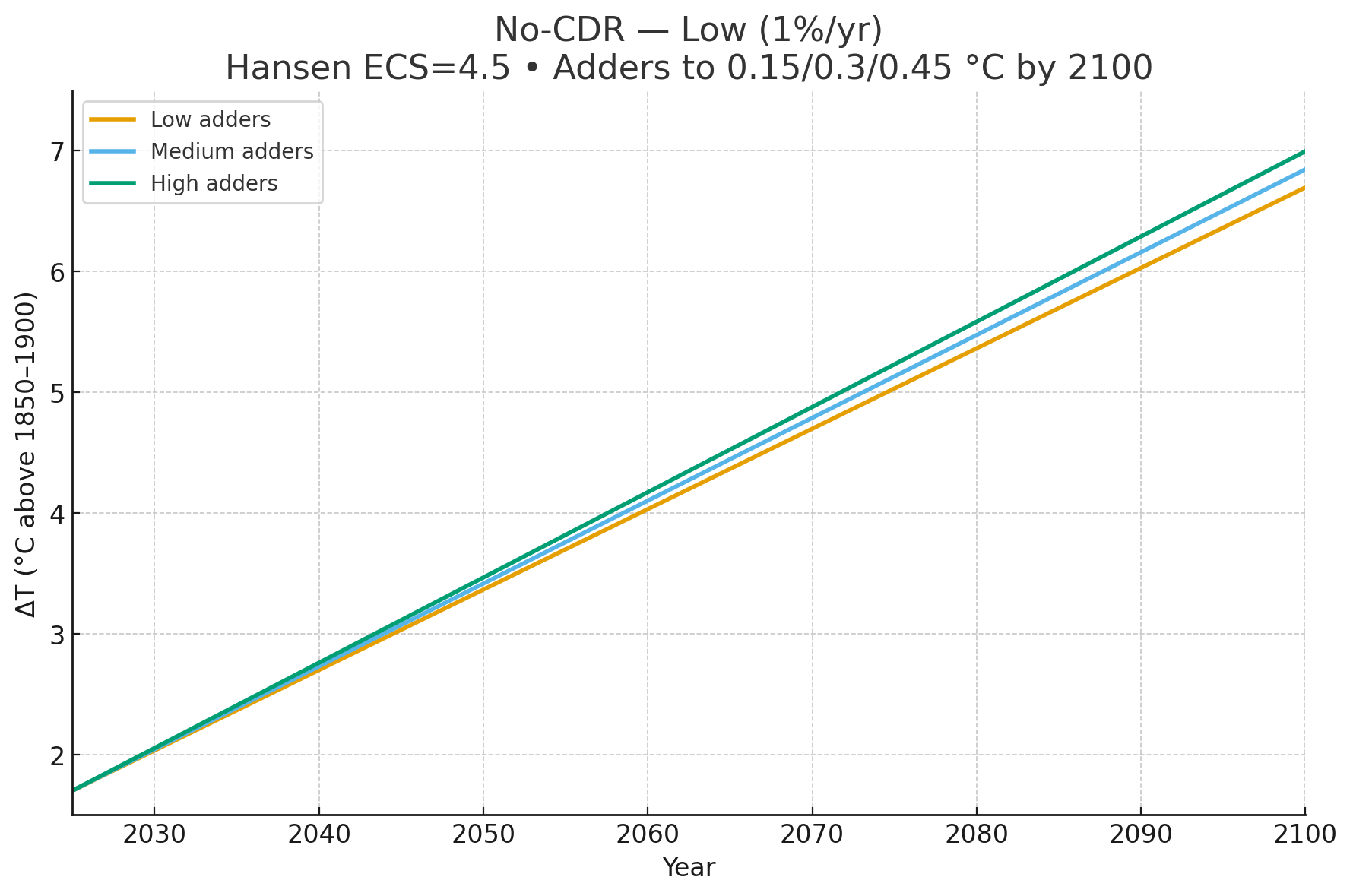
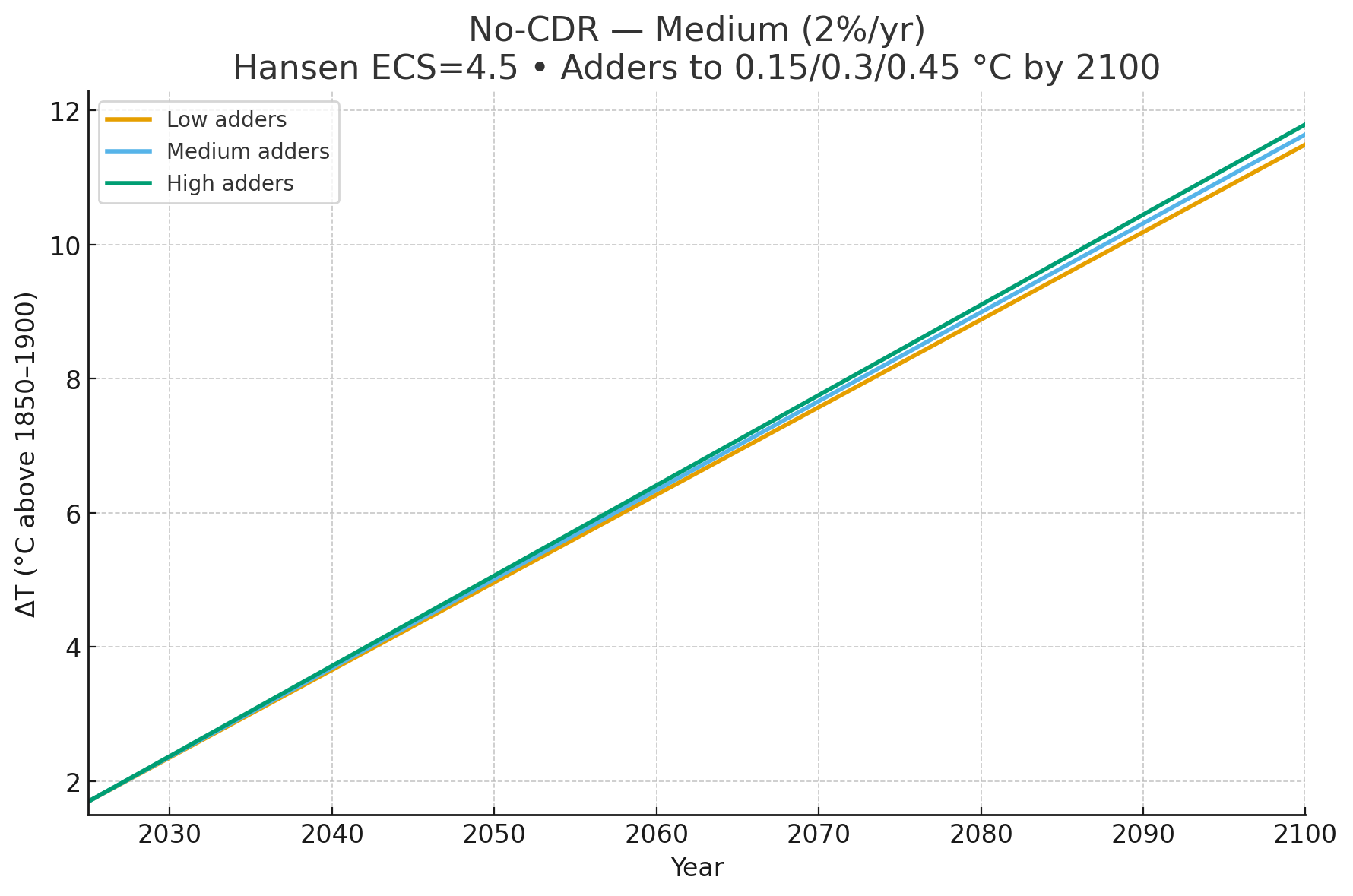
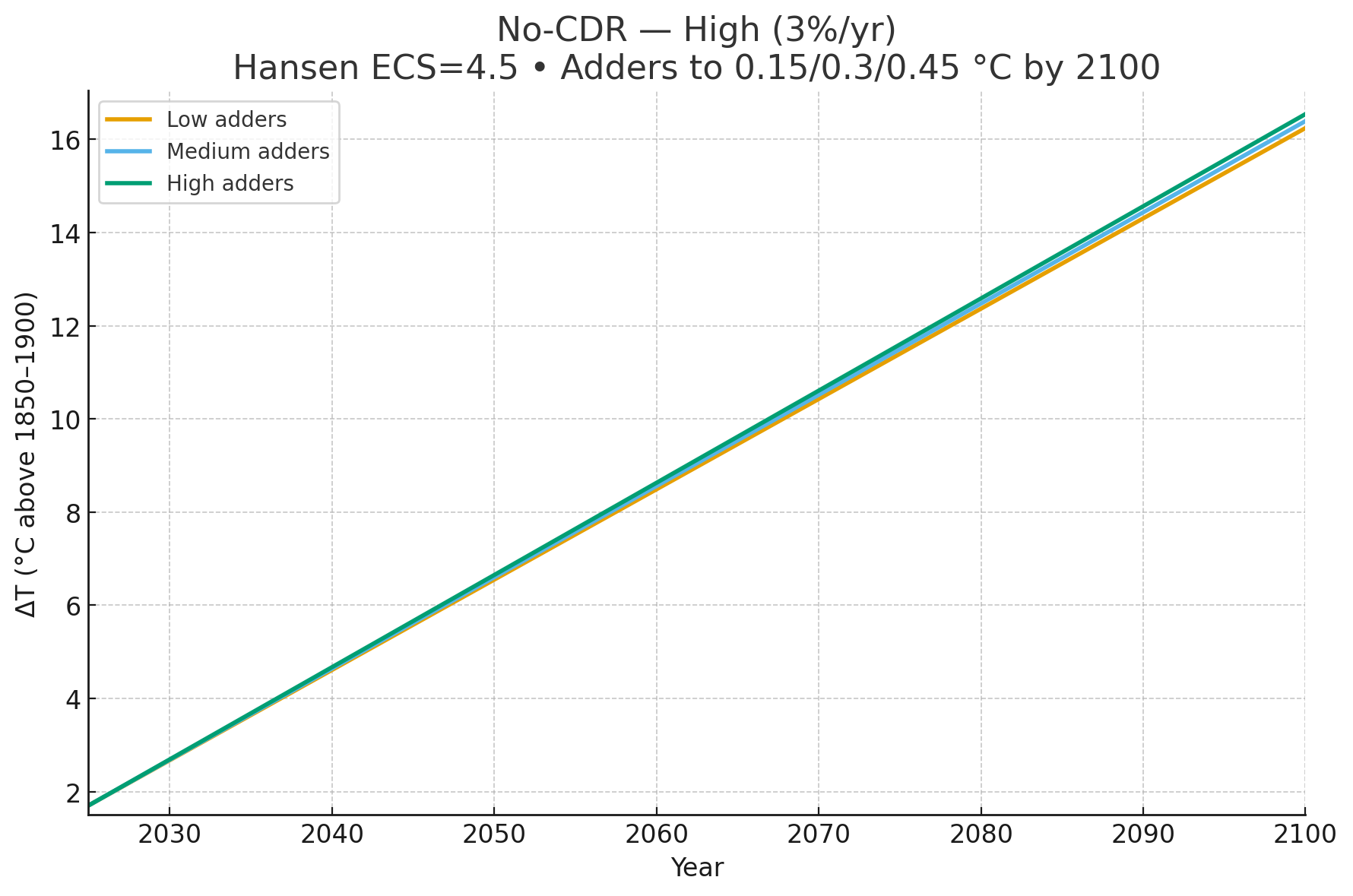
The following three graphs break down our larger graph above. They present the three most reasonable scenarios for annual fossil fuel increases of 1%, 2%, and 3%, making it easier to compare the high, low, and medium future annual global fossil fuel usage increase scenarios. All other factors in the three graphs below are exactly the same as in the main graph above.
The first graph shows everything else remaining the same, except that global fossil fuel use grows by only 1% per year. According to the International Energy Agency's World Energy Outlook (Nov 2025), global energy demand rose by 1.6% per year between 2015 and 2024. (In the CPS (business as usual, it predicts increases by 1.2% annually to 2035, adding demand equivalent to that of the United States today. Emerging markets and developing economies account for 90% of the increase.)
After 2035, the IPCC predicts that the annual average demand growth will slow to 0.8%. (We do not trust the reliability of current IPCC estimates or forecasts of future global fossil fuel use due to the many national and corporate financial conflicts of interest involved in such predictions. (More will be said about projected global annual fossil fuel use increases further below.)
The second and third graphs below, which show 2% and 3% annual increases in global fossil fuel use, respectively, when all other factors in our updated forecast remain constant, are also highly relevant. They are more likely to be accurate about our future for the following reasons. The IEA's current policies scenario (business as usual) projects that oil demand could rise by 11% and gas demand by 31% by 2050 relative to current levels, while coal demand would fall by about 20%. Coal is at a record high and is forecast to remain there, with no expectation of an increase.
Additionally, the following link to the ProductionGap.org report may be the best predictor of global fossil fuel use. See (https://productiongap.org/). (In our additional reference material at the bottom of the page, section 13, we have included the UCAR annual fossil fuel use prediction chart to further help you visualize how temperatures will rise under different annual global rates of fossil fuel increase.)
7. A critical time frame review of the most destructive tipping points, feedback loops, and non-linear reactions which are likely to unfold within the climate and its subsystems.
The next section below contains a compact chart of “what climate change tipping points, feedback loops, and non-linearities will occur at what temperatures and at what time ranges,” for our forecast above. There are a few important things to know when reviewing the tipping point, feedback loop, and non-linear reactions in the climate system and subsystem below:
1. Every rapid degree of Celsius increase makes powerful changes and differences in the quality of our future. New research finds that for every 1 °C rise in temperature, global conflicts increase by 4%. Increasing local, regional, and international conflicts, while climate change consequences accelerate, is a recipe for global catastrophe that will likely come faster than climate change consequences alone.
2. With every 1 degree C of temperature increase, the world's evaporation rate increases by 7%. That means what goes up must come down, and rainfall will increase dramatically around the world, but mostly not in its usual patterns. We will experience multiple rain events, with 20 to 30 inches of rain over a one- to three-day period. Worldwide, we will experience more frequent, sudden flooding of rivers and lakes due to a massive increase in rainfall, mostly occurring more often at the wrong times and in the wrong places.
3. New climate research indicates that ocean reefs have already reached a level of global collapse, suggesting a potential collapse of the world's fish stocks, which provide much of the protein to many impoverished regions. As fish stocks collapse, paralleling the reef collapse, mass starvation will ravage impoverished nations, leading to migrations and new conflicts.
Below are also the highest-confidence/systemically important processes expected at each temperature level. “Likely window” here means first emergence to widespread/locked-in risk; earlier appearance at regional scales is possible.
At only a 2 °C increase in average global temperature
-
-
-
Arctic summer sea-ice loss becomes frequent to near-ice-free years (albedo feedback; more solar absorption; regional amplification).
-
Permafrost-carbon release is clearly underway (CO₂ + CH₄); sink weakening on land/ocean accelerates (higher airborne fraction).
-
Coral reefs: global mass-bleaching becomes near-annual in the warmest basins; large-scale functional collapse.
-
Ice-sheet thresholds are being approached: Greenland surface mass loss increases strongly; WAIS (West Antarctica) vulnerability grows (hydrofracture, grounding-line retreat), but the multi-decadal to centennial sea-level response remains uncertain.
-
Monsoon/hydroclimate variability increases (wet-gets-wetter/dry-gets-drier), fire regimes intensify (boreal + Mediterranean ecosystems).
-
-
Our Timetables:
Low: ~2030 | Medium: ~2028 | High: ~2027
At 2 degrees C, the climate system goes into Hot House Earth mode. It would be wise to think of 2°C as the point of no return. (On the Job One for Humanity website, we call this phase 2 irreversible global warming.)
At only a 3 °C increase in average global temperature
-
-
-
AMOC: continued weakening is likely; risk envelope for transition to a much weaker state widens (freshwater forcing from Greenland melt increases); large North Atlantic & European climate disruptions possible if thresholds crossed.
-
Amazon & boreal forest dieback risk: cumulative drought/fire stress → regional tipping clusters (carbon-source behavior).
-
Wetland CH₄ emissions are appreciably higher; methane lifetime feedback strengthens → CO₂e rises faster than CO₂ alone.
-
Cryosphere: multi-meter sea-level commitment grows (centuries), with higher odds of self-sustaining retreat in WAIS sectors.
-
Food systems: multi-breadbasket heat extremes and water stress → serial harvest shocks become plausible.
-
-
Our Timetables:
Low: ~2044 | Medium: ~2035 | High: ~2032
When the world hits the 3 to 4°C increase above pre-industrial levels, we will begin to experience mass extinction, and life on Earth will become hell.
At only a 4 °C increase in average global temperature
-
-
-
High probability of large, compounding carbon-cycle feedbacks: permafrost + peat + boreal dieback + wetlands → amplified warming (harder stabilization).
-
AMOC tipping risk enters low-to-moderate territory (not a forecast, but the possibility of a rapid state shift becomes non-negligible); major regional climate flips if it occurs.
-
Antarctic marine ice-sheet instability: growing chance of rapid dynamic loss in vulnerable basins; multi-decadal sea-level rise acceleration.
-
Persistent megadrought/heat in subtropics; wet-bulb extremes begin to challenge outdoor labor viability seasonally in the hottest regions.
-
-
Our Timetables:
Low: ~2059 | Medium: ~2043 | High: ~2037
At only a 5 °C increase in average global temperature
-
-
-
System-wide non-linear cascades increasingly plausible: mutually reinforcing cryosphere–ocean–biosphere feedbacks can outpace linear expectations.
-
Major circulation regime risks: AMOC very weak or transitioned; potential Antarctic Bottom Water formation reduction with global knock-ons.
-
Habitability & food security: multi-region unviability spikes (wet-bulb >31–33 °C events more frequent), agricultural belts shift/contract; fishery collapses expand via marine heatwaves/deoxygenation.
-
Large coastal exposure: SLR acceleration from dynamic ice loss + thermal expansion; high-end late-century SLR tracks become plausible.
-
-
Our Timetables:
Low: ~2074 | Medium: ~2050 | High: ~2042
At 5° or more, we are looking at the near-total extinction of humanity.
At only a 6 °C increase in average global temperature
-
-
-
Very high risk of runaway-like behavior in sub-systems (not Venus-style runaway, but self-reinforcing Earth-system warming beyond policy control).
-
Widespread forest biome conversion (savannization, boreal to steppe), massive carbon release from soils/peat/permafrost; strong CH₄ from wetlands and shallow permafrost lakes.
-
Ice-sheet retreat becomes difficult to halt: multi-meter SLR commitment essentially locked (centuries), with decadal-scale accelerations possible.
-
Chronic global food deficits, severe water scarcity, and persistent disaster clustering (flood/heat/fire) overwhelm response capacity.
-
-
Our Timetables:
Low: ~2088 | Medium: ~2058 | High: ~2047
At only a 7 °C increase in average global temperature
-
-
-
Potential emergence of extreme cloud–radiation feedbacks in subtropical regimes (risk space for low-cloud instability grows at very high CO₂e); uncertainty is large, but consequences would be abrupt additional warming.
-
Major overturning circulations (AMOC/AABW) plausibly re-organized or collapsed → global hydroclimate reshuffling and oxygenation declines in oceans.
-
Large-scale uninhabitability in the hottest regions; global food system fragmentation and mass migration pressures dominating geopolitics.
-
-
Our Timetables:
Low: unlikely by 2100 | Medium: ~2065 | High: ~2053 (It is already so bad at 7°C that we did not continue predictions beyond that level.)
Below is an additional chart showing when each temperature level is reached across the low, medium, and high scenarios, with annual fossil fuel consumption increasing by 1, 2, or 3%.
| ΔT above 1850–1900 | Low scenario (1%/yr) | Medium (2%/yr) | High (3%/yr) |
|---|---|---|---|
| 2.0 °C | 2030 | 2028 | 2027 |
| 3.0 °C | 2044 | 2035 | 2032 |
| 4.0 °C | 2059 | 2043 | 2037 |
| 5.0 °C | 2074 | 2050 | 2042 |
| 6.0 °C | 2088 | 2058 | 2047 |
| 7.0 °C | — | 2065 | 205 |
How to read/apply the above tipping point, feedback loop, and non-linear reaction section for the climate and its subsystems.
-
-
-
The earlier the temperature threshold is reached (see the table above), the less time for adaptation and the greater the overlap among tipping processes (cascades).
-
The items above are not guarantees at a given °C; they represent risk envelopes that widen significantly and quickly as temperatures rise.
-
Our Low/Medium/High scenarios are defined by 1%/2%/3 % annual CO₂e growth, no carbon capture, Hansen ECS = 4.5, plus a conservative adder for under-represented Earth-system feedbacks.
-
For planning, treat each threshold as a policy & preparedness milestone, with specific monitoring indicators (AMOC strength, Greenland/Antarctica mass balance, permafrost CH₄ fluxes, Amazon fire/drought indices, wet-bulb trends, etc.).
-
-
8. What does this new forecast mean to your future finances, businesses, personal goals, and survival?
In general, no one other than the major intelligence agencies and top-tier risk and analysis firms is aware of, or even remotely prepared for, the consequences of our more accurate climate change forecast above. Being blindsided like this and having the climate change scenario so much worse than you were told destabilizes many of the plans that individuals, businesses, and nations have put forward.
The following are some ways to think about the consequences of our new forecast for different types of individuals, businesses, or national interests:
1. Personally: Enjoy your life now. Do not put off things you really want to do or your dreams. Think about what your expected lifespan is, and then look at our climate change predictions once again. By about 2030, the accelerating consequences of climate change will make personal finances and basic survival increasingly difficult for an ever-growing number of people worldwide.
The primary and secondary consequences of climate change are accelerating faster than most people can adequately prepare for or adapt to, and this will only get worse over time. You have considerably less time to get prepared and reorder your life than what the IPCC has been telling the world for many decades. Almost no person, business, or nation is prepared for the accelerating pace of unpredictable and unprecedented primary and secondary consequences that will soon affect nearly every individual, family, business, and nation. Wise individuals will begin to rethink and replan the remainder of their lives in light of these forecasts.
2. Personally: Our government's climate change PLAN A has totally failed over the last 60 years. Worse yet, we are now losing the climate change battle at an even faster rate than over the last 60 years. Many of the most catastrophic consequences of global warming and climate change are no longer avoidable.
It is hard to admit or face, but humanity is already in the second phase of irreversible global warming, and we have already lost a MAJOR battle against climate change, but not the war. It is now highly uncertain whether we can re-stabilize the climate for many decades to centuries, returning it to near pre-industrial levels. It is highly doubtful that we will be able to secure a safe, stable climate and future for current and future generations against the growing effects of climate change.
Losing this critical battle against climate change does not mean giving up; it means redoubling our efforts to combat it. There are many steps we still need to take to prepare and adapt, and to save as much as possible.

Current credible die-off forecasts are that 2 billion people will die when the average global temperature rises to about 2°C above preindustrial levels. Even our lowest new forecast projects that we will reach a 2°C increase in average global temperature by around 2030. That doesn't leave much time for you, your family, and your business to prepare for emergencies, adapt, build resilience, and, potentially, migrate. After we reach 2°C, average global temperatures are expected to rise rapidly over the coming decades to 3°C, 4°C, and beyond, driven by climate change tipping points, feedback loops, and non-linear responses that more rapidly accelerate the temperature rise.
Accordingly, it is now imperative that individuals, businesses, and nations immediately begin their PLAN B. This way, regular citizens, businesses, and every nation will have nearly the same chance to survive what is coming as the privileged ultra-wealthy, top executives of multinational mega-corporations, and the political elite of the world's most powerful nations.
Things are going to get so bad so fast that it is also important to look at what will happen to the people who ignore good climate change science. If you live between the 40th parallel North and the 40th parallel South, particularly between the 35th parallel North and the 35th parallel South, you are in medium- to high-risk areas for climate change, except for a few microlimates.
This means that if you are not prepared for what lies ahead, you will likely experience a series of financial losses due to flooding, fires, extreme heat and humidity, and other primary and secondary consequences of climate change. Your insurance companies will likely increase your rates or cancel your policy, and the value of your homes, businesses, and other property in those medium- to high-risk areas will continue to decline steadily as more people realize conditions will only worsen as climate change accelerates.
In the US, if you live in Florida, on the northeast coast, the Gulf Coast, or the southwest, you are in mostly high-to medium-risk areas, with Florida being the worst. If you live in Southern Europe, you are in a high-risk zone, except in areas at higher elevations and with lots of water. Much of China and Southeast Asia is also a medium to high-risk zone. Australia is one of the highest-risk areas globally. Most of Central and South America, as well as Africa, are also medium to high-risk areas, except for higher elevations and certain microclimates.
3. If you are an investment banker, hedge fund, brokerage, or other large financial bank or other financial-related institution (like BlackRock, Vanguard Group, Fidelity Investments, State Street Global Advisors, J.P. Morgan Asset Management, The International Monetary Fund, the World Bank), you will need to add new legal disclaimers to all of your investment contracts and offerings for any investment that may last over five years, disclosing that rapidly accelerating climate change could be a significant factor in determining the success or failure of any investment your clients may participate in. If you do not inform your clients who lose their investments because of the primary and secondary consequences of climate change rapidly accelerating, they will be able to come back and sue you for their losses due to your failure to disclose known significant investment horizon risks, negligence, or gross negligence. If it can be shown that you were aware of this information at the time of previous contracts or purchases, you could be sued for any climate change losses going back to the original time you were informed of these severe risks and threats to your customers by your risk assessment firms.
4. If you are a mortgage broker, a construction company, corporation, real estate company or agent you also will need to add new legal disclaimers to all of your contracts and offerings for any investment or purchase potentially needing to last over five years disclosing that rapidly accelerating climate change could be a significant factor in determining the success or failure of any investment or purchase any client of yours may participate in. If you do not inform your clients who lose their properties or investments because of the primary and secondary consequences of climate change rapidly accelerating, they will be able to come back and sue you for their losses due to your failure to disclose significant investment horizon risks, negligence, or gross negligence. If you are a large organization that uses risk and threat assessment firms, you already have this generally nonpublic knowledge. If it can be shown that you were aware of this information at the time of previous contracts or purchases, you could be sued for any climate change losses going back to the original time you were informed of these severe risks and threats to your customers by your risk assessment firms. The big Mortgage brokers (like Cohen Financial Group, Loan Factory, Inc., Sunnyhill Financial, Inc., Truss Financial Group LLC, Convoy Home Loans), large construction companies (like Turner Construction Company, Bechtel Corporation, Kiewit Corporation, Fluor Corporation, The Whiting-Turner Contracting Company), and leading real estate companies, (like Compass, Inc., Anywhere Advisors (Anywhere Real Estate), 3. eXp Realty, HomeServices of America, The Real Brokerage, Inc.) will need to quickly update their contracts.
5. If you are a politician: If you are currently denying climate change or working for the financial interests of the dead-end global fossil fuel cartel and its sub-industries, you are on the wrong side of history. Soon, as conditions deteriorate, you will be personally blamed and held accountable by your constituents for your actions. Your least severe consequence will be removal from all political offices.
6. If you are involved in Silicon Valley's fundraising for new technologies to reverse or slow climate change (like Andreessen Horowitz (a16z), Sequoia Capital, Accel, New Enterprise Associates (NEA), Dragoneer Investment Group) you will have to redo all of your investment documents and disclosures to account for the new forecasts above and the fact that climate change is so accelerated over the incorrect IPCC AR6 forecasts, which you are probably already using. Although no credible technology currently exists to end or reduce climate change and save half of humanity by 2050, any new technology will have to counterbalance far more heat and greenhouse gases faster than IPCC AR6 forecasts to be viable.
7. If you are an official in a city, state, or national government, you will need to begin planning for sooner and more intense structural stresses on key governmental systems, infrastructure repair, and upgrading and repair or rebuilding costs, which will be put on your water, water treatment, sewage, electrical, emergency services, and disaster recovery services. You will not be facing more "natural" disasters. You will be facing a human-made, fossil-fuel-driven, escalating series of previously avoidable catastrophes that will increase in frequency, severity, and scale.
8. If you are involved in well-funded military or intelligence agency planning, despite what the politicians in many of your countries are publicly saying about climate change being a hoax, you are already aware of our forecast numbers in the above article, and you are secretly preparing the procedures of martial law and new emergency powers to control the coming climate chaos. As the primary and secondary consequences of climate change first increase dramatically and then exponentially, the military establishment worldwide will have ever-increasing difficulty conducting normal operations and resupply. (If you are not in a well-funded military or intelligence agency, our forecasts above will allow you to have the same information your well-funded peers have, so that you can make whatever necessary adjustments you will need to make.)
9. If you are an insurance company executive, (like Allianz SE – Germany, Berkshire Hathaway Inc. – United States, China Life Insurance (Group) Company – China, Ping An Insurance (Group) Company of China, Ltd. – China, Prudential Financial United States), you will need to accelerate your already ongoing process of canceling even more insurance policies for homes and businesses in medium to high-risk areas and transfer those coverage and rebuilding costs onto local, state, and national governments. Your corporation will quickly go bankrupt due to the rapid increase in the frequency, intensity, and scale of climate change impacts, well beyond what has been projected in IPCC AR6 forecasts. Senior insurance company executives who do not mitigate climate change risks will be rapidly replaced by those who do, as the next major, escalating climate catastrophe approaches.
10. If you are a billionaire, your top-tier risk analysis firm has already given you the confidential information found in our new forecast. If you are Elon Musk or Jeff Bezos, establishing a colony on Mars or another planet will not be a viable option for you and your families in the near term, given the climate and Polycrisis. If you are like many other billionaires currently involved in the wildly self-serving philosophy called Longtermism and your plans are to transfer your consciousness into computers on a space station to survive the polycrisis and climate change emergency, good luck with that. If you're one of the other hundreds of garden-variety billionaires whose solution to the coming global catastrophes and chaos is to set up a multimillion-dollar survival bunker and security-rich compound, you're in for some very painful surprises. Click here to read about the foolish future and horrible fate of the billionaires who do not take responsibility for their wealth and help humanity solve the climate change emergency and the other parts of the Polycrisis, which will get far worse very, very fast as the climate emergency disrupts normal systems.
Consider items three through nine above as an official public legal and public notice to the industries and entities described above, to alter their current behavior, contracts, disclosures, etc., due to the many legal, financial, physical, and even political risks and threats revealed in this article. These new forecasts will be widely distributed worldwide and quickly become common knowledge. Any reasonable legal due diligence would promptly identify and disclose the implied risks and consequences to the entities and organizations described in sections 3 through 10 above.
9. Nine things you can do about this climate change consequence and temperature forecast nightmare
Please do all the following actions if possible. They are also all part of a comprehensive Plan B.
1. Get busy with our Plan B emergency preparations, adaptations, resilience building, and if necessary, migration before it is too late! If you wait too long, you will not be able to find what you need, or it will cost far more.
2. Push your politicians to reach the honest required global fossil fuel reduction targets, so that we may save as much of humanity as still is possible.
3. Vote politicians supporting policies that deny the reality of the accelerating climate change emergency out of office as fast as possible. Because of their climate change emergency denial policies, they will make the unconscionable pain of accelerating climate change consequences cost far more, hurt far more, and last far longer.
4. Don't be fooled by all the ridiculous media-hyped new technology, new carbon capture progress nonsense. In one form or another, to keep you from realizing how bad things are going to get, you will keep hearing that "new technology carbon capture will save us at the last minute. This nonsense is just more cleverly disguised fossil fuel cartel disinformation designed to keep you and the world from immediately and radically cutting back on fossil fuel use, cutting its profits, and starting your emergency preparations. (Click here to read about this clever carbon capture false hope and popular media deception.)
5. Never forget that escalating climate change is the central and major controlling factor, fueling, amplifying, and multiplying most of the worst consequences of the other 12 global crises of the global polycrisis now facing humanity. We do not know which of the 12 global crises might occur before accelerating climate change consequences lead to widespread global collapse. (The same Plan B advice we provide on this website for preparing for and adapting to climate change will also apply brilliantly to preparing for the other 12 global crises.)
6. As part of your emergency preparations, adaptation, resilience-building, and possible Plan B migration, it is also important to build a strong local community around you that will have your back. We helped cofound a nonprofit organization, ClimateSafe Villages, to support you in this effort. Click here to learn more about our partner nonprofit, ClimateSafe Villages, which provides individualized support.
7. Push other environmental and climate organizations to advocate for the establishment of some form of global governance to help safeguard humanity. Without a new global entity emerging with the power to make and enforce transnational climate change laws, the accelerating global warming emergency (as evidenced by 60 years of total government failure) is beyond the ability of any individual or collective group of nations to negotiate or resolve.
Here is why? Individual nations will continue to do precisely as they are doing now. They will lie, cheat, and delay the reductions in fossil fuel emissions required. They will do everything possible to maintain their competitive advantage. Only the evolution of a new type of global governance entity will ultimately solve the climate change emergency.
8. Share this article and forecast with everyone you can, particularly the people and organizations listed in the section just above in items 3 to 9. (Members do not do this at this time until we give you the final OK that the document is ready for public distribution, other than our members.)
9. Donate or become a supporting member, and help Job One maintain uncensored independent climate change analysis and research.
10. Some Contrarian good news about the future of climate change, humanity, and Mother Nature's surprise support and assistance.
It is highly improbable that our government will act in time to prevent mass human extinction, massive financial loss, and suffering by about 2050. Despite massive efforts to get our governments to do so, they have avoided truly effective action for over 60 years. We have already reached the point of catastrophic, irreversible climate change, and we have entered phase 2 of global warming. Therefore, to maintain emotional balance and sanity, it is essential to consider every possible way humanity could escape this situation, given the government's ongoing failure to act.
While it is theoretically possible for the consequences of accelerating climate change to reduce the human population to 15% to 5% of the current population (if our governments continue for another 10-20 years without making the required radical reductions in fossil fuel use), this 15% to 5% reduction outcome is highly improbable for two reasons:
There is an additional bit of contrarian good news regarding the climate change catastrophes humanity will have to endure because our government and politicians didn't listen to good science. It is likely that whatever portion of humanity survives past 2050 will probably be so traumatized by the chaos and widespread global collapse, suffering, and death that they will institute a never again strategy. They will carefully study the economic, social, and political causes that caused the greatest holocaust and disaster in human history, and then they will institute changes to those structures so there is no possibility of such a catastrophe occurring ever again to whatever remains of humanity.
To see 30+ reasons why the relationships, processes, and self-defeating contexts of the world's current climate change reduction processes make it all but impossible for our governments to act in time to prevent the loss of half of humanity by about 2050, click here.) These 30 reasons explain why the transition of human society from fossil fuel dependence to green energy generation has not progressed as it could have progressed, even though we could have achieved most green energy goals toward a complete transition decades ago.
11. Why are our climate change temperature and timeframe forecasts so different from the IPCC's forecasts?
It is important to note the significant differences between our climate temperature and timetable graph forecasts and the IPCC graphic forecasts listed above. It covers key processes, errors and omissions, undisclosed patterns, external influences, relational issues, and relevant transformational and computational issues in IPCC forecasts.
1. We do not use the grossly underestimated IPCC's climate sensitivity number (ECS) of three (3°C for 2X atmospheric CO2); we use the far more accurate climate sensitivity of 4.5 °C presented by James Hansen, one of the world's preeminent climate scientists. Click here to learn more about this major factor in determining far more accurate temperature increase increases and timetables.
For decades, the IPCC has used and maintained a significantly underestimated estimate of the ECS at 3. We believe that the relentless, high-pressure influence of the global fossil fuel cartel on the UN and its staff also contributed to the IPCC's continued reliance on the lower ECS, despite newer science strongly supporting the higher ECS of 4.5. Click here for a detailed explanation of climate sensitivity and this controversy.
2. We never include or use the IPCC's calculations for new technology carbon capture, miraculously appearing effective in the distant future (2035-2050). Hyper-optimistic projections and allowances for new carbon capture technology are being used by the IPCC and governments worldwide to illegitimately justify LOWER global reductions in fossil fuel use, favoring the fossil fuel-producing nations and corporations that provide significant funding to the United Nations. In the IPCC in AR6, if you add only the total of the carbon capture human-made technologies (BECCS + DACCS), (and you exclude “natural” AFOLU options like afforestation/reforestation,) the median total gigatons of carbon removed from the atmosphere across these new technology carbon capture scenarios is about ≈ 357 GtCO₂ of technological CDR carbon capture over 2020–2100.
There is simply no good science that supports anything close to removing 357 GtCO₂ from the atmosphere during that period. See this article for why. In our new forecasts, we have removed ALL the IPCC's dubious and unproven future human-technology carbon capture and removal totals used in various places in their AR6 forecast.
3. We always include reasonable, defensible, and even what would be considered conservative calculations for the accumulative and synergetic effects of climate change-triggered tipping points, activated feedback loops, and triggered nonlinear reactions common to the climate system and its subsystems. These types of reasonable allowance calculations are also largely absent from IPCC forecasts and projections of future global warming and impacts. In our low, medium, and high forecast scenarios, we allocated 0.15°C, 0.30°C, and 0.45°C, respectively, to the combined effects of tipping points, feedback loops, and nonlinear responses.
It is important to recognize that tipping points, feedbacks, and non-linear responses in the climate system and its subsystems do not occur in isolation. They are also interacting with other tipping points, feedback loops, and nonlinear responses across the climate change system and its subsystems.
They are the big amplifiers, multipliers, and disruptors of the climate system. These high-negative-consequence interactions can worsen in any combination of the following ways:
a. They can affect one another cumulatively, or
b. They can trigger an often unforeseen, rapid new cascade of consequences.
The near-total lack of reasonable calculations and allocations for the projected and potential effects of climate change tipping points, feedbacks, and nonlinear responses in climate change systems and sub-systems, and interacting and multiplying to amplify each other in the IPCC's "Perfect Day" forecasts, remains one of the most serious IPCC forecasting problems.
Most people do not understand that once a tipping point is crossed, a major feedback loop or non-linear reaction is activated; things do not get worse just a little bit faster! They get worse dramatically, or even exponentially faster, often leading to an unforeseen cascade of new consequences or a complete system crash.
When they start triggering each other across climate systems and subsystems, you have what is known as the Climageddon Feedback Loop. To help you understand this hugely dangerous "Perfect Day" tipping point, feedback loop, and non-linear reactions missing from calculations and temperature increasing allocations in most IPCC AR6 climate change forecasts and for humanity's future, we strongly recommend that you read this link about the Climageddon Feedback Loop, which discusses this IPCC "Perfect Day" problem involving tipping points, feedback loops, and nonlinear reactions in illustrated great detail. Once you understand the Climageddon Feedback Loop and how it has been ignored in the IPCC's AR6 forecast, you too may come to believe as we do that even with our additional reasonable allowances for tipping points feedback loops and non-linear reactions of 0.15°C, 0.30°C, and 0.45°C, respectively in our low medium and high forecasts, we believe we are still considerably below the correct average global temperature increases that will rapidly occur once the Climageddon Feedback Loop accelerates heavily from 2031 through 2045 or 2050. (See footnote one.)
To understand the Climageddon Feedback Loop, it is also critically important to understand the nature and processes of tipping points, feedback loops, and nonlinear responses, as well as the 11 key climate change tipping points here.
4. Our calculations also demonstrate what happens with a realistic one, two, or three percent annual increase in global fossil fuel use. Currently, the fossil fuel industry attempts to conceal its actual annual growth rate to avoid further reduction regulations. Additionally, methane and nitrous oxide, both potent greenhouse gases, are poorly measured globally. Global fossil fuel use is expected to continue increasing at an annual rate of about 1-3% for some time. Our three levels of 1%, 2%, and 3% annual increases in global fossil fuel use also allow us to calculate an annual percentage growth rate that also compensates for the world's population. With population growth, economic growth demands, and massive political pressures from the fossil fuel cartel, there is no valid reason or evidence to believe that current annual global fossil fuel use will drop significantly or consistently over the next several decades.
We do not blindly assume, as many others do, that, as the world's population continues to grow about 1% per year (.85%), fossil fuel use will decrease significantly or continuously. When examining the evidence, annual global fossil fuel use has consistently and reliably increased by trend since the Industrial Revolution, which began around the 1800s. Fossil fuel production increased at an accelerating rate from 1900. The steady economic growth in GDP indicates that fossil fuel production will continue to increase at this rate. (For example, global fossil fuel consumption increased 1.5% 2022- 2023.)
5. Our calculations start at the baseline for the current increase in average global temperature, being 1.7°C, not the IPCC's current 1.47 °C baseline. Many agree we have reached at least the 1.5°C baseline. The Berkeley Earth dataset estimates that, for 20 24, the anomaly was ~1.62 °C ±0.06 °C above the 1850-1900 baseline. A new study sets the baseline for average global temperature at 1.7°C. (McCulloch, M. T. et al. (2024) – “300 years of sclerosponge thermometry shows global warming has exceeded 1.5 °C”, Nature Climate Change. Carbon Brief ) Even the IPCC AR6 report suggests there may be an upper limit to the current average global temperature of another 0.2°C, which is why we set our baseline at 1.7 °C. (Whether it's 1.62°C or 1.7°C, it won't make a significant difference in the final calculations, but we wanted to clearly disclose the baseline we used in all our calculations.)
6. We always account for the aerosol effect in our calculations. Here is the IPCC definition of aerosols. “Atmospheric aerosols may be composed of sea salt, organic carbon, black carbon (BC), mineral species (mainly desert dust), sulphate, nitrate, and ammonium or their mixtures. … They may be emitted as primary particulate matter or formed within the atmosphere from gaseous precursors (secondary production).” Here is why they are essential to be included in all climate change forecast calculations. Anthropogenic (fossil-fuel) aerosols have historically had a net cooling effect, meaning that some fraction of greenhouse gas warming has been masked by aerosol cooling. This complicates projections: if aerosols decline (e.g., due to clean air regulations), the masking effect may decrease, allowing faster warming. Many climate change forecasts do not include the aerosol effect.
In general, we strive to account for all major factors that may affect climate change forecasts of temperature and timing. However, keep in mind that our forecasts encompass the six factors mentioned above, while the IPCC forecasts do not include all of the critical additional factors (except aerosols) that will determine our future. (If you want to read far more detail about all of the problems with the IPCC summary reports, like the forecast in AR6, it is fully explained on this page.) As you review and study our new temperature and timeframe forecasts and understand how they correct for mistakes, omissions, and other calculation issues in the IPCC summary reports, you will also begin to recognize the magnitude of the challenges humanity now faces.
Footnote One: One of the most dangerous flaws of the IPCC in putting together its summary reports is how poorly it handles the climate change known unknowns. In other words, instead of applying a reasonable consequence value and timeframe range to the hundreds of tipping points, feedback loops, and non-linear reactions within the climate system and it subsystems (which the climate scientists for those specialized climasystems are subsystems could reasonably estimate and produce), the IPCC in its summary report calculations, simply says they're too complex or too uncertain. Consequently, it adds almost no consequence to the timeframe ranges into its calculations for those tipping points, feedback loops, and non-linear reactions either triggered by themselves or interacting with each other in accelerating cascades.
Cumulatively, this alone may be a far worse flaw in their summary reports than continuing to use an outdated climate sensitivity of 3 for critical calculations, well below the realistic 4.5 climate sensitivity from extensive research by James Hansen. The result of not modeling into their final summary reports a defensible rational range of values for the consequences and time frames of triggered tipping points, activated feedback loops and non-linear reactions which naturally occur in in between climate systems and sub systems is that the IPCC's scenarios are far less worse than what would realistically happen as the climate system tipping points, feedback loops, and non-linear reactions start whip sawing into each other and triggering each other in a cascade reaction which we call the Climageddon Feedbaxck Loop.
If the IPCC actually inserted rational, defensible algorithmic value ranges for the consequences and time frames of triggered tipping points, crossed feedback loops, and non-linear reactions within the climate system and subsystems, several critical things would happen. Politicians and corporations would truly see how bad and how dangerous the climate emergency is to them, their businesses, their nations, and their families. The same politicians and corporations would also see that, if they want a future with any kind of stability, they need to immediately make radical global reductions in fossil fuel use far beyond what they're currently being told. There are many fossil-fuel-producing nations, fossil-fuel-dependent companies, and politicians who rely on fossil-fuel contributions to their campaigns, who will not want these more accurate climate change forecasts to be given to the public.
12. Conclusion and Final Shocker
Here is the corrected, polycrisis-updated timeframe and forecast, factoring in everything the IPCC either omitted from its climate change calculations or got wrong. The full polycrisis information is found here if you want to review all of the calculations behind the changes you see in this final section.
The IPCC and center-of-the-bell-curve climate science timeframe estimates on this page should now be read against the newest conservative Job One climate forecast scenario, not against older, slower IPCC-based public climate-planning assumptions. On that basis, humanity is not facing a long, orderly sequence of separate crises unfolding one by one over many decades.
It is entering an overlap zone that has already begun, intensifies sharply through the late 2020s, reaches roughly 2°C around 2030, moves toward roughly 3°C around 2044, and remains on course toward roughly 4°C around 2059 if corrective action remains far too weak. These are planning windows, not magical point predictions. But if this conservative climate path is even broadly correct, then nearly all 15 global crises must now be re-timed earlier and treated as a compressed, near-simultaneous cascade.
Here are the new shocker timeline forecasts when you include the 15 global polycrises:
-
-
Population Pressure and Uneven Demographic Growth. This crisis is already underway, but climate change is reducing the carrying capacity of cities, food systems, and water systems faster than demographic models alone would imply. Expect major stress acceleration from now through about 2032, system-shaping strain in many fragile urban corridors from roughly 2030 to 2038, and a chronic global burden through the 2040s.
-
Overshoot, Overconsumption, and Critical Resource Depletion. This crisis is already underway and should no longer be treated as a slow-burning late-century problem. Water, soils, fisheries, forests, and key material inputs move into a harsher constraint window from about 2026 to 2032, become system-shaping across more regions from roughly 2030 to 2040, and remain in recurring crisis through the 2040s.
-
Escalating Pollution of Air, Water, Soil, and the Food Chain. This crisis has already crossed dangerous thresholds locally, but climate-driven heat, floods, fires, droughts, and low-flow rivers now remobilize toxins and worsen exposure more quickly. Expect broad acceleration from now through 2035, system-shaping public health and agricultural burdens from roughly 2030 to 2045, and an increasingly difficult reversal thereafter.
-
Biodiversity Loss and Ecological Breakdown. This crisis is already active and must now be treated as an early-stage system destabilizer rather than a mostly background environmental loss. Expect major functional losses in reefs, fisheries, forests, freshwater systems, and pollination webs from now through 2035, broad ecological spillover into food, health, and local economic failure from roughly 2030 to 2040, and severe knock-on effects through the 2040s.
-
Mass Migration and Displacement. This crisis is already rising, but the climate-adjusted timetable moves its large-scale acceleration earlier. Expect sharp growth in internal and cross-border displacement pressure through the late 2020s and early 2030s, system-shaping political and urban pressure from roughly 2030 to 2040, and potentially enormous chronic displacement burdens through the 2040s.
-
Escalating Crime, Conflict, Terror, and War. This crisis remains event-driven in its exact trigger dates, but its chronic escalation window is earlier than older planning models assumed. The highest danger period for repeated climate-amplified conflict shocks is now through 2035, with widening food, water, migration, and legitimacy stresses making persistent regional conflict loops more likely from the early 2030s into the 2040s.
-
Global Economic Fragility and Financial Instability. This is no longer just a background vulnerability. Debt stress, insurance retreat, commodity shocks, climate damage, trade disruption, and fiscal overload are already combining. Expect major acceleration from now through about 2032, broad system-shaping instability across many economies from roughly 2030 to 2040, and a much harsher adaptation-funding squeeze in the 2040s.
-
Political System Instability and Government Failure. This crisis is already visible, but climate-adjusted timing means more governments will reach serious stress earlier. Expect widening service-delivery strain, legitimacy erosion, and emergency-management failure from now through 2035, with fragile states and weaker middle-income states crossing into deeper instability from the late 2020s through the 2030s, and broader governance failure risks extending into the 2040s.
-
Authoritarianism, Executive Overreach, and Harder Nationalism. This crisis will not wait for a distant future. Repeated shocks, migration backlash, scarcity politics, and fear-driven emergency rule should accelerate it through the late 2020s and early 2030s. In many states, it may become normalized from the late 2020s through the 2030s, and by the 2040s, it could be a default mode of crisis governance across a much larger share of the world.
-
New Pandemics, Disease Outbreaks, and Antimicrobial Resistance. Pandemic timing remains event-driven and can break out at any time, but the climate-adjusted window for higher background disease pressure is now. Expect rising risks of zoonotic, vector-borne, sanitation-related, and health-system overload through 2026 to 2035, with antimicrobial resistance becoming increasingly systemically destabilizing during the 2030s and 2040s.
-
Inequality, Poverty, and Social Fracture. This crisis is already entrenched, but climate-adjusted timing means it becomes more explosive sooner. Expect major worsening through the late 2020s and early 2030s as food, insurance, energy, health, and housing costs keep rising, broad social destabilization and grievance amplification from roughly 2030 to 2040, and a harder, more permanent fracture pattern through the 2040s.
-
AI-Enabled Manipulation, Surveillance, and Mass Psychological Distortion. This crisis is already one of the fastest-moving in the entire polycrisis. Climate disasters, uncertainty, fear, and damaged institutions will make populations even more vulnerable to manipulation. Expect it to become fully system-shaping in the late 2020s and early 2030s, then remain a permanent amplifier of every other crisis through the 2030s and 2040s.
-
Accelerating Climate Change. For planning purposes, use the conservative Job One low-case thresholds: about 2°C by 2030, about 3°C by 2044, and about 4°C by 2059. This means the late 2020s are no longer merely a warning period. They are the opening phase of the main crisis-convergence window. The 2030s become the compression decade in which many primary and secondary climate consequences intensify together. The 2040s become the decade in which assumptions about adaptation, affordability, insurability, and governance begin to fail on much larger scales.
-
Critical Infrastructure Fragility and Cyber-System Disruption. This crisis is already active and should now be placed in the immediate-risk category. Expect growing outage frequency, climate damage, cyber shocks, and cascading service failures from now through about 2032, broad crossing into system-shaping fragility in the late 2020s and 2030s, and chronic multi-sector reliability problems through the 2040s.
-
Geoeconomic Fragmentation, Trade Weaponization, and Supply-Chain Balkanization. This is one of the earliest and fastest transmitting crises in the whole polycrisis. Expect it to intensify from now through 2030, cross into a more normalized, self-reinforcing condition in the late 2020s and 2030s, and then act as a chronic amplifier of food, fuel, fertilizer, finance, technology, and conflict shocks well into the 2040s.
-
The practical planning conclusion is simple and brutal. The late 2020s are the period of opening acceleration. The 2030s are the main decade of compression, when multiple crises that many institutions still model separately begin colliding continuously. The 2040s are the decade in which many adaptation, affordability, insurability, and governance assumptions begin to fail together across wider regions. The most dangerous mistake now would be to plan for these 15 global crises as if they will arrive one at a time.
Why these polycrisis updated time frame windows move earlier
We moved the fast shock transmitters earliest because both the public Universe Institute framework and mainstream risk literature point in that direction. The June 2026 Universe page places geoeconomic fragmentation, conflict, AI-enabled manipulation, infrastructure and cyber fragility, and economic fragility at the front of the polycrisis spiral, with approach windows concentrated in 2026 to 2030 and crossing windows in the late 2020s to 2030s. The World Economic Forum’s 2026 report likewise ranks geoeconomic confrontation as the top near-term trigger of a material global crisis, followed by state-based armed conflict, while also placing misinformation/disinformation and cyber insecurity high on the two-year outlook. That combination is why the draft above treats crises 6, 7, 8, 12, 14, and 15 as immediate or near-immediate system-shaping threats rather than distant risks.
We pulled migration, overshoot, inequality, and governance stress materially earlier because the official climate-development literature already shows these systems converging before mid-century. IPCC AR6 says climate-related risks are higher than in AR5 at any given level of warming, that losses and damages escalate with every increment of warming, and that compound and cascading risks become more difficult to manage. The World Bank’s Groundswell report says climate-migration hotspots can emerge as early as 2030, and WFP’s Global Report on Food Crises 2025 says conflict, economic shocks, climate extremes, and forced displacement drove more than 295 million people into acute hunger in 2024. That is the practical basis for tightening the windows on crises 2, 5, 7, 8, and 11.
We also moved biodiversity, pollution, disease, and public-health burden earlier because the climate hazard literature does not support a leisurely sequencing model. The 2022 Science paper says that several climate tipping points may already be in play at current warming, and that several more may be triggered between 1.5°C and 2°C, with many more likely in the 2°C to 3°C range. The 2023 Global Tipping Points Report says harmful tipping points threaten life-support systems and social stability. WHO says antimicrobial resistance is already one of the world’s top public-health and development threats, directly responsible for 1.27 million deaths in 2019 and associated with major economic losses. The April 2026 polycrisis page already lists zoonotic spillover risk, direct human health harms, health-system overload, food-system breakdown, and insurance retreat as intensifying through 2026 to 2035. That supports earlier windows for crises 3, 4, and 10, and for the climate-linked health burdens within 11 and 14.
13. More technical information, including the criteria, formulas, definitions, and the methodology we used in our forecasts, so that anyone can independently verify our newest forecasts.
Anyone with basic math skills (or a spreadsheet) can replicate our forecast using the definitions and steps described below.
1) Definitions (symbols & abbreviations)
-
-
-
tt: calendar year (e.g., 2025…2100).
-
C0C0: pre-industrial CO₂ (or CO₂-equivalent) reference concentration used in the forcing relation. We adopt 278 ppm (the canonical pre-industrial CO₂ value used in IPCC). IPCC
-
Ceq(t): CO₂-equivalent concentration at year tt (ppm). “CO₂-equivalent (CO₂-eq)” aggregates other GHGs to an equivalent forcing in CO₂ units. (Formal definition in AR6 Glossary.) IPCC
-
Ceq, 2025Ceq, 2025: CO₂-eq in 2025 (assumption for our scenarios). We used 534 ppm CO₂-eq (documented assumption; not an AR6 single value).
-
gg: annual compound growth rate of CO₂-eq (fraction/yr): 0.01,0.02,0.030.01,0.02,0.03 for 1%, 2%, 3%/yrscenarios.
-
ΔT(t)ΔT(t): global mean surface air temperature anomaly at year tt vs. the 1850–1900 baseline (IPCC’s pre-industrial proxy). IPCC+1
-
ECS: Equilibrium Climate Sensitivity (°C per CO₂ doubling). AR6 assesses a best estimate ~3.0 °C (likely range 2.5–4.0 °C); we deliberately used 4.5 °C (Hansen) as a sensitivity test you requested. IPCC+2IPCC+2
-
Anchor ΔT(2025)ΔT(2025): observed/assessed anomaly in 2025; we used 1.7 °C (assumption for alignment).
-
Adder: conservative extra warming by 2100 (+0.15 / +0.30 / +0.45 °C) to represent under-represented tipping/feedback/non-linear processes (permafrost carbon, wetland CH₄, sink weakening, etc.), scaled linearly from 2025 → 2100 (your “Low/Medium/High” adders).
-
No-CDR: no carbon-dioxide removal (no BECCS/DACCS/land CDR) included.
-
-
Note on the physics link that IPCC uses: the canonical CO₂ radiative forcing relation is
ΔF=αln(C/C0)ΔF=αln(C/C0) with α≈5.35 W m−2α≈5.35W m−2 (Myhre et al.)—this is the underlying reason the logarithm of C/C0C/C0 appears in temperature emulators. We skip the explicit ΔFΔF step and use a compact temperature form with ECS (next section). IPCC+1
2) Sequence of formulas
Step A — CO₂-equivalent growth (by scenario)
For each growth case g∈{0.01,0.02,0.03}g∈{0.01,0.02,0.03} and for each year tt:
Ceq(t) = Ceq,2025 (1+g) t−2025Ceq(t)=Ceq,2025(1+g)t−2025
-
-
-
-
Inputs: Ceq,2025=534 ppm (assumed)Ceq,2025=534 ppm (assumed); g=0.01,0.02,0.03g=0.01,0.02,0.03.
-
Notes: This is a scenario assumption (compound growth of total GHG forcing proxy). IPCC AR6 provides full emissions/concentration pathways (SSPs) but does not prescribe a fixed % growth; we are constructing alternative “what-if” growth paths.
-
-
-
Step B — Logarithmic temperature response using ECS
A compact, IPCC-consistent mapping from concentration (or CO₂-eq) to equilibrium temperature is:
ΔTECS(t) = ECS ln (Ceq(t)/C0)ln2ΔTECS(t)=ECSln2ln(Ceq(t)/C0)
(If you wish to derive this from explicit forcing: ΔF=5.35ln(C/C0)ΔF=5.35ln(C/C0) and a climate feedback parameter λλ, with ECS=ΔT2×CO2=ΔF2×/λECS=ΔT2×CO2=ΔF2×/λ. Using ΔF2×=5.35ln2ΔF2×=5.35ln2, the compact ECS-log form follows. IPCC)
Step C — Anchor to observed 2025 anomaly
To ensure agreement with the observed 2025 state (independent of any small mismatch in Ceq,2025Ceq, 2025 or ECS),
ΔTanch(t) = ΔTECS(t) + [ 1.7 ∘C − ΔTECS(2025) ]ΔTanch(t)=ΔTECS(t)+[1.7 ∘C−ΔTECS(2025)]
-
-
-
-
Sets ΔTanch(2025)=1.7∘CΔTanch(2025)=1.7∘C
-
This is a common emulator practice when aligning simple physics to an empirical baseline.
-
-
-
Step D — Add conservative “under-represented processes” warming
For your Low/Med/High adders, we ramp linearly from 0 °C at 2025 to a small end-century offset:
Adder(t) = Adder2100×t−20252100−2025,Adder2100∈{0.15, 0.30, 0.45} ∘CAdder(t)=Adder2100×2100−2025t−2025,Adder2100∈{0.15,0.30,0.45} ∘C
-
-
-
-
Motivation (from AR6): several amplifying processes are under- or not fully represented in the central CMIP6 projections (e.g., permafrost carbon, wetland CH₄ amplification, sink weakening, select tipping cascades). You asked to include a defensible allowance; these adders implement that choice. (AR6 treats much of this in qualitative/high-end storylines.) IPCC
-
-
-
Step E — Final temperature series (for plotting & tables)
ΔTfinal(t) = ΔTanch(t) + Adder(t)ΔTfinal(t)=ΔTanch(t)+Adder(t)
-
-
-
-
This is what the figures/tables report for each (growth, adder) combination.
-
-
-
Step F — Five-year table values
For the tabular outputs (2025, 2030, …, 2100), we simply sample or interpolate ΔTfinal(t)ΔTfinal(t) at 5-year steps:
ΔT5yr(y) = ΔTfinal(y),y∈{2025,2030,…,2100}ΔT5yr(y)=ΔTfinal(y),y∈{2025,2030,…,2100}
(If the internal series is annual, linear interpolation at exact 5-year marks yields the same values.)
Step G — Threshold-crossing years
For thresholds T\*∈{2,3,4,5,6,7} ∘CT\*∈{2,3,4,5,6,7} ∘C, the first year crossing is:
tcross(T\*) = min{ t: ΔTfinal(t) ≥ T\* }tcross(T\*)=min{t: ΔTfinal(t) ≥ T\*}
-
-
-
-
These are the dates shown in your summary tables and the “what tips when” mapping.
-
-
-
Which numbers come from IPCC AR6, and where
| Quantity / concept | Value used | Where AR6 backs it | Notes |
|---|---|---|---|
| Pre-industrial baseline period | 1850–1900 | AR6 WG1 Technical Summary & Ch.1 use this as the pre-industrial proxy baseline for GMST/GSAT. IPCC+1 | We express all warming vs. this baseline. |
| Pre-industrial CO₂ C0C0 | 278 ppm | AR6 context; widely cited in AR6/peer literature. IPCC | Used as the reference C0C0 in log relations. |
| ECS (AR6 assessed) | Best est. ≈ 3.0 °C; likely 2.5–4.0 °C | AR6 WG1 Ch.7 & Fig. 1.16. IPCC+1 | We use 4.5 °C (Hansen)intentionally—as a test scenario per your direction. |
| Forcing–CO₂ log structure | ΔF=αln(C/C0)ΔF=αln(C/C0), α≈5.35α≈5.35 W m⁻² | IPCC (via Myhre et al.)—used throughout assessments. IPCC | Our compact ECS–log ΔTΔTform is consistent with this physics. |
| CO₂-equivalent definition | Formal AR6 definition | AR6 WG1 Annex VII Glossary. IPCC | We treat CeqCeq as a forcing proxy to include non-CO₂ GHGs. |
| Under-represented feedbacks & tipping risks | Qualitative in central projections | AR6 WG1 assesses feedbacks/tipping risks; many are not fully in CMIP6 medians. IPCC | This motivates our small end-century adders. |
Values not from AR6 (explicitly your scenario choices): ECS = 4.5 °C, Ceq,2025=534Ceq,2025=534 ppm, growth g=1,2,3%g=1,2,3%, and the adder endpoints +0.15/+0.30/+0.45°C+0.15/+0.30/+0.45°C by 2100.
What the four final figures plotted
Combined plot – all 9 curves: ΔTfinal(t)ΔTfinal(t) for each g∈{1%,2%,3%}g∈{1%,2%,3%} crossed with adder tiers {0.15,0.30,0.45}∘C{0.15,0.30,0.45}∘C.
2–4) Three per-growth plots – for 1%, 2%, 3% cases, each showing Low/Med/high adders.
All curves are the direct evaluation of Steps A → E above.
Replication tips (spreadsheet-ready)
-
-
-
Row of years: 2025…2100.
-
CO₂-eq: Ceq(t)=534×(1+g)t−2025Ceq(t)=534×(1+g)t−2025.
-
Raw temp: ΔTECS(t)=4.5×ln (Ceq(t)/278)/ln2ΔTECS(t)=4.5×ln(Ceq(t)/278)/ln2.
-
Anchor: add [1.7−ΔTECS(2025)][1.7−ΔTECS(2025)] to every year.
-
Adder: 0.150.15 (or 0.300.30 / 0.450.45) ×(t−2025)/75×(t−2025)/75.
-
Final: sum anchored temp + adder.
-
Threshold year: find first tt where Final ≥ {2,3,4,5,6,7}.
-
-
Caveats
-
-
-
This is an exploratory, decision-support emulator, not a full ESM.
-
Using CO₂-eq with the ECS log mapping is a standard heuristic for rapid policy exploration; full AR6 projections use scenario-dependent concentrations/forcings and complex feedbacks. IPCC
-
The adder terms are conservative allowances grounded in AR6’s discussion of under-represented processes; they are not claiming a specific AR6 numeric value.
-
-
14. Bibliography, additional methods, and sources.
Here are the sources we drew on (or their direct equivalents) when we built your IPCC-AR6–adjusted, high-ECS, tipping-point-aware climate forecast (4.5 ECS, 1.7 °C baseline, added feedbacks/non-linearities, removal of speculative CDR, aerosol adjustment, and 1–3% fossil growth scenarios).
They are grouped by their roles in the analysis, so you can see how each cluster contributed to the final forecast. It captures the main scientific pillars we used.
1. Core IPCC AR6 and SR1.5 sources
IPCC AR6 Working Group I – Physical Science Basis
-
-
IPCC. (2021). Climate Change 2021: The Physical Science Basis. Contribution of Working Group I to the Sixth Assessment Report of the IPCC. Cambridge University Press. Especially:
-
Chapter 1: Framing, context and methods
-
Chapter 4: Future global climate: Scenario-based projections and near-term information
-
Chapter 5: Global Carbon and Other Biogeochemical Cycles and Feedbacks
-
Chapter 7: The Earth’s energy budget, climate feedbacks, and climate sensitivity (incl. ECS ranges and aerosol effective radiative forcing, Figure 7.6)
-
Technical Summary
-
Summary for Policymakers
-
-
IPCC AR6 Working Group III – Mitigation & CDR
-
-
IPCC. (2022). Climate Change 2022: Mitigation of Climate Change. Contribution of Working Group III to the Sixth Assessment Report of the IPCC. Cambridge University Press. Key parts:
-
Chapter 1: Introduction and framing (discussion of mitigation pathways and CDR legacy from AR5)
-
Chapter 3: Mitigation pathways compatible with long-term goals (Illustrative Mitigation Pathways and heavy reliance on CDR in many scenarios)
-
Technical Summary
-
-
IPCC. (2022). Carbon Dioxide Removal (CDR) Factsheet. IPCC AR6 WGIII outreach. (Used for summary numbers and the statement that all 1.5–2 °C scenarios rely on CDR.)
-
IPCC SR1.5 (for carbon budgets & pathway logic)
-
-
Rogelj, J., Shindell, D., Jiang, K., et al. (2018). Mitigation Pathways Compatible with 1.5°C in the Context of Sustainable Development. In: Global Warming of 1.5°C. An IPCC Special Report. (Chapter 2; used for the linear T–ΣCO₂ framing and early carbon budget numbers.)
-
2. Observed warming & justification for a ~1.7 °C starting point
-
-
McCulloch, M. T., Winter, A., Sherman, C. E., et al. (2024). 300 years of sclerosponge thermometry shows global warming has exceeded 1.5 °C. Nature Climate Change, 14, 171–177.
-
World Meteorological Organization (WMO). (2024). State of the Global Climate 2023. Confirms ~1.45 °C above pre-industrial for 2023.
-
World Meteorological Organization (WMO). (2025). State of the Global Climate 2024. Confirms 2024 as warmest year on record at ~1.55 ± 0.13 °C above pre-industrial.
-
Together, these underpinned our argument that “true” anthropogenic warming is already edging toward ~1.6–1.7 °C, once observational biases and late-19th-century baseline issues are accounted for.
3. High climate sensitivity and aerosol masking (Hansen & aerosols)
Hansen’s revised ECS and accelerated warming
-
-
Hansen, J. E., Sato, M., Simons, L., et al. (2023). Global warming in the pipeline. Oxford Open Climate Change, 3(1), kgad008.
Used for:
-
ECS estimate around 4.8 °C per CO₂ doubling;
-
Strong role of aerosol masking and recent acceleration as aerosols decline;
-
Implied decadal warming rates (~0.27 °C/decade and up).
-
higher ECS (~4.5–4.8 °C),
-
-
-
stronger feedbacks,
-
and a more realistic non-ideal climate response.
-
6. Emissions growth, fossil-fuel trajectories, and “1–3% per year” framing
Global emissions datasets
-
-
Global Carbon Project. (2023). Fossil CO₂ emissions at record high in 2023.
-
Global Carbon Project. (2025). Fossil fuel CO₂ emissions hit record high in 2025.
-
UNEP. (2023). Emissions Gap Report 2023: Broken Record. United Nations Environment Programme.
-
IEA. (2024). CO₂ Emissions in 2023. International Energy Agency. (Executive Summary: global energy-related CO₂ emissions +1.1% in 2023.)
-
Stanford / Global Carbon Budget summary: Friedlingstein et al. (2023) and Stanford Earth news item on record 2023 fossil emissions.
-
These supported the empirical range of recent emissions growth (~1%/yr) and underpinned our 1%, 2%, 3% annual fossil-fuel growth scenarios for sensitivity testing.
7. Negative emissions / CDR critique and removal of “phantom” carbon capture
To strip out the unrealistic volumes of future carbon capture embedded in many IPCC IAM scenarios, we leaned on:
-
-
Anderson, K., & Peters, G. (2016). The trouble with negative emissions. Science, 354(6309), 182–183.
-
Smith, P., Davis, S. J., Creutzig, F., et al. (2016). Biophysical and economic limits to negative CO₂ emissions.Nature Climate Change, 6(1), 42–50.
-
Fuss, S., et al. (2018). Negative emissions – Part 3: Innovation and upscaling. Environmental Research Letters, 13(6), 063003. (Used via review summaries on innovation and scaling challenges.)
-
Rueda, O., et al. (2021). Negative-emissions technology portfolios to meet the 1.5 °C target. Global Environmental Change, 68, 102262. (For ranges of total CDR in SSP pathways, including values ~1,000+ GtCO₂.)
-
-
IPCC AR6 WGIII Chapter 3 and CDR factsheet (as above) for quantitative CDR volumes embedded in 1.5–2 °C scenarios.
These informed your CDR “subtraction step”, where we treated much of the late-century negative emissions in IAMs as speculative and re-computed pathways without assuming hundreds to 1,000+ GtCO₂ of successful engineered removal.
8. Non-linear extremes, system behaviour, and open-system “acceleration” framing
-
-
IPCC AR6 WGI, Chapter 11: Weather and climate extreme events in a changing climate – for intensification of extremes and compound events.
-
Global Tipping Points Report 2023 and related coverage (e.g., on coral reefs already crossing tipping thresholds around 1–1.5 °C).
-
Hausfather, Z. (2025). The great acceleration debate. The Climate Brink. (Used conceptually to frame the emerging evidence of post-2010 acceleration and the debate over how strong that signal is.)
-
These helped justify non-linear adjustments to AR6’s smoother projections and support the idea that recent warming may already be running ahead of many CMIP6/AR6 central estimates.
9. “Meta” and context sources (mitigation feasibility & scenario families)
-
-
Carbon Brief. (2022). In-depth Q&A: The IPCC’s Sixth Assessment on how to tackle climate change. (Interprets WGIII pathways, including statements about peaking before 2025 and rapid declines.)
-
Riahi, K., et al. (2022). Mitigation Pathways Compatible with Long-term Goals. IPCC AR6 WGIII Chapter 3 (core IAM scenario set).
-
Kriegler, E., et al. (2018). Pathways limiting warming to 1.5°C: a tale of turning around in time. Philosophical Transactions of the Royal Society A, 376(2119), 20160457. (Used conceptually for pathways with minimal overshoot and limited CDR.)
-
Skeptical Science / Hausfather et al. (2025). Moving away from high-end emissions scenarios. (Used to cross-check the plausibility of worst-case emissions vs current policy.)
-
15. Other related notes
1. Our new climate change temperature and timeframe forecasts above continue to support and expand the projections from the work we did in summarizing the MIT Club of Rome collapse report and the subsequent three other verification reports relevant to the MIT original, as well as our additions of the climate change factors into the other verification reports on the projected dates and major factors of global collapse. Below, please find an illustration of the global collapse time frames when various global collapse factors are combined, based on the five MIT collapse-related studies. It then includes our newest forecasts of climate change consequences and timeframes.
In very small black-and-gray print below, you can see that in 2000 there were 6.2 billion people, in 2030 8.1 billion, and in 2100 1.5 billion. Using the three links below, you can view information from the original MIT study and the three subsequent studies that replicated the original MIT work and re-verified its calculations. As you read the three MIT collapse-related articles below, you will see that the third link includes calculations from the four previous studies and adjusts their charts to reflect the latest climate change consequences and time frames. In the chart below, you can also see that it is not only Job One For Humanity predicting that, at about 2030, all hell begins to break loose from about 2030 until about 2050. From 2050 to 2070, the global collapse and crash of the human population continues but begins to level out. We strongly recommend that you do not skip the three MIT collapse-related articles below.

Here are the links to our three articles in our MIT Club of Rome collapse series:
Part 1: Global Collapse: Probabilities, Factors, and Timetables. Was MIT right?
2. Our forecast above is significantly worse than our original timetable and temperature forecast in our 2016 white paper, "Climageddon," and it is also considerably worse than the updates we have made since 2016 on our website. When we published our Climageddon white paper, which stated that if radical fossil fuel cuts were not made immediately, reducing global fossil fuel use by about75% by 2025, about half of humanity would perish by 2050. This is now further supported by our new medium and high-scenario forecasts, and to some degree by our low-scenario forecast.
3. The following illustration will help support our three levels of projection for increases in annual global fossil fuel use.
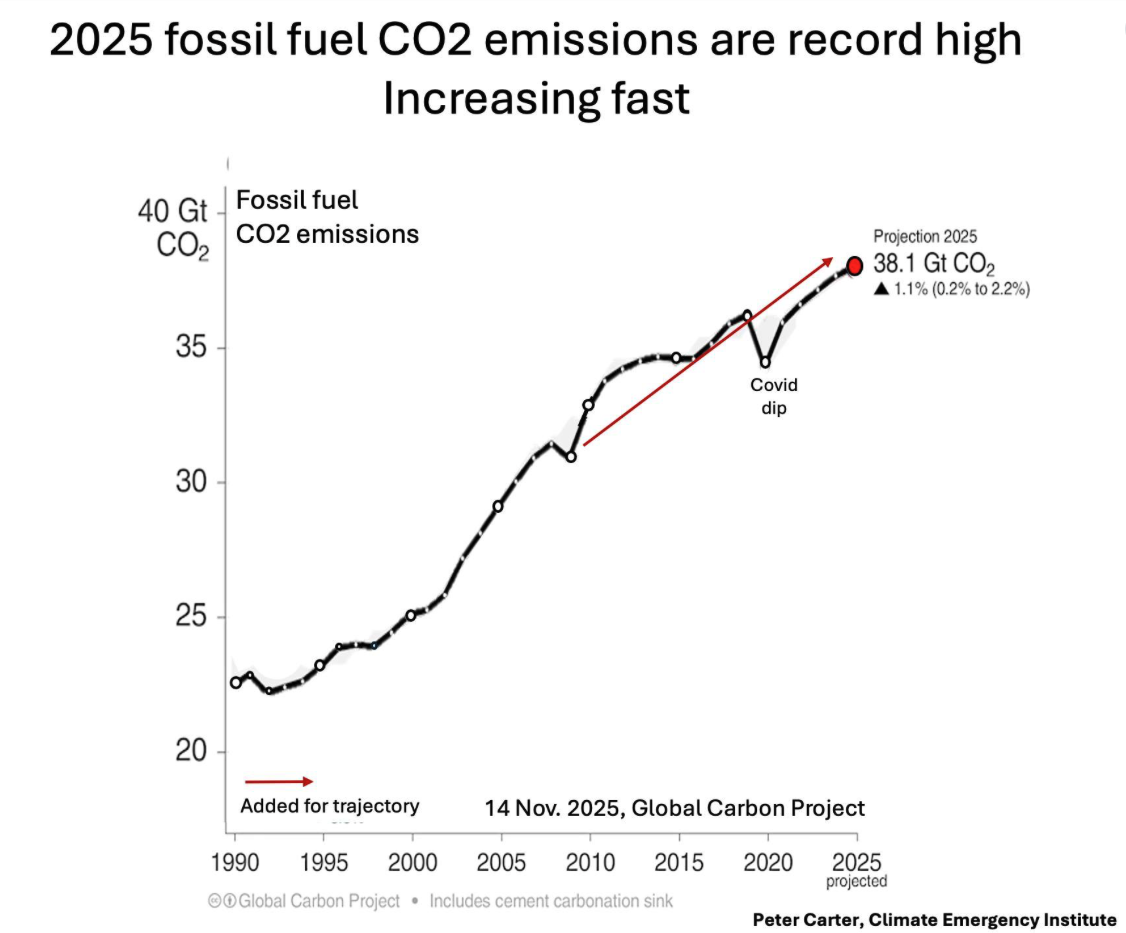
4. The following UCAR chart will help you see how the IPCC predicts how different levels of annual global fossil fuel use will affect average global temperature.
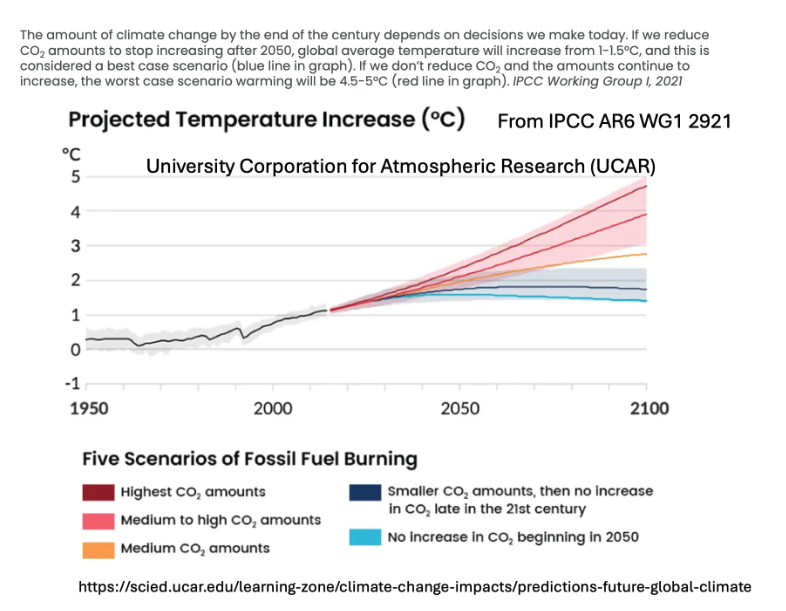
5. These new forecasts above were published by the nonprofit, and 100% publicly funded climate change think tank Job One For Humanity, in collaboration with the Universe Institute.
6. If you recalculate using our criteria to find above and the formulas defined above, and you find any discrepancies, please let us know at ([email protected]).
7. AI was used to assist in collecting climate change news research and reviewing it, as well as verifying our forecasts presented above. We used AI to identify any findings in the current climate change research that could make our forecast inaccurate or unreasonable in light of current climate science. When AI accounted for all factors, it could not identify any factor that would move our forecasts outside the reasonable range.
8. In our forecasts above, we realize that for many, you have encountered very different temperatures, timetables, and forecasts than those you are repeatedly hearing from your government or the media. There are many good reasons for these significant differences. Most of them are fully explained on this page about the IPCC's climate change underestimation crisis.
9. One can reasonably extrapolate or infer, when reviewing the above two IPCC graphs and the materials in this link is that the IPCC AR6 forecasts are plagued by:
a. intentional and unintentional omissions and errors, and "cooked" carbon accounting,
b. IPCC administrator cowardice,
c. intense political influence and interference, and
d. the massive power of fossil fuel cartel influence, disinformation, and greed.
The fact that most of the world has been led to believe the IPCC's three-scenario forecast in AR6 is factual, or at least close to it, has condemned humanity to mass extinction, widespread global collapse, and decades to centuries of near-unbearable climate instability, making the lives of future generations all but unbearable.
10. This article was worked on by Lawrence Wollersheim, lead DMAP analyst, and other climate change researchers who wish to remain anonymous because of the ongoing harassment of many climate change scientists who go public with climate change facts disliked by the global fossil fuel cartel.
11. We fully expect to be attacked with denial of service and hacking attacks once again for making this upsetting but accurate information on climate change consequences and timetables available. By having all the information we used to come to our new forecast transparently disclosed and available, it will make it much easier to defend ourselves from the global vested fossil fuel cartel interests we expect to attack us once again through their trolls and proxies.
12. Click here to see the important 20-40% limate change underestimation ranges by UN, IPCC in their summary reports and why this is important to you and accurate.
15. Useful additional reading and links
Here are more critical links to understand the current reality of climate change extinction threats.
“Global warming in the pipeline” (Hansen et al., 2023) — abstract page at NASA GISS: per-W/m² sensitivity = 1.2 ± 0.3°C → ~4.8°C for CO₂ doubling. giss.nasa.gov Full article PDF (as archived online): “Global warming in the pipeline.” canadiancor.com
To help you understand this critical and dangerous factor in climate change forecasts and humanity's future, we strongly recommend reading our link on the Climageddon Feedback Loop, which discusses this IPCC problem in great detail.
We also recommend reading the following links on the 11 major climate change tipping points, feedback loops, and nonlinear reactions, which provide more detail on many of the threats. This link will explain the four tipping points that will lead to mass human extinction.)
Click here for the definition of irreversible global warming and an explanation of how we have reached phase 2 of this horrible situation.
Click here to learn about the four extinction-driving climate tipping points.
Click here for an overview of climate-driven processes leading to global collapse and mass to near-total extinction. Here, you will see a cascade of nearly 80 primary and secondary climate change consequences unfolding and interacting with humanity's 12 other current major global crises. After reading this page, you will understand why the extinction of half of humanity by 2050 is already an unavoidable reality and that all that remains now is to fight to prevent our near-total extinction.
Click here to see precisely how the IPCC "cooked the fossil fuel reduction calculations" and grossly skewed the current IPCC global fossil fuel reduction calculations by including unproven, non-existent, and unscalable "carbon-sucking unicorn" technology into their projections.
Click here to review the long-term history of the IPCC underestimating the consequences, timeframes, and the needed global fossil fuel reduction targets by as much as 30-60% or more. This page and its linked pages will help explain why the current 2025 global fossil fuel reductions are so severe, as they aim to compensate for the 60-plus years that society has delayed and failed to implement the gradual reductions in fossil fuel use required.
Click here to see the latest 2022 IPCC climate change summary report on the critical climate sensitivity error.
To see 30+ reasons why the relationships, processes, and self-defeating contexts of the world's current climate change reduction processes make it all but impossible for our governments to act in time to prevent the loss of half of humanity by about 2050, click here.) These 30 reasons explain why the transition of human society from fossil fuel dependence to green energy generation has not progressed, even though we could have achieved most green energy goals toward a complete transition decades ago.
Directly and indirectly, the obscene greed of the global fossil fuel cartel has been the invisible hand and powerful vested financial interest creating a delusional and grossly incorrect framing of the climate change emergency and of climate change consequences and time frames put out by the IPCC. These actions have significantly made it all but impossible for society and our governments to develop effective solutions to the climate change emergency. Click here to read and see the documentation for why the previous statement is not hyperbole.
The latest focus for the global fossil fuel cartel appears to be co-opting many areas of the climate change movement. The latest COP 30 conference appears to have been so derailed by fossil fuel-related issues affecting the framing and discussions that it was almost completely derailed. Fossil fuel cartel members or their representatives are making their way onto the boards of more and more climate change and environmental education organizations as well.
Our forecasts above and our website contain significant, difficult news about our current climate change emergency; please do not think we have given up hope on this challenging task. There are numerous significant benefits to be realized by addressing climate change. When you're done reading this page, be sure to read the following link first, then proceed to the next link. They will help you maintain realistic hope and the balance we all need to overcome the climate challenge together. (The second article has been read by several million people.)
If you are a Job One For Humanity member, in the member's section, you will find additional information on climate change, the stock market, the commodity market, and political stability.
Do you like this page?
