
“Read not to contradict and confute; nor to believe and take for granted; nor to find talk and discourse; but to weigh and consider.”
— Francis Bacon, English philosopher, statesman, and advocate of early scientific methodology, 1561–1626.
Introduction to Our Three Rational Thinking Guides
Across our three rational thinking and metacognition guides, you will learn how to clarify claims, test evidence, check logic, use probability, detect bias, evaluate big data, analyze causes, make better decisions, forecast more honestly, understand systems, examine your own assumptions, and eventually use advanced metacognitive and DMAP (Dialectical Metasystemic Analysis and Problem-Solving) methods for the most complex, high-stakes problems.
If you use AI, you will also find AI prompts to help you use AI prudently and efficiently throughout the guides.
Some individuals even treat these three guides as an analysis and problem-solving checklist or test to see how smart, effective, and rational a thinker they already are. They know that being smart without being trained and proficient in rational, accurate thinking, analysis, and decision-making tools is like a thoroughbred racehorse pulling a slow, heavy freight wagon on a muddy, pothole-filled road—a horrible waste of talent and potential.
These three guides are not just guides to “rational thinking that better reflects reality” in some abstract sense. Abstract rationality is charming, but only slightly more useful than owning a gym membership you never use. These guides are meant to help you take the most difficult problems pressing on your life right now and work on them with better tools.
As a wonderful side effect of learning the material in these three guides, you will also become less susceptible to propaganda, deception, hidden conflicts of interest, manipulation, and corporate and political influence strategies designed to take advantage of people who have not yet learned strong rational thinking and evidence testing.
These guides recognize that better thinking is not only cold analysis. Human judgment also uses intuition, emotion, bodily signals, memory, imagination, values, and tacit pattern recognition. Rational thinking and intuition can work well together, and this guide will show you how.
The main problem is not intuition itself. The problem is untested intuition masquerading as certainty. One key goal of these guides is to help your natural intuition and rational analysis skills cooperate rather than fight like two committee members trapped in one skull with no adult supervision.
(Please note that we hope to have all three guides done by mid September to early October. But the basic guide should be done by late July, early August.)
Start Here: The Practical Shortcut
Too busy? Emergency? Do this first:
- Write down your three real problems.
- Start with the Basic Guide.
- Use one method on one problem.
- Do not rely on AI without checking it.
This gives you a life raft before the conceptual cruise ship departs.
But, we strongly recommend that you do read this full introduction first because it contains critical foundational information on how the guides work, what's in the guides, how to use the guides with our AI prompts, the role of intuition and experiential knowledge, and what you really need to know before you even start the three guides to achieve the maximum success with them.
Metacognition and Our Three Guides to Rational Thinking, Analysis, and Problem-Solving
The simplest definition of metacognition is thinking about your own thinking so you can understand it, test it, and improve it. Metacognition is receiving growing public attention, including on social media, where it is often presented as a kind of “superpower” for learning, emotional regulation, self-awareness, and problem-solving.
In everyday language, aspects of metacognition often go by friendlier labels such as self-awareness, reflection, emotional regulation, self-regulation, learning how to learn, recognizing cognitive biases, journaling, therapy language, and better AI prompting. These labels are not all identical, but they point to a shared practical question: How can I become more aware of and improve the way I think, feel, react, learn, decide, and solve problems?
Our three guides and the 80 rational thinking and metacognition tools within them are designed to give you a serious, structured, practice-based answer to that question. They teach you how to think about your thinking so you can improve your rationality, analysis skills, problem-solving abilities, learning capacity, and real-world judgment. Across the guides, you will also find powerful exercises that strengthen self-awareness, reflection, emotional regulation, and self-regulation while also improving your rational thinking skills.
With diligent, repeated practice, these guides can help you develop many of the real advantages people seek when they talk about metacognition as a “superpower”: clearer self-awareness, better emotional regulation, stronger learning, sharper analysis, better problem-solving, and more reality-aligned judgment. It is not magic, and it is not instant superintelligence. It is something more useful: a trainable way to notice, test, and improve the mental processes that shape your choices, actions, and results.
Our Promise for These Guides
Start with a real problem. Use the simplest method that can help. Practice it. Learn from the result. Then move to stronger methods as the problem becomes more complex.
No guarantees. No magic wand. No secret decoder ring delivered by a committee of enlightened dolphins. But if you actually apply these methods, they can give you more clarity, better judgment, fewer self-inflicted mistakes, and a much stronger chance of improving the life and career outcomes that matter most.
Please take the time to read this whole introductory page. It contains critical information you will need as you go through any of our three guides, and it will not be repeated in those guides.
Quick Navigation
- Why These Guides Matter Now
- Why Just Knowing These Rational Thinking Tools Is Not Enough: Declarative vs. Experiential Knowledge
- The Modern Complexity Problem We All Face
- How to Use AI Wisely With These Three Thinking Guides
- Core AI Support Prompts for Using These Guides Responsibly
- Before You Begin: Write Down Your Three Most Important Current Problems
- The Three-Guide Map: Basic, Intermediate, and Advanced
- What Each Section of the Guides Will Include to Help Make Your Learning and Practicing These Thinking Tools a Success
- Why Smart People Should Not Skip the Basic Guide
- How to Use the Guides Without Turning Them Into Shelf Decoration
- Where Intuition Fits: Use It as a Signal, Then Test It
- Why These Guides Were Created by the Universe Institute Think Tank
- We Are Seeking Your Feedback After Completing Any Guide
- Frequently Asked Questions
- Mini-Glossary
- Selected Bibliography, References, and Source Links
- Links to the Three Guides
Why These Guides Matter Now
Our three guides are important for learning, teaching, screening for, and practicing the core habits of stronger reasoning, better evidence testing, more accurate analysis, and more effective problem-solving.
The rational thinking, information, and strategies explained in these guides can be tailored to almost any situation. The good news is that you do not have to use every method in every situation. That would be like bringing an entire hardware store to tighten one screw, which is very human but not especially efficient.
With practice, you will learn to select only the rational-thinking tools and accuracy checks needed for the complexity of the situation or problem you are facing. Knowing these tools can put your analysis, decision-making, and problem-solving significantly ahead of people who are still trying to solve twenty-first-century problems with inherited guesses, emotional reactions, old slogans, and whatever their phone screamed at them before breakfast.
Used regularly, these guides can help you make significantly higher-quality decisions in your personal life, career, family, organization, business, civic work, and leadership roles.
Even if you believe you are already a smart, highly rational thinker, reviewing these guides can strengthen your skills and introduce you to important principles you may have forgotten or never encountered. Some methods are newer, while others are established tools now being integrated in more advanced ways.
Being smart is a potential. It is not the same thing as being well-trained in analytical thought and accurate problem-solving. A powerful engine still needs steering, brakes, fuel, maintenance, a map, and some basic agreement with the road.
Why Just Knowing These Rational Thinking Tools Is Not Enough: Declarative vs. Experiential Knowledge
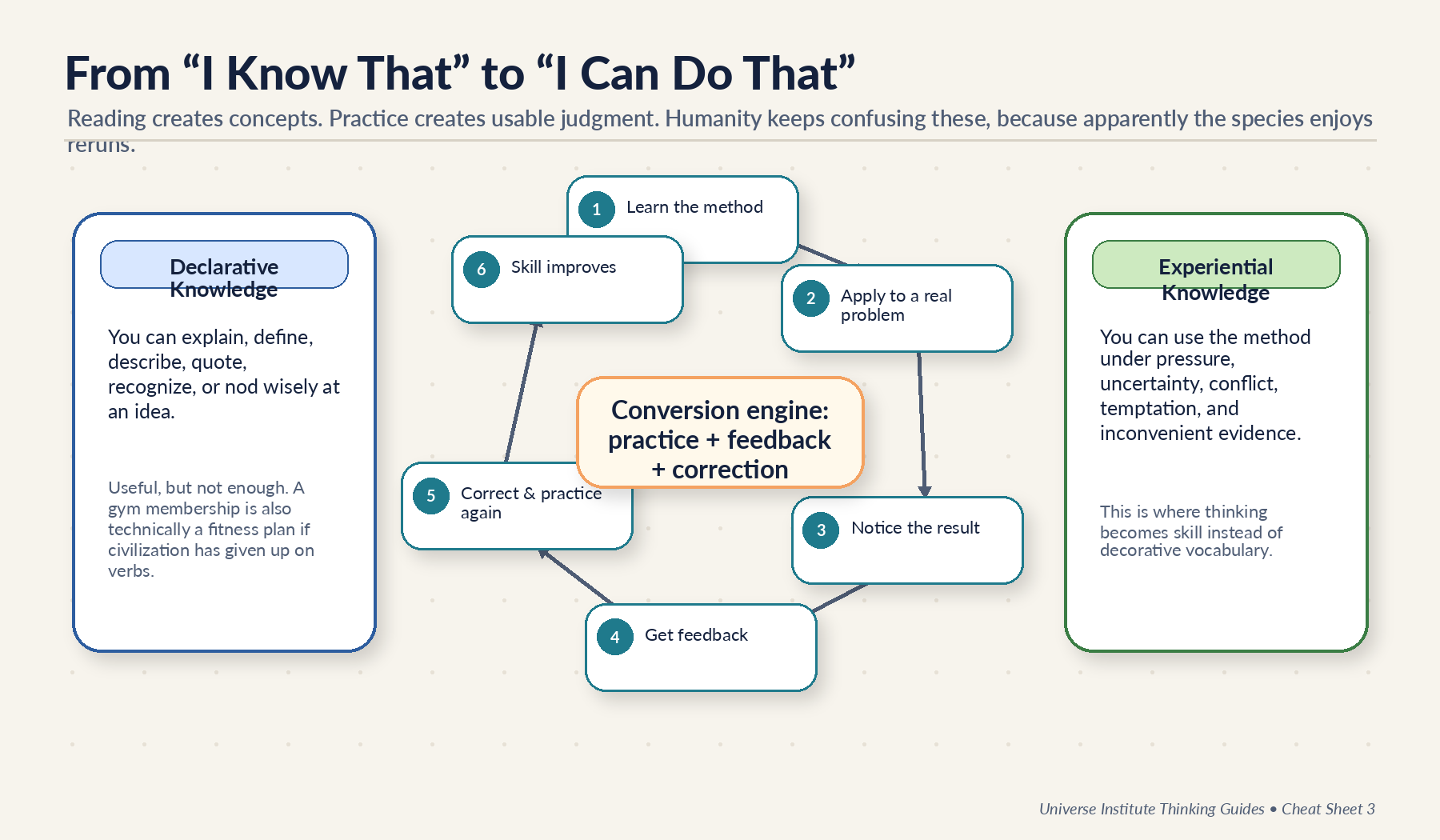
There is a major difference between declarative knowledge and experiential knowledge.
Declarative knowledge is what you can explain, define, describe, quote, or recognize on a page. It is the kind of knowledge you get from reading a book, watching a video, hearing a lecture, or telling yourself, “Yes, yes, I already know that.” Humanity says this a lot, usually right before repeating the same mistake with better lighting.
Experiential knowledge is what you can actually do under real conditions. It is knowledge converted into skill through repeated practice, feedback, correction, and use. A person may understand the definition of confirmation bias and still spend the afternoon lovingly collecting only evidence that flatters their existing opinion. Knowing the name of the trap is not the same as stepping around it.
These guides are built to move you from declarative knowledge to experiential knowledge. That means you will not only read about logic, evidence, bias, probability, decision-making, systems thinking, and advanced analysis. You will be asked to use them on real problems, notice what happens, revise your thinking, and practice again.
That is how rational methods become transformative. They become useful when they stop being concepts you admire and become practiced judgment, better perception, improved decision habits, and changed behavior.
The Modern Complexity Problem We All Face
Modern life is becoming more complex because more systems are interacting with more other systems, faster, across greater distances, with more feedback effects, more hidden interdependencies, more data, more conflicting incentives, more technologies, more social fragmentation, more environmental stress, and more consequences arriving from places no one was watching because everyone was busy optimizing a dashboard.
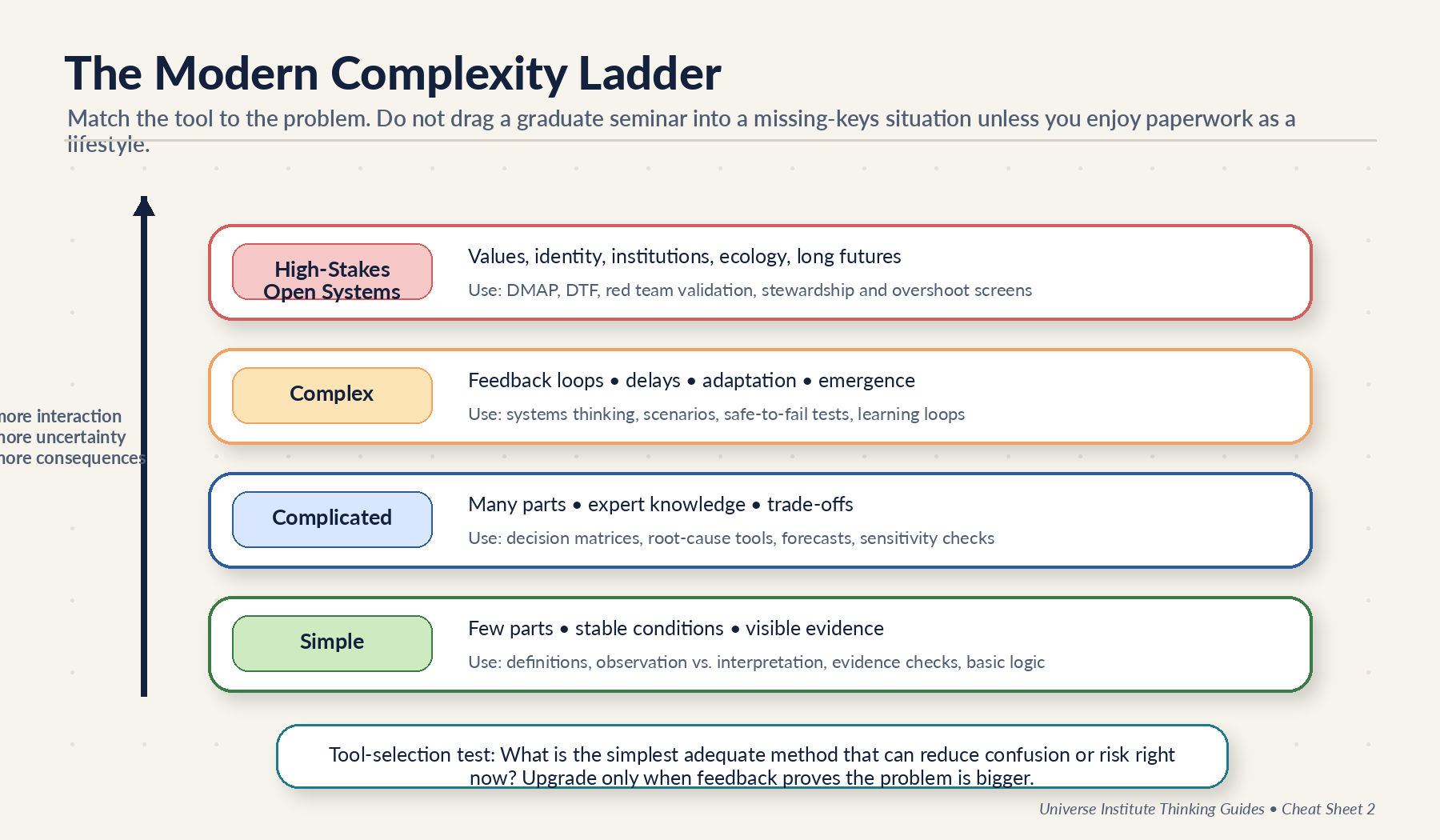
Complexity means a situation has many interacting parts, changing conditions, delayed consequences, feedback loops, tipping points, competing goals, uncertainty, and sometimes nonlinear outcomes that cannot be understood by looking at only one piece. A simple problem is like finding your keys.
A complex problem is like discovering your keys are missing because of your schedule, your habits, your memory, your stress level, your house layout, your phone notifications, your family system, and a small but determined pile of unopened mail.
Modern society keeps increasing in complexity. People can either learn to manage it or be controlled by it. In some cases, they can be eaten by it, though usually in the polite bureaucratic way: bad decisions, bad systems, bad incentives, bad data, delayed consequences, institutional denial, and a cheerful quarterly report.
The following illustration is important to keep in mind as you look for the right and simplest tool in our three guides to solve the complexity of the problem you are dealing with.
How to Use AI Wisely With These Three Thinking Guides
AI can be a powerful research assistant when you are using these three thinking guides. It can help you gather background information, summarize complex material, generate possible explanations, compare options, create checklists, suggest questions, identify missing evidence, and see perspectives or options you may not have considered.
Used well, AI can reduce blank-page paralysis, speed up early research, and help you discover options that might otherwise remain hidden under the usual pile of assumptions, habits, and whatever mental lint humans collect while pretending to be objective.
But AI should not be treated as the final thinker, judge, or decision-maker. AI systems can and do make mistakes, invent false information, miss important context, overstate weak claims, reflect bias in their training data, misunderstand your actual goals, and produce confident-sounding answers that are still wrong.
AI is especially risky when the issue is high-stakes, emotionally charged, legally sensitive, medically important, financially significant, politically charged, technically complex, or dependent on local facts that the AI may not know. In other words, exactly the kinds of situations where humans most want a magic answer machine. Naturally.
This is precisely why, in the age of AI, the rational thinking, analysis, judgment, and problem-solving methods found in these three guides are even more important today, not less important. AI can help you research and generate information and options, but these guides will help you test the AI claims, check evidence, separate facts from interpretations, examine assumptions, identify bias, compare hypotheses, evaluate uncertainty, map systems, forecast consequences, and decide what is wise to do.
AI can accelerate thinking. It can also accelerate poor thinking if the user lacks sound rational reasoning, analysis, and decision-making skills. A poor thinker with AI can become wrong faster, louder, and with better formatting. So do not rely lazily on unverified AI output without applying the relevant evidence-testing techniques and AI prompt recommendations in these guides, or you may make some very embarrassing or costly mistakes.
On the other hand, a trained and proficient three-guide rational thinker who uses AI wisely can become dramatically more capable, better prepared, and more useful to the people and institutions that depend on their judgment.
The best use of AI is wise coordination: let AI help gather, organize, summarize, question, and challenge. Then use the Basic, Intermediate, and Advanced Guide methods to evaluate the AI's output.
Ask: What is the evidence? What is missing? What would change my mind? What assumptions are hidden here? What are the alternative explanations? What are the risks if this is wrong? What do I know from direct experience that the AI does not? What values, scope, scale of responsibilities, and consequences must a human still judge?
A person who understands today’s best AI tools and is also skilled in the many rational-thinking methods of these three guides could gain a major advantage in life, career, leadership, research, education, strategy, and problem-solving. That person would be able to move faster from confusion to clear questions, from vague concern to testable claims, from scattered information to structured options, from emotional reaction to evidence-based judgment, and from overconfidence to calibrated action.
They would not merely “use AI.” They would supervise it, test it, redirect it, and integrate it with their original questions into a disciplined human thinking process. That is the real advantage: not replacing your judgment with AI, but strengthening your judgment with AI support while keeping reality, humility, and responsibility in charge.
Core AI Support Prompts for Using These Guides Responsibly
Use prompts like these whenever you want AI help while working through the three guides:
-
- “Act as a research assistant, not as an authority. Help me gather relevant information, possible explanations, and useful questions about this problem: [describe problem]. Clearly separate credible facts, interpretations, assumptions, and guesses.”
- “Help me identify what information I need before I can think clearly about this issue. Separate what I already know from what I need to verify.”
- “Give me several possible ways to frame this problem. For each framing, tell me what it helps reveal and what it might hide.”
- “List the strongest arguments for and against this conclusion: [state conclusion]. Do not flatter my current view. Help me test it.”
- “What assumptions does my current plan depend on? Which assumptions are most fragile, least tested, or most likely to fail?”
- “Help me identify where AI might be unreliable in this analysis. What facts should I independently verify using primary or high-quality sources?”
- “Before I make a decision, help me create a final review checklist using evidence quality, uncertainty, bias, alternatives, consequences, and reversibility.”
- “What parts of this decision require human judgment, values, responsibility, local knowledge, relationship awareness, or moral evaluation that AI cannot provide for me?”

Important: Before You Begin This Basic Manual, Write Down Your Three Most Important Current Problems
Before you enter the guides, do one practical thing. Write down the three biggest problems, issues, or decisions pressing on your life right now. Not theoretical problems. Not “humanity should improve itself,” though that would be adorable. Use real problems that are actually costing you attention, money, time, sleep, peace, trust, opportunity, or emotional energy.
Your three current problems:
- Problem or issue one: ________________________________________________
- Problem or issue two: ________________________________________________
- Problem or issue three: ________________________________________________
As you move through the guides, you will regularly be asked questions like these:
- How could this thinking method help me understand one of my three current problems more clearly?
- What assumption, missing evidence, bias, system pattern, or decision error might this method reveal?
- After I applied this method, what changed?
- What worked, what failed, and what did I learn?
This repeated application is not filler. It is the whole point. These guides are not meant to become another impressive pile of unread wisdom. Civilization already has warehouses full of that. These guides are meant to help you practice better thinking on real problems until better judgment becomes a skill you can actually use.
AI Support Prompts for Choosing Your Three Current Problems
- “I am beginning these three rational thinking guides. Help me identify three real problems, issues, decisions, or patterns in my life or work that are concrete enough to analyze. Ask clarifying questions if needed, but do not choose for me.”
- “Here are several possible problems I could work on: [list problems]. Help me rewrite each one as a clear problem statement that is specific, observable, and practical enough to analyze.”
- “For each of these problems, help me identify what is at stake, who is affected, what decision may be needed, what evidence I already have, and what evidence I still need.”
- “Help me decide whether each problem is best suited for the Basic, Intermediate, or Advanced Guide. Explain your reasoning using problem complexity, uncertainty, stakes, system effects, and reversibility.”
The Three-Guide Map: Basic, Intermediate, and Advanced
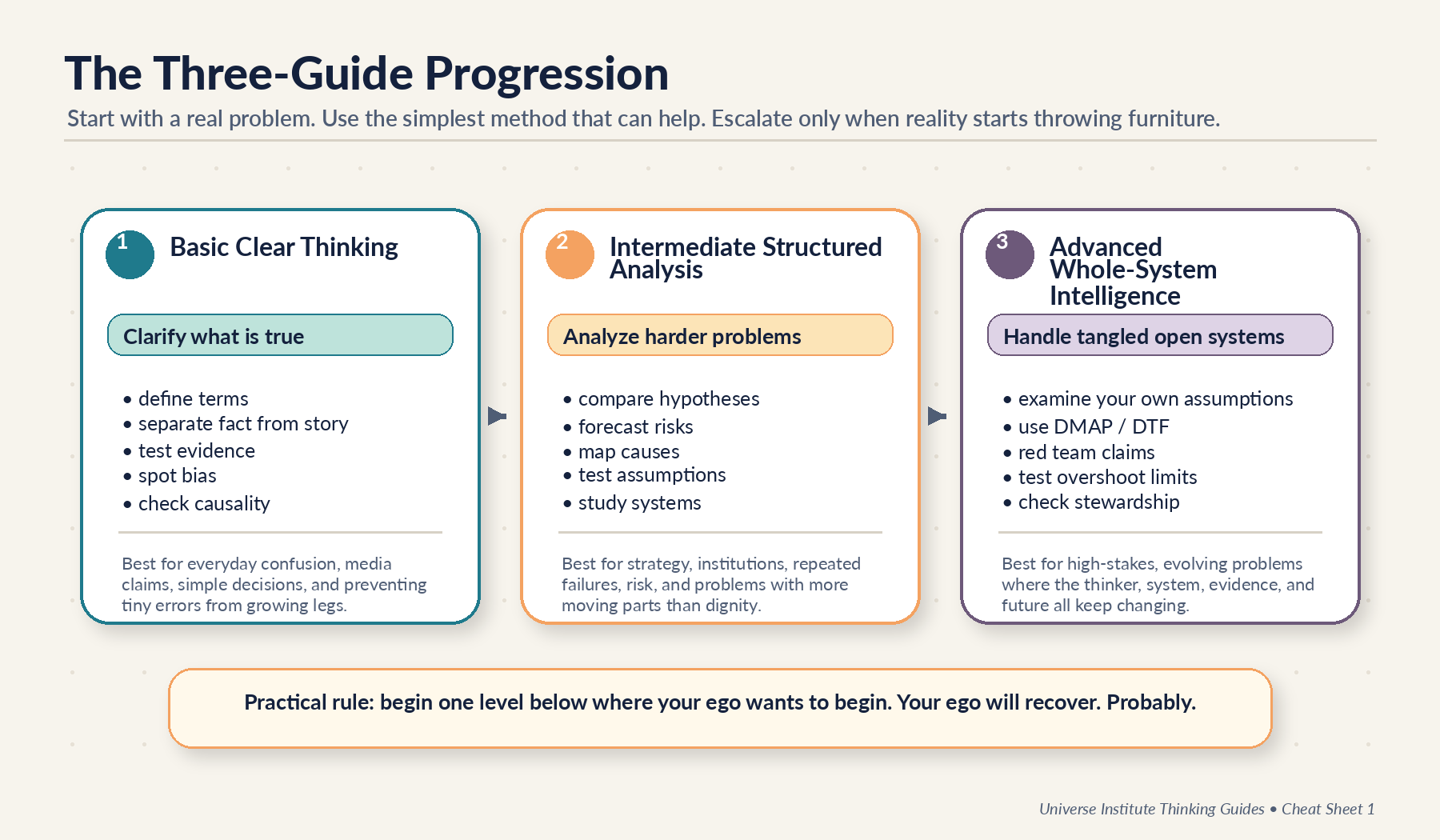
The three guides are arranged as a progression from clear thinking to structured analysis to whole-system intelligence.
Guide One: Basic Clear Thinking helps with everyday confusion, bad information, emotional reactions, simple decisions, basic evidence checks, hidden bias, and common reasoning mistakes. It also helps you slow down first impressions long enough to ask, “What is actually true here?” The Basic Guide is especially useful for anyone living today. Unfortunately, much of this survival-critical basic thinking material is never taught to high school students or beyond.
Guide Two: Intermediate Structured Analysis helps with harder decisions, competing explanations, forecasts, root causes, repeated failures, risk, institutions, incentives, design problems, and system-level challenges. At this level, intuition becomes a source of hypotheses, weak signals, and pattern recognition that must be tested with stronger methods. The Intermediate Guide is especially useful for anyone who wants to operate well at a mid-management level in a corporation, nonprofit, government agency, or complex organization.
It is also especially useful for college and graduate students who want to work in advanced research areas.
Guide Three: Advanced Whole-System Intelligence helps with high-stakes, complex, evolving, value-loaded, multi-system problems where your own assumptions, worldview, identity, and developmental limits may become part of the problem. At this level, intuition, disciplined analysis, metacognition, DMAP, systems thinking, and reality testing must work together.
The Advanced Guide is especially important for people working at high levels of corporate, governmental, political, intelligence, scientific, philanthropic, or civil-society decision-making, where complex choices can affect large numbers of people over long periods.
At the beginning of each of the three guides, all the rational analysis and problem-solving tools will be listed, along with their best uses, for quick reference.
Why Smart People Should Not Skip the Basic Guide
Many people will be tempted to skip our Basic Guide because they are educated, experienced, successful, or very sure they are already rational and great thinkers. This is understandable. It is also how many expensive mistakes begin.
Most people do not consistently use even the basic tools of clear thinking. They may know some of them by name, but they do not regularly apply them under pressure, uncertainty, conflict, stress, or temptation. That is exactly when the tools matter.
The Basic Guide is not there because readers are unintelligent. It is there because strong advanced thinking depends on strong basic thinking. If you cannot clearly define terms, separate fact from interpretation, test evidence, track confidence, check causality, and notice bias, then systems thinking and advanced DMAP will only give you a more sophisticated way to be wrong.
Start with the Basic Guide. Review it quickly if you already know the material. Practice the parts you do not consistently use. Then move on.
Practical rule: begin one level below where your ego wants to begin. Your ego will recover. Probably.
What Each of the Guides Will Include to Help Make Your Learning and Practicing These Thinking Tools a Success
The three guides are built for learning, practice, and real-world use. We will repeat critical or fundamental ideas in different ways across our charts and illustrations to ensure visual learners can quickly grasp the material. We recommend learning one new tool at a time. Across the three guides, there are many rational thinking, analysis, and problem-solving tools.
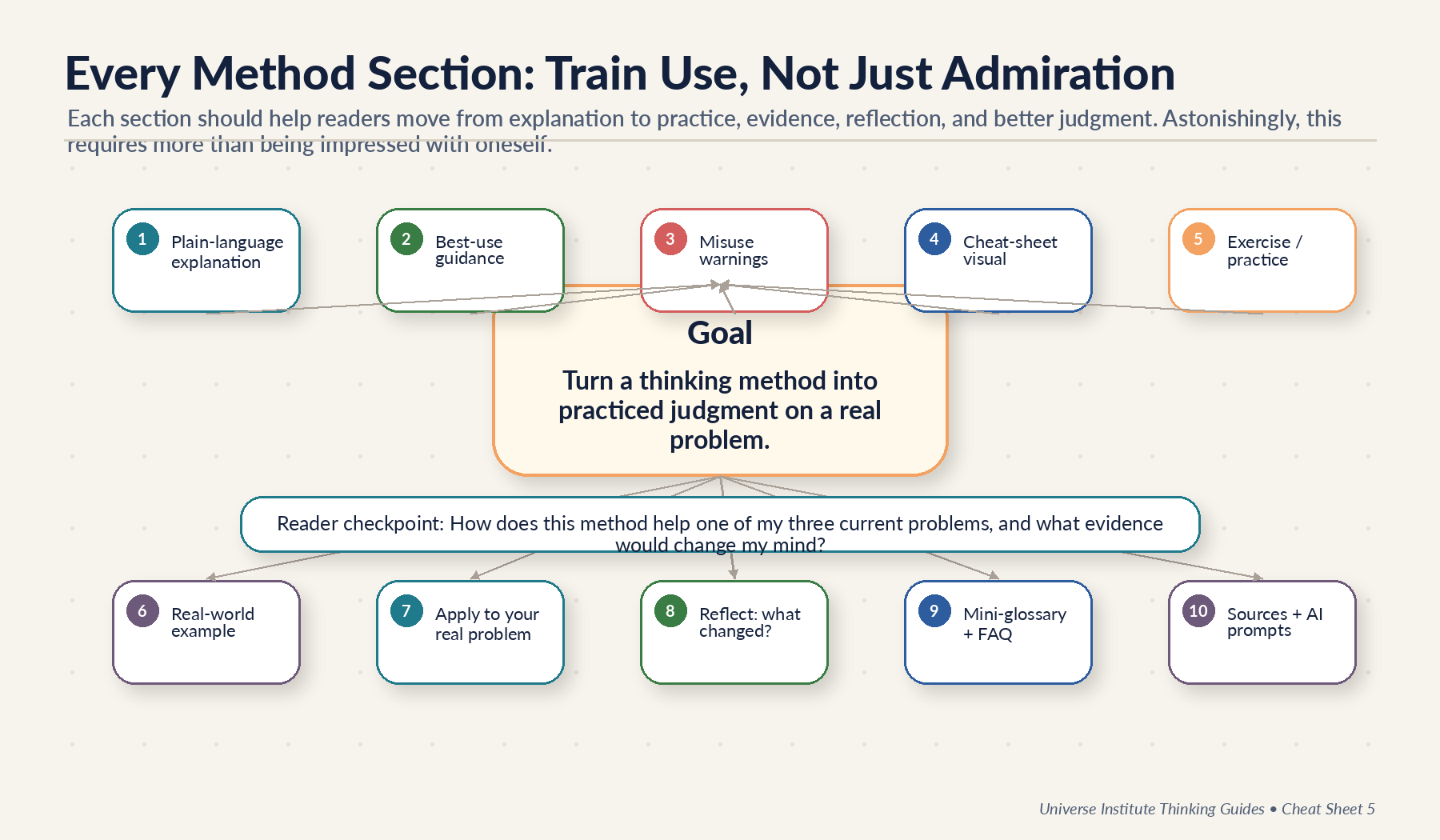
Where appropriate, each section will include:
- A plain-language explanation of the method or strategy. We aim to write at a clear high-school-to-college reading level.
- Best-use guidance showing what kinds of problems the method is best suited for.
- Warnings about when the method should not be used or when it can mislead you.
- Guidance on when first impressions, hunches, intuition, or emotional signals should be noticed, tested, or set aside.
- Illustrations, charts, and diagrams that can also serve as quick cheat sheets to print and take wherever you need them.
- Exercises to help turn the method into a usable skill.
- Real-world examples showing how the method can be applied.
- Application prompts asking how the method could help with one of your three current problems.
- Reflection prompts asking what happened after you applied the method and what you learned.
- Mini-glossaries for all technical terms and abbreviations used in that section. The glossary for the terms or abbreviations on any page is at the bottom of that page for speed and ease of use.
- Frequently asked questions for that method or strategy.
- Bibliographies and source links for readers who want to go deeper.
- Short method/creator background notes where helpful, so readers know where important tools came from.
- Sample AI prompts for readers who use AI to support research, analysis, and problem-solving. AI use is growing rapidly across many kinds and levels of analysis and problem-solving. AI can quickly gather information, organize options, summarize material, and surface possibilities the user may not have considered. But AI does not think like a human, and its output must still be checked by human judgment.
- Pre- and post-self-scoring tests to assess your improvement.
- Practice worksheets for almost every tool, where you can apply what you have just learned from that tool to a current problem you are dealing with. Please note that not all tools will be applicable to all problems.
The guides will also ask you to keep returning to your real problems. This is not meant to be annoying. It is meant to prevent the classic educational tragedy where people learn an idea, admire it briefly, and then continue living exactly as before. Lastly, keep in mind that AI does make mistakes, and that is why you also have to do the final thinking and review.
How to Use the Guides Without Turning Them Into Shelf Decoration
Use this simple process:
-
- Name the real problem. Write down what you are trying to understand, decide, fix, improve, or prevent.
- Select the simplest, most useful guide. Use Basic for clarity and evidence, Intermediate for structured analysis and systems, and Advanced for high-stakes whole-system problems.
- Apply one method. Do not try to use everything at once. That is how people create a spreadsheet with 400 tabs and then quietly lose the will to continue. We strongly recommend against trying too many methods at once, as it can cause you to lose focus or become overwhelmed by more than you can handle.
- Write the result. Capture what one single method helped you see.
- Act carefully. Convert a better understanding into a small next action, test, decision, conversation, or plan revision.
- Review what happened. Ask what worked, what failed, what surprised you, and what you should update.
- Repeat. Skill grows through cycles of use, feedback, correction, and use again.
- If possible, we especially encourage readers to learn and use these guides with a small learning cohort. A group of three to eight people can work through one guide at a time, apply the methods to a real problem, compare reasoning, challenge assumptions respectfully, offer positive support to each other in the process, and then share what worked and what did not. Thinking and metacognition improve faster when they are practiced, tested, discussed, corrected, and applied to real problems rather than merely admired from a safe distance
These guides are not trying to turn you into a cold machine. Machines are already doing a spectacular job of being machines. The goal is to become a more reality-aligned, rational human being: clearer, calmer, more honest with evidence, less easily manipulated, more adaptive, more capable of solving real problems, and less likely to confuse confidence with correctness.
There are no rewards or recognition for being the person who gets through these guides the fastest. The only rewards these guides provide are the real-life benefits they can deliver when applied regularly to the problems and issues we all face, whether at home or in our careers.

Where Intuition Fits with Rational Thinking Tools: Use It as a Signal, Then Test It
These guides do not ask you to throw away intuition. That would be foolish. Intuition is often the first place where your mind notices a pattern, a danger, a mismatch, a possibility, a human signal, or a value conflict before your conscious analysis has assembled the paperwork.
Intuition means fast, often unconscious judgment based on pattern recognition, memory, emotion, bodily signals, and prior experience. It overlaps with what some cognitive scientists call System 1 thinking: fast, automatic, low-effort processing. Analytical thinking overlaps with System 2 thinking: slower, deliberate, effortful reasoning that uses attention, comparison, evidence, logic, calculation, and careful testing.
The best working rule is simple:
Use intuition first for noticing. Use analysis next for testing. Then use mature intuition again for integration, judgment, timing, communication, and action.
In other words, let intuition raise the flag. Do not let it run the whole government unsupervised. Humans have tried that. The record is mixed, and the minutes of the meeting are embarrassing.
A Practical Sequence for Using Intuition Correctly
- Name the intuition: “My gut says X.”
- Identify the pattern: “What past experience, signal, mismatch, or concern does this remind me of?”
- Check the domain: “Is this a familiar, predictable situation where I have received clear feedback before?”
- Look for disconfirming evidence: “What would show that this intuition is wrong?”
- Use base rates: “What usually happens in similar cases?”
- Run a premortem: “Imagine this decision failed. What did I miss?”
- Track outcomes: “Was my intuition accurate, partly useful, distorted, or misleading?”
This converts intuition from a mystical fog machine into a trainable hypothesis generator. It also helps build better intuition over time because you begin comparing your first impressions with actual outcomes.

When Intuition Is More Trustworthy
Research on expert judgment suggests that intuition is more trustworthy when the environment has real patterns, the person has substantial experience in that environment, and the person has received clear feedback that allowed learning. A firefighter, nurse, mechanic, editor, therapist, negotiator, or experienced systems analyst may quickly notice important patterns because their intuition has been honed by repeated contact with reality.
Use intuition more confidently when:
- You have deep experience in the domain.
- The situation resembles patterns you have seen many times before.
- The environment is reasonably predictable.
- You have received clear feedback from past decisions.
- Your body or emotions may be noticing a real mismatch, danger, opportunity, or value conflict.

When Rational Analysis Must Take the Lead
Use slower rational analysis when the decision is high-stakes, unfamiliar, numerical, politically pressured, emotionally loaded, complex, or vulnerable to wishful thinking. Also use analysis when feedback is delayed or noisy, such as in investing, climate forecasting, organizational strategy, health decisions, public policy, relationships under stress, or long-range planning.
In those situations, intuition may feel confident while being magnificently wrong, which is one of humanity’s more reliable product lines.
Use rational analysis more strongly when:
- The stakes are high or the consequences are hard to reverse.
- The situation is new, rare, or rapidly changing.
- You are angry, afraid, ashamed, flattered, rushed, or socially pressured.
- The decision depends on numbers, probabilities, base rates, timelines, or trade-offs.
- You have strong incentives to believe one answer.
- Different people’s lives, rights, money, safety, or futures are affected.

Is Intuition in the Right Brain and Analysis in the Left Brain?
Not in the oversimplified popular sense. Some brain functions are lateralized. For example, language functions are often more left-lateralized, while some spatial and attentional functions can be more right-lateralized. But the old personality story that some people are “right-brained intuitive creatives” and others are “left-brained logical analysts” is not supported as a simple global brain-type model.
A better brain model is distributed. Intuition can involve perception, memory, emotional learning, body-state sensing, and prediction. Analytical thinking can involve attention, working memory, language, executive control, comparison, and rule-based reasoning. Both use networks across the brain. Apparently, the brain declined to organize itself into a tidy motivational poster. Very inconsiderate.
One useful concept is interoception, the brain’s perception of internal body signals such as heartbeat, breathing, tension, hunger, and “gut feelings.” Another useful concept is the somatic marker hypothesis, associated with Antonio Damasio and colleagues, which proposes that bodily and emotional signals can help guide decision-making under uncertainty. These signals can be useful, but they still need testing.
A body signal may be wisdom, stress, trauma, memory, caffeine, hunger, or a calendar reminder your conscious mind forgot. Best not to build a life plan on indigestion alone.

The Short Intuition Rule for All Three Guides
Intuition without analysis becomes bias wearing a cape. Analysis without intuition becomes a spreadsheet trapped in a basement.
The mature thinker uses intuition to detect patterns, concerns, values, possibilities, and weak signals. Then the mature thinker uses rational analysis to test, refine, falsify, prioritize, and act. The goal is not intuition or reason. The goal is to train cooperation between them.
AI Support Prompts for Testing Your Intuition
- “My intuition about this situation is [intuition]. Help me list what evidence would support it, weaken it, or show that it is probably wrong.”
- “Help me separate bodily/emotional signals, past experience, assumptions, and actual evidence in this decision: [describe decision].”
- “What base rates, comparison cases, or alternative explanations should I check before trusting this gut feeling?”
- “Act as a fair red team. How could this intuition be biased by fear, wishful thinking, ego, loyalty, group pressure, or incomplete information?”

Why These Guides Were Created by the Universe Institute Think Tank
My name is Lawrence Wollersheim. I am the lead DMAP analyst at the Universe Institute and the person responsible for compiling the three guides you are about to read. While working to train individuals in complex and advanced DMAP analytical and problem-solving methodologies, I realized that both highly gifted and non-gifted DMAP trainees had not learned, had learned poorly, or had forgotten many of humanity’s basic and foundational rational-thinking, analysis, and problem-solving strategies. This issue was making their DMAP analysis and problem-solving attempts considerably less accurate and more difficult.
Because of this weak-fundamentals issue in basic and intermediate-level rational-thinking tools and the advent of major new methodologies for advanced analysis and problem-solving over the last 10 years, I decided that the Universe Institute organization needed to create the basic, intermediate, and advanced guides you are about to read for its own internal training and new recruit testing.
I wanted to make available a comprehensive, public-facing, beginner-to-advanced rational thinking, analysis, and complex problem-solving training system that refreshes or integrates critical thinking, evidence evaluation, probability, causality, bias correction, forecasting, structured analysis, systems thinking, adult developmental metacognition, dialectical/metasystemic analysis (DMAP), AI-assisted validation, and final red-team accuracy checks.
I also came to realize that what the world's future needs most right now is not so much another technological breakthrough. It is a widespread and major upgrade in rational thinking, analysis, and decision-making skills that better enable individuals to problem-solve and act on the challenges in their lives, ranging from the simple to the complex.
Why is this so important at this moment in humanity's history? Because humanity faces serious, rapidly escalating survival problems for our species in the intensifying global polycrisis.
This implies that if there is intrinsic value in protecting humanity and the cycle of life for future generations, our three-guide rational-thinking upgrade, if widely adopted at the highest levels of government and society (and at some point, even integrated into the next level of AI programming), could significantly improve and protect the human condition.
Click here for the mission of the Universe Institute.
Click here for more information about Lawrence Wollersheim the DMAP analyst on the three guide project.
We Are Seeking Your Feedback After Completing Any of Our Guides
Our three rational-thinking guides are available free of charge for a limited time if you agree to provide us with written feedback on your experience with them. All you need to do is share honest feedback about how they worked for you, where they helped, where they confused you, and where they can be made clearer, stronger, and more useful.
We are especially seeking feedback and review from people with relevant expertise such as critical thinking educators, decision scientists, forecasters, superforecasting trainers, systems thinkers, system dynamics specialists, AI risk or AI evaluation experts, adult development specialists, Kegan-informed reviewers, Laske/DTF reviewers, DMAP practitioners, university instructors, organizational trainers, and educators who teach reasoning, problem-solving, leadership, strategy, or complex systems.
Each of these expert perspectives can also help us find weak spots, overstatements, missing methods, unclear explanations, and places where readers may misunderstand or misuse the tools.
We are also looking for volunteer graduate students, researchers, teaching assistants, and program evaluators who would create and conduct cohort practice and feedback sessions. This could include helping organize small groups, collecting anonymous feedback, comparing pre- and post-test results, summarizing user experiences, identifying confusing sections, and sending that information to help us improve the exercises and scoring tools.
These three guides provide a powerful and meaningful opportunity for students interested in education, adult development, decision science, cognitive science, psychology, systems thinking, AI-assisted learning, evaluation research, or applied rationality to improve their own metacognition, rational thinking, analysis, and problem-solving skills.
These guides are meant to become better through use, feedback, correction, and revision. Your honest feedback can help us make them clearer, more practical, more teachable, and more effective for the people who need them most, which, judging by the current condition of public reasoning, may be a fairly large demographic.
If you are using these guides for teaching, training, coaching, organizational development, graduate study, community education, company learning programs, or any other educational setting, we would especially value your feedback and suggestions. To obtain our written permission to use these copyrighted materials without charge with your agreement to provide feedback on your application of them to us
Please send your request to use our materials without charge to: ([email protected]). In your request please describe how you will be using the materials, who will be using the materials, and in what settings.
Frequently Asked Questions
Do I Need All Three Guides?
Not for every problem. Use the guide's thinking strategy that best fits the issue's complexity. But if you want to reach the Advanced Guide responsibly, you should review the Basic and Intermediate Guides first. Advanced methods are powerful, but weak foundations turn powerful methods into elaborate mistake factories.
Can These Methods Help with Personal Problems?
Yes. Many personal problems involve unclear assumptions, bad evidence, emotional capture, poor forecasting, repeated patterns, weak boundaries, hidden incentives, or system dynamics. Apparently, human lives are not simple spreadsheets. Tragic, but useful to know.
Can These Methods Help with Work, Leadership, or Organizational Problems?
Yes. The Intermediate and Advanced Guides are especially useful for team decision-making, repeated failures, risk management, strategy, institutional analysis and design, forecasting, systems thinking, and leadership under uncertainty.
Will Reading the Guides Make Me a Better Thinker?
Reading helps. Practice changes you. The guides are designed to be used, not merely admired. The difference matters.
Can AI Replace Learning These Thinking Methods?
No. AI can help you gather information, generate options, summarize material, and challenge your thinking, but it cannot replace disciplined human judgment. Without these methods, users may simply accept AI outputs that sound impressive but are incomplete, biased, outdated, or wrong. The point is not to outsource thinking. The point is to use AI as support while you remain responsible for evidence testing, judgment, values, and final decisions.
What Is the Safest Way to Use AI with These Guides?
Use AI to help you ask better questions, gather background information, identify options, create checklists, compare perspectives, and test and red-team assumptions. Use the guide methods to verify, test, revise, and decide. Always check important facts against reliable sources, especially when decisions involve health, money, law, safety, employment, relationships, public claims, or long-term consequences.
What Is the Biggest Danger of Using AI for Thinking and Problem-Solving?
The biggest danger is confusing fluency with truth. AI can produce confident, polished, highly readable answers that still contain false facts, weak reasoning, missing context, or bad assumptions. This is why users need strong rational thinking methods. The prettier the answer, the more carefully it may need to be tested. Humanity did not need another way to be confidently wrong, but here we are.
Are the Advanced Methods Only for Experts?
No, but they require more preparation, emotional steadiness, study, and practice. The Advanced Guide is not meant to impress people with complexity. It is meant to help people handle problems where simpler methods are no longer enough.
Should I Trust My Gut?
Sometimes. Treat your gut feeling as a signal, not a final answer. Trust it more when you have deep experience, the situation has real patterns, and you have received clear feedback in the past. Test it more carefully when the stakes are high, the situation is unfamiliar, the evidence is incomplete, or your emotions and incentives are unusually strong.
Is Intuition Mainly Right-Brain, and Rational Thinking Mainly Left-Brain?
No, not in the oversimplified popular sense. Some brain functions are lateralized, but intuition and rational analysis both use distributed brain networks. The “right-brained intuitive person” versus “left-brained logical person” model is too crude for serious use, which naturally means it became very popular.
Are Women Naturally Intuitive and Men Naturally Rational?
Some studies find average self-reported differences in thinking preferences, but individuals vary enormously. Training, practice, feedback, emotional development, culture, role expectations, and education matter. The useful point is not to stereotype people. The useful point is to train both capacities: intuition for noticing and rational analysis for testing.
Why Include Humor in Serious Thinking Guides?
Because serious work does not require dead prose. Humor helps people stay engaged, remember key points, and face uncomfortable truths without immediately hiding behind denial, defensiveness, or a heroic snack break.
Mini-Glossary
-
- AI-assisted thinking: Using AI to help gather, organize, summarize, question, or compare information while keeping human judgment responsible for verification, values, and final decisions.
- AI hallucination: A plausible-sounding but false or unsupported answer generated by an AI system.
- AI support prompt: A question or instruction given to an AI system to help with research, analysis, option generation, critique, or review.
- Analysis: Breaking a problem into meaningful parts so it can be understood, tested, and acted on.
- Analytical thinking: Slower, deliberate, effortful thinking that uses attention, evidence, logic, comparison, calculation, and careful testing.
- Base rate: Information about how often something usually happens in a relevant reference class.
- Bias: A recurring distortion in perception, memory, judgment, or decision-making.
- Big Data Error Traps: Errors that occur when large datasets are biased, incomplete, mismeasured, outdated, non-representative, contaminated, overfit, or interpreted with bad assumptions.
- Complex adaptive system: A system made of interacting agents that learn, adapt, self-organize, and produce outcomes not easily predicted from the parts alone.
- DMAP: Dialectical Metasystemic Analysis and Problem-Solving, a new method for examining complex, changing, nested, relational, and transformational systems.
- Domain validity: The degree to which a field or situation has stable patterns that can be learned from experience and feedback.
- DTF: Dialectical Thought Forms, Otto Laske’s set of thought forms used to examine process, context, relationship, and transformation and essential to DMAP.
- Evidence: Information that supports, weakens, or changes the credibility of a claim.
- Forecasting: Estimating what may happen under uncertainty, ideally with probabilities and later accuracy checks.
- Human final judgment: The responsibility of the human user to verify AI-produced or non-AI evidence, evaluate trade-offs, apply values, consider consequences, and make the final decision.
- Interoception: The brain’s perception of internal body signals such as heartbeat, breathing, hunger, tension, and other bodily states.
- Intuition: Fast, often unconscious judgment based on pattern recognition, memory, emotion, bodily signals, and prior experience.
- Metacognition: Thinking about and regulating your own thinking.
- Premortem: A planning method in which you imagine a future failure and work backward to identify likely causes before the failure happens.
- Rational thinking: Thinking that tries to align beliefs with reality and actions with well-chosen goals.
- Red Team validation: A disciplined process for stress-testing claims, evidence, assumptions, logic, incentives, risks, and possible failure modes.
- Somatic marker hypothesis: A theory associated with Antonio Damasio and colleagues proposing that bodily and emotional signals can help guide decision-making under uncertainty.
- Source triangulation: Checking important claims against multiple credible sources, especially primary sources or expert sources, before relying on them.
- Subject-object awareness: The ability to notice and examine beliefs, assumptions, identities, emotions, or worldviews that previously controlled perception from the background.
- System 1 thinking: A common shorthand for fast, automatic, low-effort cognition.
- System 2 thinking: A common shorthand for slower, deliberate, effortful reasoning.
- Systems thinking: Understanding problems by examining interacting parts, relationships, feedback loops, delays, boundaries, incentives, and emergent outcomes.
Selected Bibliography, References, and Source Links
The full guides will include more detailed bibliographies and source links in their relevant sections. The following are a few major sources and traditions that help ground the three-guide sequence:
-
- Whitehead, Alfred North. The Concept of Nature. Project Gutenberg edition.
- Kahneman, Daniel. Thinking, Fast and Slow. Farrar, Straus and Giroux.
- Stanovich, Keith E. Rationality and the Reflective Mind. Oxford University Press.
- Frederick, Shane. Cognitive Reflection and Decision Making. Journal of Economic Perspectives, 2005.
- Kahneman, Daniel, and Gary Klein. Conditions for Intuitive Expertise: A Failure to Disagree. American Psychologist, 2009.
- Klein, Gary. A Naturalistic Decision Making Perspective on Studying Intuitive Decision Making. Journal of Applied Research in Memory and Cognition, 2015.
- Bechara, Antoine, and Antonio R. Damasio. The Somatic Marker Hypothesis: A Neural Theory of Economic Decision. Games and Economic Behavior, 2005.
- Chiu, Yao-Chu, Jong-Tsun Huang, Jeng-Ren Duann, and Ching-Hung Lin. Twenty Years After the Iowa Gambling Task: Rationality, Emotion, and Decision-Making. Frontiers in Psychology, 2018.
- Nielsen, Jared A., Brandon A. Zielinski, Michael A. Ferguson, Janet E. Lainhart, and Jeffrey S. Anderson. An Evaluation of the Left-Brain vs. Right-Brain Hypothesis with Resting State Functional Connectivity Magnetic Resonance Imaging. PLOS ONE, 2013.
- Corballis, Michael C. Left Brain, Right Brain: Facts and Fantasies. PLOS Biology, 2014.
- McDonough, Michael. Making Sense of Interoception. Harvard Medicine Magazine, 2024.
- Sladek, Ruth M., Malcolm J. Bond, and Paddy A. Phillips. Age and Gender Differences in Preferences for Rational and Experiential Thinking. Personality and Individual Differences, 2010.
- Bao, W., Y. Wang, T. Yu, J. Zhou, and J. Luo. Women Rely on “Gut Feeling”? The Neural Pattern of Gender Difference in Non-Mathematic Intuition. Personality and Individual Differences, 2022.
- Heuer, Richards J. Jr. Psychology of Intelligence Analysis. Center for the Study of Intelligence, CIA.
- Tetlock, Philip E., and Dan Gardner. Superforecasting: The Art and Science of Prediction. Crown.
- Meadows, Donella H. Systems Thinking Resources. The Donella Meadows Project.
- Kegan, Robert. In Over Our Heads: The Mental Demands of Modern Life. Harvard University Press.
- Cabrera Research Lab. Science of Systems Thinking.
- Ostrom, Elinor. Governing the Commons. Cambridge University Press.
- OpenAI. Why Language Models Hallucinate. OpenAI, 2025.
- National Institute of Standards and Technology. AI Risk Management Framework. NIST.
- Stanford Institute for Human-Centered Artificial Intelligence. The 2025 AI Index Report. Stanford HAI, 2025.
Links to the Three Guides
- Basic Guide: This should be ready for readers about June 24. (This can be viewed now, but we are still doing final tweaks and adding a pre- and post-self-scoring test.)
- Intermediate Guide: This guide is still in final development and should be available soon. Check back for updates in mid-July.
- Advanced Guide: This guide is still in final development and should be available soon. Check back for updates in mid-July.
Start with the Basic Guide, then return for the Intermediate and Advanced guides as they become available. This turns the page into a path instead of a dead end, which is usually considered polite to readers and rude to confusion.
© 2026 Universe Institute and Lawrence Wollersheim. All rights reserved.
No part of this page, guide, or related educational material may be copied, reproduced, republished, uploaded, posted, transmitted, distributed, sold, modified, adapted, or used to create derivative works in any form or by any means without prior written permission from Universe Institute, except for brief quotations used for review, commentary, education, or other uses permitted by law. For permission requests, please contact Universe Institute, attention Lawrence Wollersheim at [email protected]
Do you like this page?
