
Last updated: April 26, 2026. Please note that this document is being upgraded from an earlier version and is still in pre-final draft mode. We recommend not reading the v.4 draft below until the final version is out in about a week.
Please do not share it at this time! Once this version is listed as final, you can always share this page with a link back and credit.
Prologue
Maybe what the world needs now more than another set of new technological innovations to solve our growing global polycrisis is a massive worldwide upgrade in how rationally, effectively and accurately people think before deciding, and acting. For a moment, imagine if even only the small part of the population that is in key leadership roles was able to think more rationally, accurately, and comprehensively. What could that mean for the well-being and stability of everyone, the world, and our future?
The advanced rational-thinking information in this guide has the potential to significantly improve how those in leadership roles think, analyze, decide, problem-solve, and act. For those of us not in leadership roles, the information and exercises in this guide, when applied regularly, are life-improving, enabling us to make significantly higher-quality decisions in our lives, careers, and businesses.
Even if you believe you are already a highly rational, analytical, and wise thinker, reviewing this guide will significantly strengthen those skills and likely introduce you to important new advanced thinking principles and information you may have never encountered before.
Please note that we have a companion Basic Rational Thinking Guide, which is commonly reviewed before beginning this advanced thinking guide, especially if the reader is uncertain or weak in basic logic, scientific method and evidence, big data set errors, probability, causality, bias checking, and systems thinking, all of which are essential, foundational, and integral to the highest levels of success using our advanced thinking guide. Additionally, our Basic Rational Thinking Guide does not take long to review and is an elnightening read or review for most individuals.
Introduction
Most people use their minds the way a person uses a car with no dashboard lights, no mirrors, and no map. They can move fast, but they do not really know what is overheating, what they are about to hit, or why they keep ending up in the same ditch. This page is for people who want something better: clearer thinking, wiser self-regulation, better choices, stronger problem-solving, and a more mature way of meeting complex reality.
This advanced article on rational thinking methodologies is written for serious readers, early college-level learners, analysts, coaches, leaders, and self-directed adults seeking a practical introduction to four major domains of higher-order thinking.
But be aware, this is not a fluffy “ten hacks for genius” page. Some sections are demanding because reality is, and it is rude that reality keeps being so.

Quick navigation
- Why this work matters
- The big clarification: four domains, not one ladder
- Who are Kegan, Laske, Basseches, Jaques, Stewart, and De Visch?
- Domain 1: self-regulation of thinking
- Domain 2: subject-object growth and meaning-making
- Domain 3: dialectical and metasystemic cognition
- What is DMAP, where did it come from, and what does it not guarantee?
- DMAP prerequisites and readiness
- Creative attunement before analysis: Jan De Visch’s pre-DMAP warm-up
- Domain 4: Stewart’s recursive self-improvement and human superintelligence
- A 90-day practice structure, not a magic staircase
- What all four domains can do for your life
- How DMAP is used on a real complex problem
- Could DMAP help spark a second enlightenment?
- A broader evolutionary and philosophical possibility opened by DMAP training
- FAQ
- Glossary
- References
- Selected bibliography
- Universe Institute internal links
Why this work matters
Choose one important problem in your life before you read further. Keep it in the background while you work through this page. It could be a repeating conflict, a leadership challenge, a money pattern, a health habit, a strategic work problem, grief you keep organizing badly, or an old fear that still gets to run the show. Then keep notes. Watch what happens when you apply each domain to the same problem. That is how this work stops being abstract and starts becoming useful.
Why begin with motivation? Because none of this is easy. Ordinary metacognition already asks you to slow down and monitor yourself. Kegan’s subject-object work asks you to examine identities and loyalties you normally live inside. Laske’s dialectical cognition asks you to stop freezing reality into neat little things and to think in terms of process, context, relationship, contradiction, and transformation. Stewart then asks you to improve not only your strategies, but the processes that generate your strategies. That is a lot. You need a real reason to do it.
The payoff is worth it. Better self-regulation helps you avoid stupid mistakes that looked clever at the time. Greater subject-object capacity helps you become less ruled by approval hunger, ideology, fear, and fragile identity. Dialectical cognition helps you analyze complex systems more realistically. Recursive self-improvement helps you keep upgrading the whole process instead of plateauing. In practical life, these capacities support better learning, wiser decisions, stronger leadership, better relationships, more mature action under stress, and more freedom from your own mental autopilot.
There is also a status reality here, whether polite people like it or not. Those who develop higher levels of self-regulation, wider perspective-taking, stronger complexity handling, and better judgment often rise into more demanding roles in organizations and society. Not always. Human institutions are still full of vanity, nepotism, and theatrical nonsense. But over time, real capability still matters.
A simple working rule: do not study these ideas as a spectator sport. Pick one real problem, revisit it at each domain, and notice what becomes visible only after the previous domain has matured enough to support the next one.
The big clarification: four domains, not one ladder
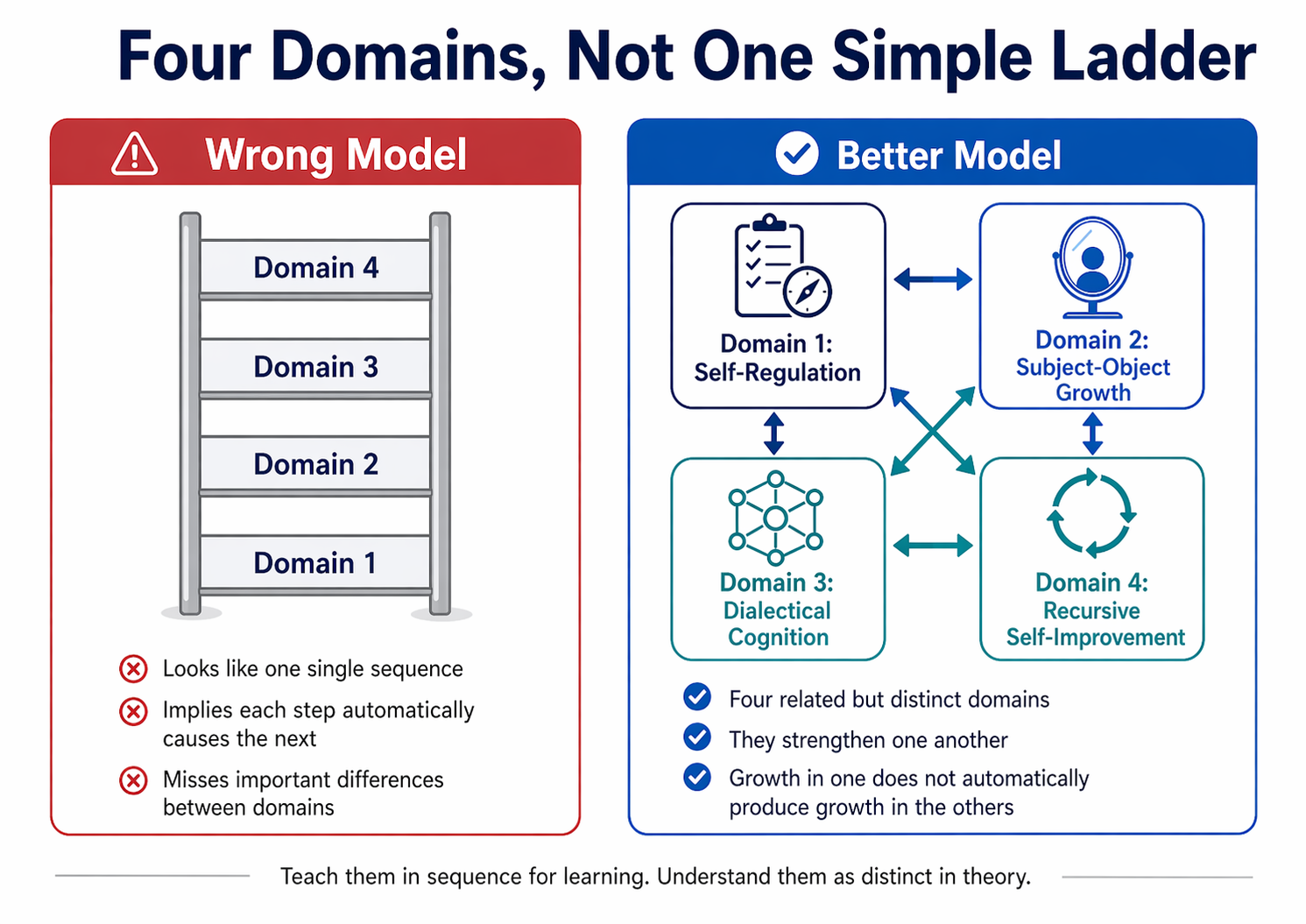
It is misleading to treat ordinary metacognition, Kegan’s subject-object development, Laske’s dialectical cognition, and Stewart’s recursive self-improvement as if they were simply four rungs of one identical developmental ladder. They are not.
The cleaner and more accurate picture is a four-domain integration model:
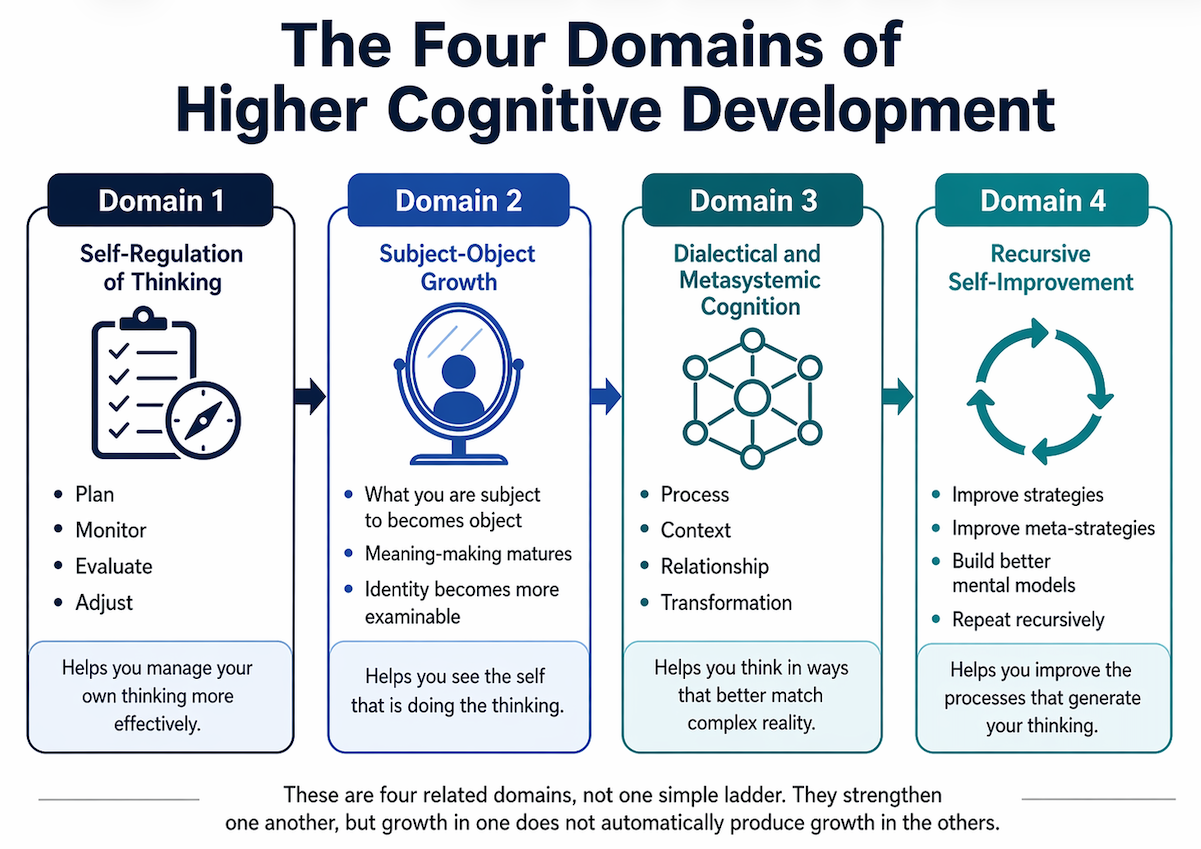
- Domain 1: Self-regulation of thinking. This is metacognition in the standard research sense. It is mainly a skill set: planning, monitoring, evaluating, and adjusting your thinking and behavior.
- Domain 2: Structure of meaning-making. This is Kegan’s territory. It is mainly about the organization of the self: what you are fused with, what you can reflect on, and how adult meaning-making matures over time.
- Domain 3: Complexity of thinking. This is Laske, drawing heavily on Michael Basseches and also influenced by Elliott Jaques and Roy Bhaskar. It is mainly a cognitive capability structure: how reality is construed in terms of process, context, relationship, contradiction, and transformation.
- Domain 4: Recursive self-scaffolding and self-improvement. This is where John Stewart is most useful. It is both a capstone domain and an integration overlay. It draws on the previous three, then asks you to improve the very strategies and meta-strategies that produce your thinking and action.
So why still teach them in sequence? Because educationally, sequence helps. Better self-regulation makes subject-object work more honest. Greater subject-object capacity makes dialectical tools less likely to become mere ego decoration. Greater dialectical cognition makes it easier to build better mental models. And Stewart’s recursive self-improvement helps you intentionally refine all three over time. In other words: these domains are different, but they can strengthen one another.
Important caution: growth in one of the four domains does not automatically produce growth in the others. You can be very self-reflective and still think statically. You can think dialectically in one area and still be emotionally fused in another. You can know better strategies and still fail to act on them. Human development can also be uneven, nonlinear, domain-specific, and frequently rude.
Why not call ALL of this “metacognition”?
Because that stretches the word too far. In the research literature, metacognition was developed by academics to help students learn more effectively. Metacognition usually refers to self-monitoring and self-regulation of cognition. That fits Domain 1 very well.
Kegan is about meaning-making structure. Laske is about cognitive complexity and dialectical sense-making. Stewart is about recursive self-scaffolding. You can use “metacognition” as a friendly doorway into the topic, but if you use it as an umbrella for everything, you flatten the very distinctions that make Kegan and Laske powerful.
Who are Kegan, Laske, Basseches, Jaques, Stewart, and De Visch mentioned in this guide?
Robert Kegan is a Harvard developmental psychologist best known for his work on adult development, especially the idea that growth happens when what you were once subject to becomes something you can hold as object. His work focuses on the evolution of meaning-making in adulthood.
Michael Basseches is a foundational thinker in adult dialectical development. His work on dialectical thinking and adult development strongly influenced Otto Laske’s later framework.
Otto Laske is the founder of the Constructive Developmental Framework (CDF) and the developer of the Dialectical Thought Form Framework (DTF). He distinguishes between social-emotional meaning-making and cognitive sense-making, and he argues that dialectical cognition can be supported and measured in ways that differ from Kegan’s meaning-making line.
Elliott Jaques was an organizational theorist and psychologist known for work on levels of work complexity, human capability, time-span of discretion, and requisite organization. He matters here because Laske explicitly identifies Jaques as one of the important influences on his thinking about complexity, capability, and the developmental demands of real work.
John Stewart is an evolutionary theorist who argues that people can learn to recursively improve their thinking, build stronger mental models, and scaffold higher-order cognition through sustained practice. In Human Superintelligence, he connects that developmental work to the challenge of understanding and acting within complex adaptive systems.
Jan De Visch is a developmental practitioner and organizational psychologist working at the intersection of adult development, organizational transformation, collaboration, and systems thinking. His work is useful here because he gives learners a gentler entry into the complex dialectical thinking practices by initially attending to image, felt sense, symbol, rhythm, and other early signs of emerging meaning before entering the analysis phase of this new methodology.
Together, these thinkers do not give us one giant theory blob. They give us a sharper four-domain map of adult growth: better self-regulation, deeper meaning-making, greater cognitive complexity, and more deliberate recursive self-improvement.
Domain 1: self-regulation of thinking
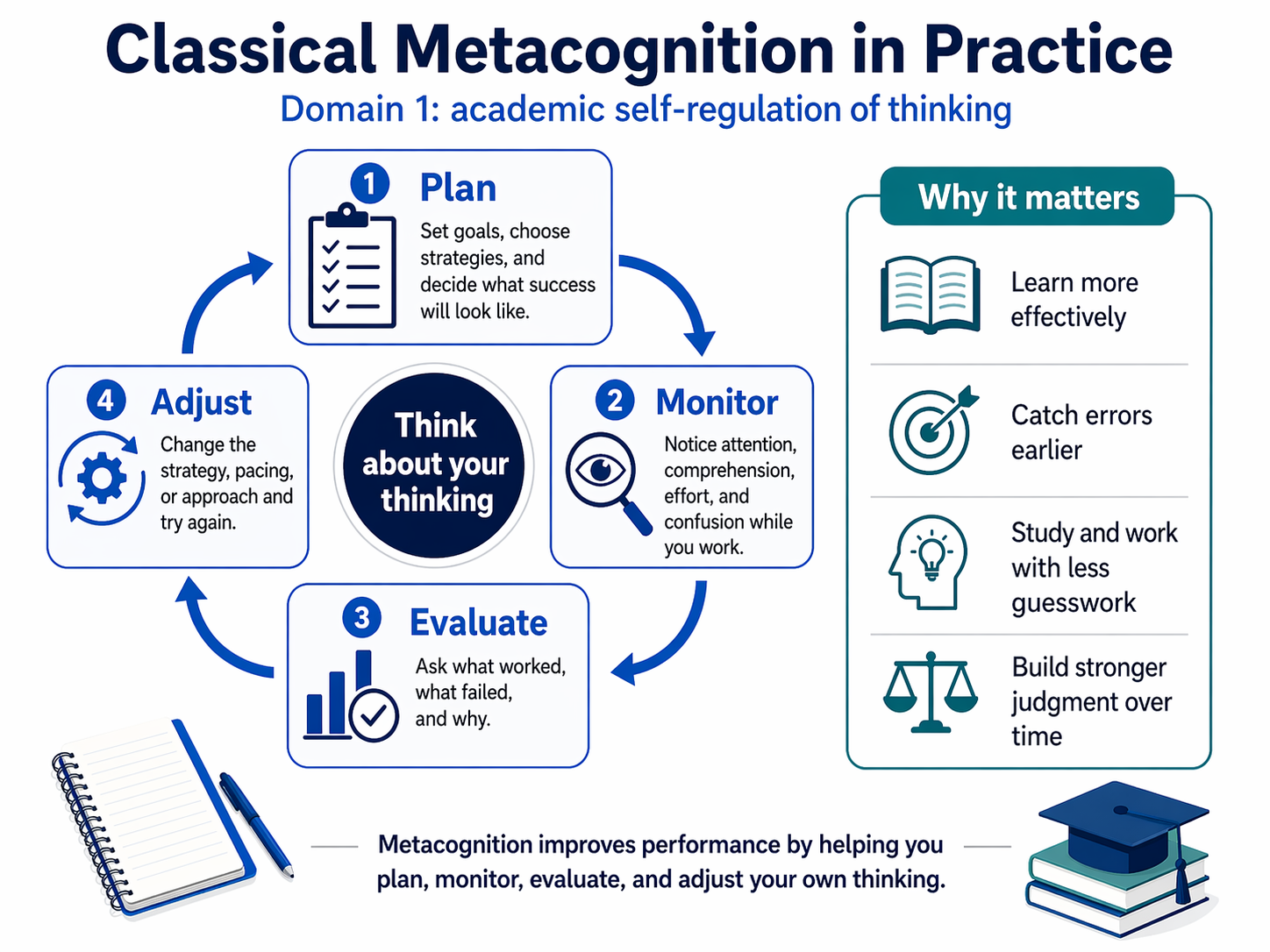
This is metacognition in the clearest and most research-grounded sense. It is the practical ability to notice and regulate your own thinking before, during, and after a task. This form of metacognition was originally taught in academia to help students get better learning outcomes.
Plain-language definition
Self-regulation of thinking means asking questions like these:
- What am I trying to do?
- What strategy am I using?
- Is it working?
- What am I missing?
- What should I change next time?
What this domain can produce
- fewer careless mistakes,
- better studying and writing,
- better awareness of confusion before it hardens into false confidence,
- stronger emotional pause before reacting,
- better judgment under pressure,
- more reliable learning from experience.
The four classic moves
- Plan. What is the real task? What does success look like? What is the likely trap?
- Monitor. Am I understanding? Am I drifting? Is emotion distorting my judgment?
- Evaluate. What worked? What failed? What surprised me?
- Adjust. What one specific change will I make next time?
Simple practices
- The 60-second preview: before a task, write the goal, likely trap, and best strategy.
- The stoplight check: green = clear, yellow = uncertain, red = lost or emotionally flooded.
- Teach-back: explain what you learned in plain language.
- Error log: track repeated mistakes instead of pretending every mistake is a charming little one-off.
- Prediction vs. outcome: write what you think will happen, then compare it to what actually happened.
- Pause-question: when triggered, ask: What story am I telling? What evidence supports it? What else may be true?
Mini story: Before a difficult meeting, a manager writes, “My goal is understanding, not victory. My trap is interrupting when I feel criticized.” During the meeting, he notices his chest tighten and labels himself yellow. He pauses, asks one clarifying question, and avoids his usual defensive spiral. That is Domain 1. It is not glamorous. It is effective.
When Domain 1 goes wrong: a student skims a chapter, feels familiar words, mistakes that familiarity for understanding, and walks into the test with cheerful confidence and a statistical disaster waiting for him. When Domain 1 goes right: the same student pauses, does a teach-back in plain language, discovers the holes, and fixes them before the exam. The benefit is not just a better grade. It is a better habit of engaging with reality.
Please be aware of that self-regulation in learning is not going inside and truly being aware and watching your own thoughts. Tools to help you develop this important skill set will be provided in the next several domains.
Transition to Domain 2
Domain 1 helps you notice that your thinking is off. But it does not always show you why the same distortions keep showing up. Often, the deeper issue is not just a bad strategy. It is a hidden identity, fear, loyalty, worldview, or approval dependence you are still living with. That is where Kegan becomes useful.
Domain 2: subject-object growth and meaning-making
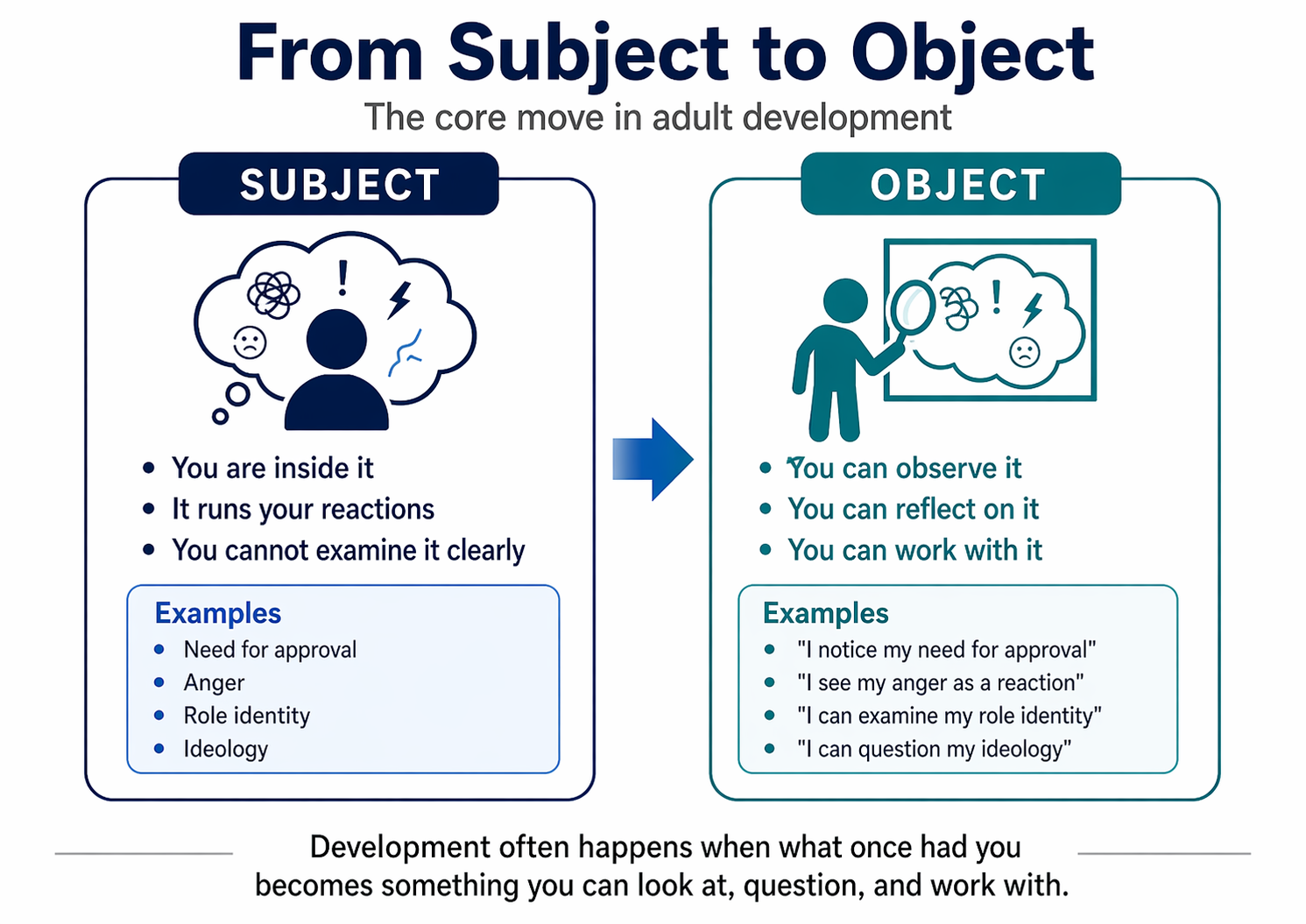
Kegan’s central idea is elegant and powerful: development happens when what you were once subject to becomes something you can hold as an object. If you are subject to a belief, identity, role, or emotional script, you are inside it. It is using you. When it becomes an object, you can examine it, question it, and work with it.
Why subject-object capacity matters for metacognition
Thinking about your thinking is already a small subject-object move. But the deeper value of this domain is that it helps you see the hidden self-system behind the thinking. Why do some people crave certainty at all costs? Why do others collapse under disapproval? Why does smart analysis mysteriously disappear when ego, tribe, or fear get involved? Because intelligence and maturity are not the same thing.
Kegan’s social-emotional developmental scale in simple language
The following summary focuses on the later stages most relevant to adult life:
- Socialized mind: the self is strongly shaped by important others, belonging, external expectations, and group values. People here may be intelligent and responsible, but they are often still fused with approval, role expectations, and inherited standards.
- Self-authoring mind: the person develops a more internally generated system of values, standards, and purpose. External pressures can be evaluated rather than simply absorbed.
- Self-transforming mind: even one’s own internal system can be examined. The person can hold multiple systems in view, see the limits of their own framework, and work more fruitfully with contradiction and plural perspectives.
These are not intelligence rankings. They are meaning-making structures. A person can be socially skilled and still be fused. A person can be analytically brilliant and still be psychologically captured by approval, ideology, or fear. That is why this domain matters.
A key theoretical caution
Subject-object transformation is not something you can train directly in a linear, mechanical way, like increasing your squat max or learning keyboard shortcuts. Development is uneven, domain-specific, and often triggered by real-life contradictions, feedback, suffering, responsibility, failure, and relationship strain. Practices can support awareness and create conditions in which development may occur, but they do not force structural growth on schedule.
Practices that support Domain 2
- Subject-object journaling: What am I unable to step back from right now?
- Trigger work: What identity or fear gets threatened when I react strongly?
- Approval scan: Whose approval is quietly steering this decision?
- Competing commitments: What hidden commitment may be undermining the change I say I want?
- Worldview reflection: What does my current framework help me see, and what does it hide?
Mini story: A nonprofit leader says she wants honest feedback. But every time staff question her, she experiences it as betrayal. Domain 1 helps her notice the stress response. Domain 2 reveals the deeper issue: she is still subject to the equation “disagreement means rejection.” Once that becomes object, she can begin working with it instead of obeying it.
Another everyday example: a young adult says, “I want to choose my career freely,” but every serious choice still gets quietly filtered through the question, “Will my family approve?” Nothing is wrong with valuing family. The issue is hidden captivity. Once the approval system becomes visible, the person can honor the family relationship without letting it completely author the life. That is one of the real life benefits of Domain 2: more freedom, better boundaries, and fewer invisible strings attached to your decisions.
Transition to Domain 3
Greater subject-object capacity does not automatically make your thinking more complex. You can step back from your reactions and still analyze the world in flat, static categories. Domain 2 makes you less fused with your lens. Domain 3 helps you build a better lens.
Domain 3: dialectical and DMAP metasystemic cognition
This is where Otto Laske’s work becomes crucial, with Michael Basseches as a key predecessor and Elliott Jaques as an important influence on work complexity and capability. Domain 3 is not simply “more metacognition.” It is a shift in how reality itself is cognitively construed. The world is no longer treated mainly as a pile of static things. It is seen more as a field of moving processes, nested contexts, constitutive relationships, tensions, contradictions, and transformations.
Laske makes a distinction that is extremely useful here: meaning-making is Kegan’s territory, while sense-making is the cognitive territory of dialectical thought. They are related, but not identical. That distinction helps prevent the common mistake of flattening all adult development into one blurred category.
Why this domain matters in ordinary life and career life: the 28 perspectives help you frame problems better, ask better questions, reduce one-sided analysis, and make wiser decisions in situations that are messy, political, emotional, systemic, or fast-changing. Students use this to deepen essays and research. Managers use it to diagnose recurring problems. Analysts use it to widen models. Citizens use it to stop getting fooled by simplistic narratives. In short, Domain 3 helps you move from “What is the answer?” toward “What reality am I still failing to see?”
What is DMAP, where did it come from, and what does it not guarantee?
DMAP stands for Dialectical Metasystemic Analysis and Problem-Solving. The methodology is derived from Professor Otto Laske’s Dialectical Thought Forms system, often shortened to DTF. In practical terms, DMAP is the application layer of Laske’s breakthrough: a disciplined way of using 28 dialectical thought forms to analyze situations, decisions, conditions, and changing systems more completely.
There are 28 unique dialectical thought forms and perspectives employed in DMAP analysis and problem-solving. Used in a disciplined way, the DMAP process enables a person to view a single moment in time, a series of moments, a situation, a continually changing condition, a problem, or one or more interacting and interdependent complex adaptive systems from 28 distinct dialectical perspectives. This is one of the great practical powers of DMAP: it trains a person to see a single moment, or a process in continuous change, from 28 different perspectives. That is a significant new way of visualizing reality in dialectical motion.
Without DMAP, most people examine a situation from only a handful of angles, often two to five at most. DMAP requires a much broader sweep. It pushes the analyst to revisit the same situation through 28 distinct but related perspectives, which often reveals overlooked conditions, hidden relationships, missing context, developmental pressures, and solution possibilities that were not visible earlier.
In plain language, DMAP provides a much more detail map and many more relevant perspectives on a situation. And in serious analysis, a better map and more relevant detail usually improves the odds of producing a better diagnosis, a better forecast, a better decision, or a better solution.
In a high-level DMAP, you are creating mental models, maps, and "simulations" to observe processes and outcomes. DMAP processes help you see and distinguish that your beliefs are maps, but reality is the territory.
A useful analogy is screen resolution. Think of traditional logic as offering one level of clarity, scientific methodology and falsification as offering a higher level, and systems thinking as offering still more depth. In that same analogy, DMAP functions like a dramatic increase in resolution, adding far more relevant detail, movement, context, and relational structure to what is being examined.
DMAP is designed especially for analyzing and managing complex adaptive systems, whether those systems are individual or multiple, interacting, interdependent, and constantly changing. That is why it is particularly relevant to areas such as climate change, politics, war, the economy, society, ecological breakdown, and other high-complexity research fields. It is also highly useful in serious science and policy work whenever many moving variables must be considered together.
DMAP does not discard earlier methods. It advances, transcends, and still incorporates the best of earlier thinking methodologies, including systems thinking, data and statistical analysis, logic, bias checking, and the principles of scientific methodology and falsification. That is one reason it can be so powerful in high-level analysis: it does not ask you to abandon the earlier tools, but to use them inside a more comprehensive dialectical frame.
The word dialectical here does not mean ordinary back-and-forth dialogue, and it goes far beyond the simplified textbook formula of thesis, antithesis, and synthesis. In Laske’s work, dialectical thinking is a disciplined way of tracking process, context, relationship, contradiction, and transformation. Laske built on and extended important lines of work associated with figures such as Theodor W. Adorno, Elliott Jaques, Michael Basseches, and Roy Bhaskar, among others. In that expanded sense, dialectical thinking now includes the 28 thought forms that help a person examine reality as moving, layered, relational, and developmental rather than static and isolated.
DMAP also sits inside a broader developmental project. Laske’s DTF work has at least two other major application areas beyond this analytic method: adult education and developmental growth, especially in relation to cognitive and social-emotional development, and executive, management, consulting, and coaching practice. That broader context matters because DMAP is not just a technique for producing smarter reports. It is part of a larger shift in how adults can learn to perceive, interpret, and act within complexity.
At the same time, an important criticism of the earlier version of this article was correct and must remain clear: using DMAP as a method is not the same thing as already possessing dialectical capability. Someone can follow the steps of DMAP procedurally without yet thinking dialectically in a deep, fluid, or developmentally mature way. DMAP is a methodological scaffold. Dialectical capability is a developmental accomplishment.
So the balanced conclusion is this: DMAP can support the development of dialectical thinking, but following DMAP does not by itself guarantee dialectical cognition. That is also why it helps to keep a real problem in mind while learning it. When the 28 perspectives are applied to a living problem you actually care about, the method becomes more concrete, more rigorous, and more transformative.
A practical readiness caution
Universe Institute repeatedly describes DMAP as a very demanding methodology and uses a practical rule of thumb that people under about 27 are usually not ready to do it well at a high level. Mainstream neuroscience would state that more cautiously: executive functions and prefrontal development continue maturing into the mid-to-late 20s. So the best balanced advice is this: younger adults can begin learning the basics, but very advanced dialectical and metasystemic work is usually better approached after substantial cognitive, emotional, and experiential maturation.
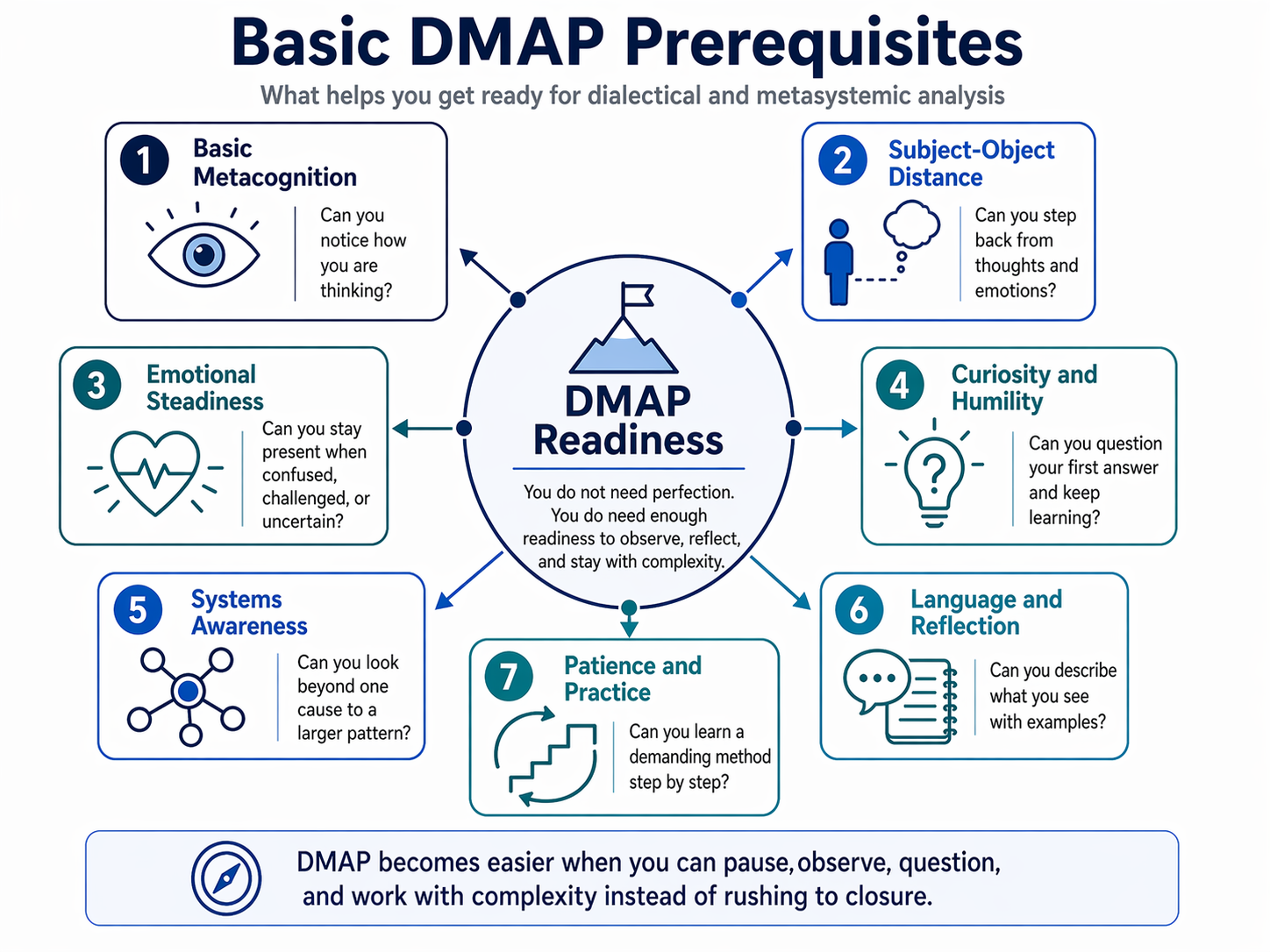
DMAP prerequisites and readiness
This section is best read as a readiness guide, not as a gatekeeping ritual. DMAP is demanding, but it is learnable. Not every practitioner agrees on every prerequisite, and not every DMAP task requires elite think tank-level capability. Still, if you want to use DMAP for high-stakes work across multiple interacting complex adaptive systems, the capacities below make the climb much easier.
The hopeful part is simple: you do not need to have everything on day one. If you have at least average intelligence, patience, and the willingness to build skills step by step, you can make real progress. The mistake is not starting without perfection. The mistake is pretending this is easy when it clearly is not.
Minimal suggested prerequisites
- A practical age floor of about 24-27 for very advanced work. Universe Institute uses this as a rule of thumb because advanced DMAP requires heavy cognitive bandwidth, emotional regulation, and long-range judgment. Younger adults can absolutely begin learning the basics, but the highest levels of multi-system dialectical work are usually easier after more development, more life experience, and a more mature nervous system.
- At least above-average intelligence and strong persistence. DMAP is complex and effortful. It asks you to hold many variables in mind, question your assumptions, and keep refining your view long after simpler minds would have declared victory and gone for coffee.
- The ability to step back from your own thoughts, feelings, ideas, and biases. If you cannot separate from them, you cannot examine them clearly. Meditation, reflective journaling, honest dialogue, and Stewart’s subject-object exercises all help here.
- Strong motivation. DMAP becomes much easier to sustain when it is tied to a real benefit: a life problem, a research problem, a policy problem, a strategic challenge, or a serious desire for wiser self-regulation.
If you are serious about this path, John Stewart’s Human Superintelligence is worth reading alongside Laske’s core books because Stewart makes the subject-object challenge, recursive practice loop, and learning struggle much more visible than most theorists do.
Additional foundational skills that make deep DMAP easier
For smaller personal or business problems, you do not need every skill below at full strength. For high-stakes work involving multiple interdependent systems, these foundations matter a great deal:
- Rational and analytical thinking. You still need to reason carefully, compare claims, and follow an argument.
- Classical logic. DMAP does not replace logic. It goes beyond logic while still relying on it.
- Scientific methodology and falsification. Claims must still meet evidence, survive testing, and remain open to revision.
- Statistical and big-data literacy. You need enough numerical judgment to avoid being hypnotized by charts, datasets, or fake precision.
- Bias checking. You must know how to look for motivated reasoning, omission, conflict of interest, and selective attention in both yourself and your sources.
- Systems thinking and complex adaptive systems knowledge. DMAP works especially well when many systems are interacting. If you do not understand systems, feedback loops, adaptation, and emergence, you will miss too much.
There is a paradox here. These earlier skills remain necessary, but at certain points in mature DMAP practice they must be held more lightly so a fuller dialectical pattern can emerge. That is not a rejection of logic, science, or systems thinking. It is their integration into a broader mode of seeing.
Why social-emotional development matters so much for DMAP success
Universe Institute has long argued that high-level DMAP usually becomes much easier once a person reaches at least the fourth of Kegan’s six major social-emotional balances. The point is not snobbery. The point is that advanced dialectical work is much easier when a person is less fused with approval, identity, role, ideology, or emotional reactivity.
Kegan’s framework can be summarized in six broad balances:
- Incorporative balance. Very early life. The person is embedded in immediate sensation and experience. There is not yet much stable self to step back with.
- Impulsive balance. The person is more separate, but still largely organized by impulses, perceptions, and immediate needs.
- Imperial balance. The person can pursue goals and hold a more stable sense of self, but still tends to organize life around personal needs, interests, and advantage.
- Interpersonal balance. Identity becomes strongly organized by mutuality, loyalty, belonging, and the expectations of important others. This often produces more empathy, but also more susceptibility to approval and group pressure.
- Institutional balance. The person develops a stronger internal system of values, standards, and self-authorship. This is the level at which many people become far more capable of principled judgment and sustained responsibility.
- Interindividual balance. The person can examine even their own internal system, hold multiple systems in view, and relate more flexibly to contradiction, complexity, and transformation.
For DMAP purposes, the key transition is usually from the interpersonal to the institutional balance. That is the shift from being run mostly by external expectations to being guided more by an internally authored framework. Higher still, the interindividual balance helps a person work with multiple systems and perspectives without collapsing into confusion or rigid certainty.
You do not “train” stage growth directly the way you train deadlifts. Development usually grows through challenge, contradiction, responsibility, reflection, emotional honesty, and repeated encounters with the limits of your current way of making meaning. Practices can support this growth, but they do not mechanically force it.
Laske’s Measuring Hidden Dimensions, especially volume 1, is valuable here because it refines and extends this territory in ways directly relevant to adult development and professional capability.
The subject-object skill: one of the most important subskills in DMAP
A central subskill in DMAP is the ability to turn what you are subject to into something you can hold as object. When you are subject to a thought, bias, fear, role, or loyalty, you are inside it. It is running you. When it becomes object, you can observe it, question it, regulate it, and work with it.
This matters enormously in DMAP because many gifted but highly left-brain-dominant individuals can be brilliant and still remain deeply fused with their own assumptions, preferences, and internal narratives. That fusion becomes a hidden source of distortion in advanced analysis. It is especially dangerous because the person often feels certain precisely when they are most embedded.
The good news is that subject-object skill can be supported by practice. Helpful methods include reflective journaling, noticing emotional triggers, asking “What am I unable to step back from right now?”, meditative observation of thought and feeling, perspective-taking dialogue, and Stewart’s exercises in viewing thoughts and emotions as events rather than identities. Over time, what once felt like “me” can become something I can examine.
Realistic notes on intelligence, difficulty, and DMAP teaching
- Higher IQ helps. It is not the whole story, but very high-complexity work is usually easier for people with stronger raw cognitive horsepower.
- Lower right-brain social-emotional development can become a bottleneck. Many highly analytical people are strong in technical reasoning but weak in subject-object capacity, emotional flexibility, and relational perspective-taking.
- No one should teach DMAP without demonstrated proficiency. DMAP is not a linear checklist. It is a disciplined way of engaging both analytic and non-linear capacities in a demanding whole.
Tips for reading Laske’s source training materials
This guide cannot possibly handle all the richness of Otto Laske's dialectical work on the 28th perspectives. Because of this, we strongly recommend that you get his books and read them as well.
You will need to pay careful attention when reading is work, because Laske’s books are concept-dense and slow to read for most people. He often moves through numerous interrelated conceptual spaces in a single paragraph and occasionally draws on language from multiple traditions to capture important nuances.
Read slowly. Keep notes. Re-read definitions. Do not rush to perform mastery after one pass. This material rewards patience and punishes bluffing.
Why do creative attunement before DMAP analysis: Jan De Visch’s pre-DMAP warm-up
Before you charge into a hard problem with note-taking fury, spreadsheets, and a heroic amount of left-brain confidence, it helps to do something softer first. Slow down. Settle. Notice what is already trying to emerge before you start dissecting it. That gentler entry point is where Jan De Visch’s work is especially useful.
De Visch is a Belgian developmental practitioner and organizational psychologist who works in the wider CDF/DTF ecosystem. He is Managing Director of Connect & Transform, Executive Professor at Flanders Business School (KU Leuven), and co-author with Otto Laske of Practices of Dynamic Collaboration. In later work, including opening the box and The Developmental Practitioner, he keeps pushing on the question of how people actually learn to sense complexity before they can cleanly explain it.
His core contribution here is not a replacement for Laske’s DTF. It is better understood as a pre-dialectical companion layer. Laske helps you hear and structure the architecture of thought once meaning is articulated. De Visch helps you notice the earlier phase when meaning is still arriving as image, felt sense, gesture, rhythm, symbol, silence, or a not-yet-sayable hunch. In one sentence: Laske gives you the disciplined grammar of deep thinking; De Visch gives you a more human doorway into where that thinking often begins.
This matters because many learners hit DMAP like it is a brick wall of brilliant concepts. They read about dialectical thinking, freeze slightly, and assume they are underqualified for civilized life. De Visch offers a kinder entrance ramp. He says, in effect, start by noticing what your mind and body are already showing you before you try to produce a polished analysis.
What De Visch is adding in plain language
De Visch proposes a set of Creative Thought Forms (CTFs). Do not let the label intimidate you. The basic idea is simple: important meaning often begins before full conceptual clarity. It first shows up as a symbolic image, a bodily pressure, a shift in tempo, a repeated metaphor, a silence that suddenly matters, or a feeling that something is “not right” even before you can explain why.
He organizes these early signals into four broad families:
- Generative imagery: meaning arrives first as an image or symbolic scene, such as a doorway, a descent, a center, a wall, a storm, a bridge, or a threshold.
- Associative movement: meaning starts moving through metaphor, gesture, contrast, rhythm, repetition, or an odd connection that keeps returning.
- Transformative reframing: meaning shifts when something reverses, sheds an old identity, dissolves, recenters, or starts to feel like it is becoming something else.
- Embodied attunement: meaning shows up in the body first, as heaviness, constriction, openness, stillness, tension, a breath shift, a felt pull, or a quiet sense of alignment.
None of this means you should treat every random image as a sacred oracle. Humans are fully capable of over-reading symbolism with the confidence of a caffeinated mystic. The point is not magical thinking. The point is to notice early developmental and analytic signals that may help you enter a problem more openly and more intelligently.
Why this is a good pre-DMAP exercise
As a front-end to DMAP, De Visch’s approach is useful because it helps learners begin with phenomena they can usually notice more easily than abstract dialectical structure:
- an image,
- a felt sense,
- a repeated metaphor,
- a shift in tone or rhythm,
- a tension that is present but not yet clear,
- or a piece of meaning that is still half-formed.
That makes this section a pre-analysis stimulation and preparation practice. It is not the full analysis. It does not replace evidence gathering, systems thinking, logic, scientific method, or later DTF-based work. What it does is help you arrive at the material with more openness, more sensitivity, and less premature closure. In plain English: it helps you stop rushing to flatten a living problem into the first tidy explanation your mind finds comforting.
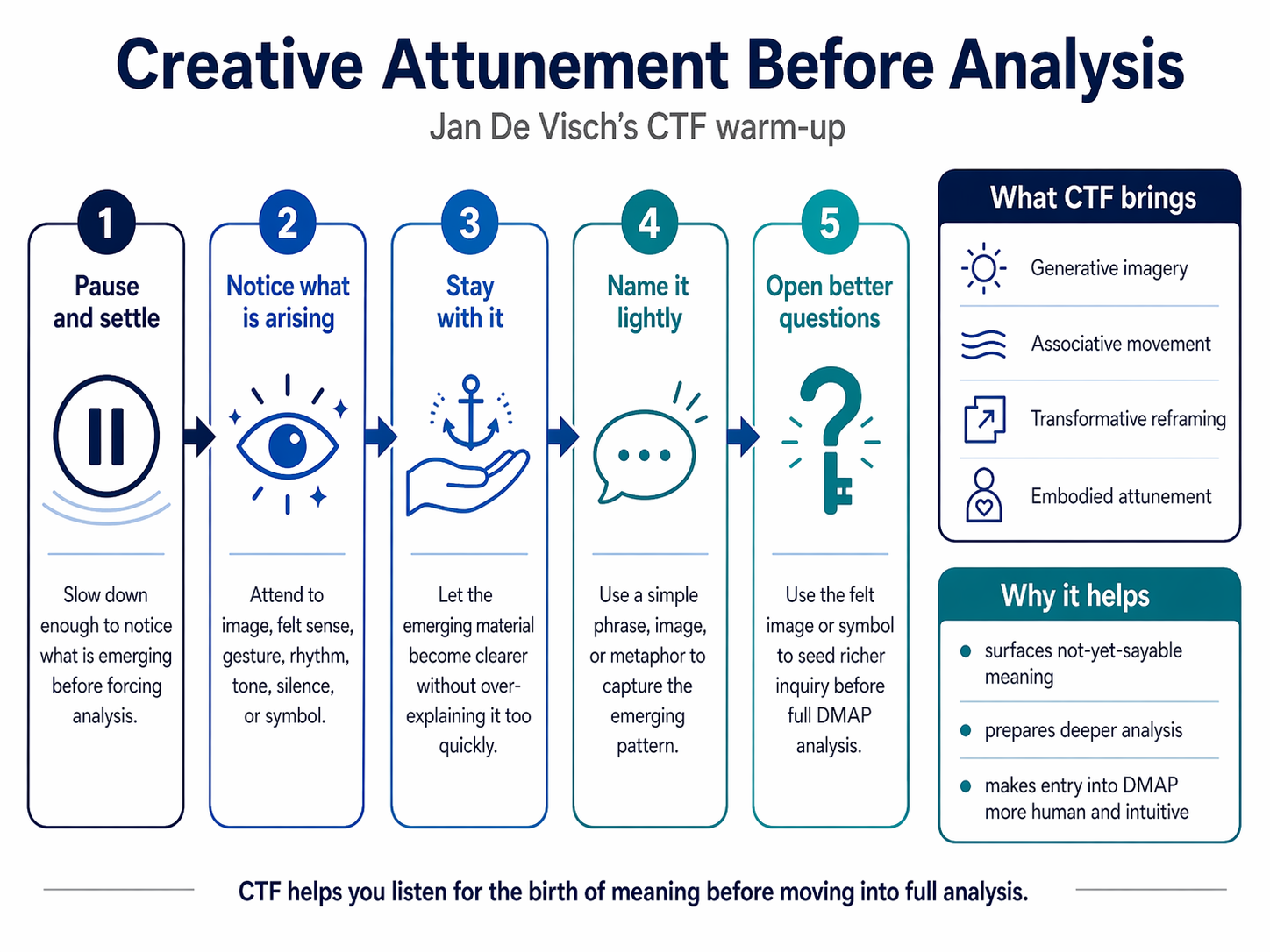
A simple pre-DMAP creative attunement process
You can use the following process before you begin a serious analysis session. It is especially helpful when the topic is emotionally loaded, strategically messy, or not yet conceptually clear.
- Sense. Sit quietly for a few minutes and bring the topic to mind without trying to solve it yet. Notice the first image, mood, bodily sensation, recurring phrase, or symbolic impression that appears. Ask: What is showing up before I start explaining?
- Stabilize. Stay with the image or felt sense a little longer than is comfortable. Do not immediately translate it into a neat conclusion. Ask: What happens if I let this stay unclear for another minute?
- Classify lightly. Without getting technical, ask what kind of early signal this seems to be. Is it mainly an image, a bodily sense, a shift in rhythm, a repeating metaphor, or a feeling of reversal or transition? Keep this light. You are sorting, not forcing.
- Seed a few starter questions. Turn the signal into a few exploratory prompts. If the image is a doorway, ask what is opening or closing. If the body feels tight, ask what pressure or contradiction may be present. If a metaphor keeps returning, ask what it might be highlighting that direct language is missing.
- Reality-check and park it. Write down two or three notes, then move on to the actual research and analysis. Keep the early cues as hypotheses, not verdicts. They are there to open inquiry, not to win it.
This sequence works well because it preserves creative emergence without letting it drift into interpretive theater. That last part matters. Otherwise, the pre-analysis warm-up turns into an interpretive talent show, and nobody needs that.
Helpful prompts for this warm-up
- What image appears first when I hold this problem in mind?
- What feels heavy, blocked, unfinished, or quietly alive?
- What metaphor keeps trying to describe the situation?
- Where do I feel pressure, contraction, openness, or hesitation in my body?
- What seems to be ending, shedding, reversing, or waiting to emerge?
- What feels important but still not fully sayable?
For beginners, these prompts can make the entry into complex analysis feel much more human. You are not starting with a demand to sound brilliant. You are starting with a demand to notice honestly.
How this pairs with Laske’s DTF without replacing it
The cleanest way to understand the relationship is this: De Visch helps you listen for the birth of meaning; Laske helps you analyze the structure of meaning once it can be more clearly thought and said. De Visch is earlier and softer. Laske is later and more structurally disciplined. One warms up perception. The other sharpens cognition.
That pairing can be very useful in practice. First you notice what is emerging. Then you examine it more rigorously through logic, systems thinking, dialectical questioning, and Red Team review. The sequence is not strictly one-way, of course. Sometimes analysis evokes a new image. Sometimes a felt sense reveals a missing contradiction. Sometimes thinking reorganizes feeling. The two layers can become recursively helpful to one another.
Important cautions so this stays useful
- Do not over-interpret. Not every metaphor is profound. Sometimes “I feel stuck” means exactly that and nothing more exotic.
- Do not substitute this for evidence. This warm-up opens inquiry. It does not replace disciplined research, testing, or verification.
- Do not force symbols into a fixed code. Some are personal, some cultural, some situational, and some are just the first workable language the mind found.
- Do not stay vague forever. The purpose of this stage is to help inquiry begin better, not to remain forever in a poetic fog bank.
Used well, this pre-DMAP stage can make later analysis richer, calmer, and less brittle. It gives many learners a better entry ramp into difficult material because they begin with lived signals before moving into more demanding structure. That is one of the real gifts in De Visch’s contribution.
Part 1: The four major aspects of DMAP dialectical cognition
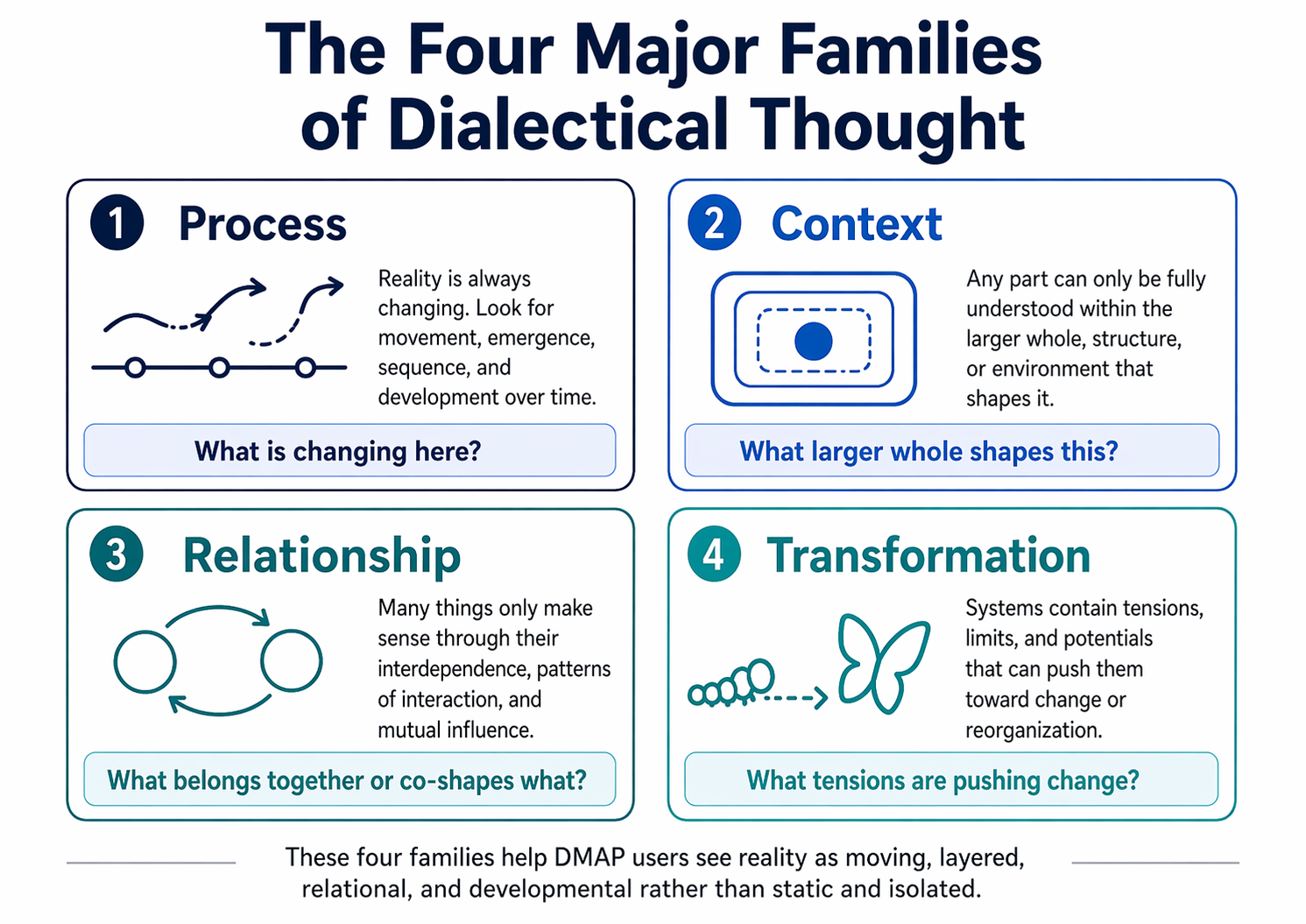
1. Process
Core question: What is changing, emerging, decaying, interacting, or being falsely frozen into a static “thing”?
Why it matters: Most failures of analysis begin by freezing a moving reality. We speak about “the economy,” “the relationship,” “the team,” or “the problem” as if these were fixed objects sitting on a shelf. Process thinking reminds you that nearly everything important is in motion. When you miss the motion, you miss the direction, and when you miss the direction, you usually miss the future.
Applied example: A school says, “Student motivation is dropping.” Process thinking asks: dropping since when, in response to what, through what sequence, and with what feedback loops? That shift often turns a vague complaint into an analyzable pattern.
2. Context
Core question: What larger whole, structure, level, frame, or environment is shaping this?
Why it matters: A lot of bad thinking happens when a person studies a part while ignoring the system it lives inside. Context thinking stops you from treating a symptom as if it were the whole disease. It helps you see the larger structures, incentives, histories, institutions, and environments that are shaping the event in front of you.
Applied example: Suppose an employee looks “unproductive.” Context thinking asks whether the real issue is the worker, the manager, the software, the workflow, the incentive system, the workload, or the culture. Suddenly, the problem gets less moralistic and more accurate.
3. Relationship
Core question: What belongs together? What co-shapes what? What false separation is distorting the picture?
Why it matters: many things only make sense in relationship. Relationship thinking helps you stop analyzing parts as if they were self-contained. It reveals mutual influence, shared ground, reciprocal shaping, and hidden dependencies.
Applied example: A family says one child is “the difficult one.” Relationship thinking asks how the whole family system helps create and stabilize that role. The analysis becomes more compassionate and more useful at the same time.
4. Transformation
Core question: What contradiction, limit, pressure, or developmental potential is pushing the system toward reorganization?
Why it matters: transformation thinking keeps you from mistaking temporary stability for permanent order. It helps you look for stress points, tensions, developmental openings, and the conditions under which a system may change form.
Applied example: A business still looks profitable on paper, but employee burnout, customer churn, and brittle supply chains are rising. Transformation thinking asks whether the current model is quietly approaching a limit and what new form may be needed.
A short memory trick helps: Process keeps you from freezing reality. Context keeps you from shrinking reality. Relationship keeps you from splitting reality. Transformation keeps you from mistaking temporary stability for permanence.
Mini story, when things go wrong: A hospital administrator says, “Nurses are underperforming.” She treats the issue as an individual motivation problem. Turnover rises, morale falls, and patient care worsens. Why? Because the real issue was not just individual effort. It was process overload, staffing ratios, bad scheduling software, cross-department friction, and transformational pressure in the whole system. The administrator had an answer before she had a map.
Mini story, when things go right: Another administrator studies the same issue through the four domains. She tracks the process over time, examines the larger staffing context, maps the relationships between units, and identifies the contradiction between “maximum efficiency” and “human sustainability.” The intervention changes. So do the results. Same problem. Much better flashlight.
Part 2: The full 28 dialectical thought forms in plain English
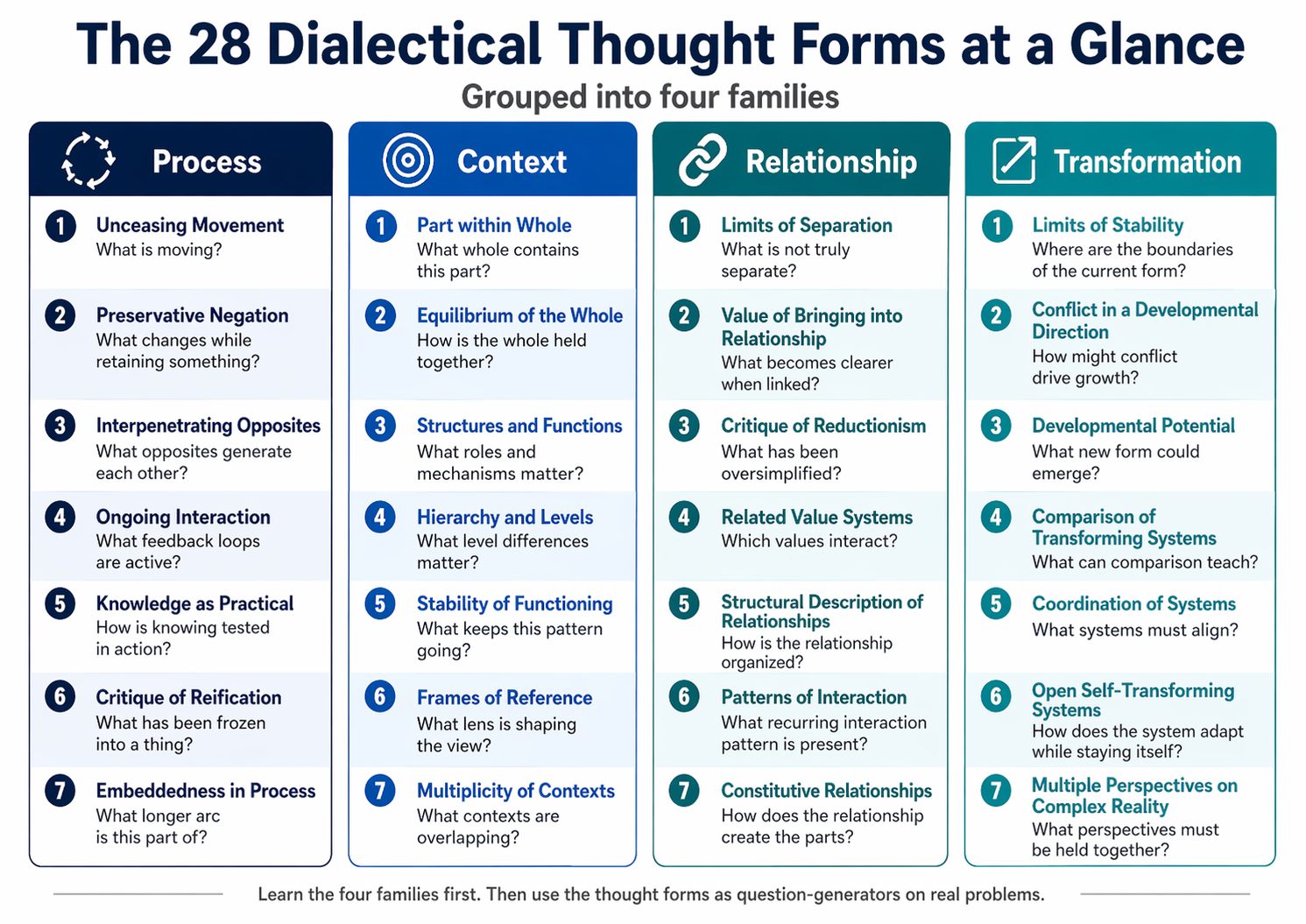
Do not panic at the number 28. The point is not to memorize them like a medieval punishment. The point is to learn the kinds of questions they open. Start with the four families. Then go deeper. Each thought form below includes a plain-language explanation, why it matters, and a simple example of how it might be used.
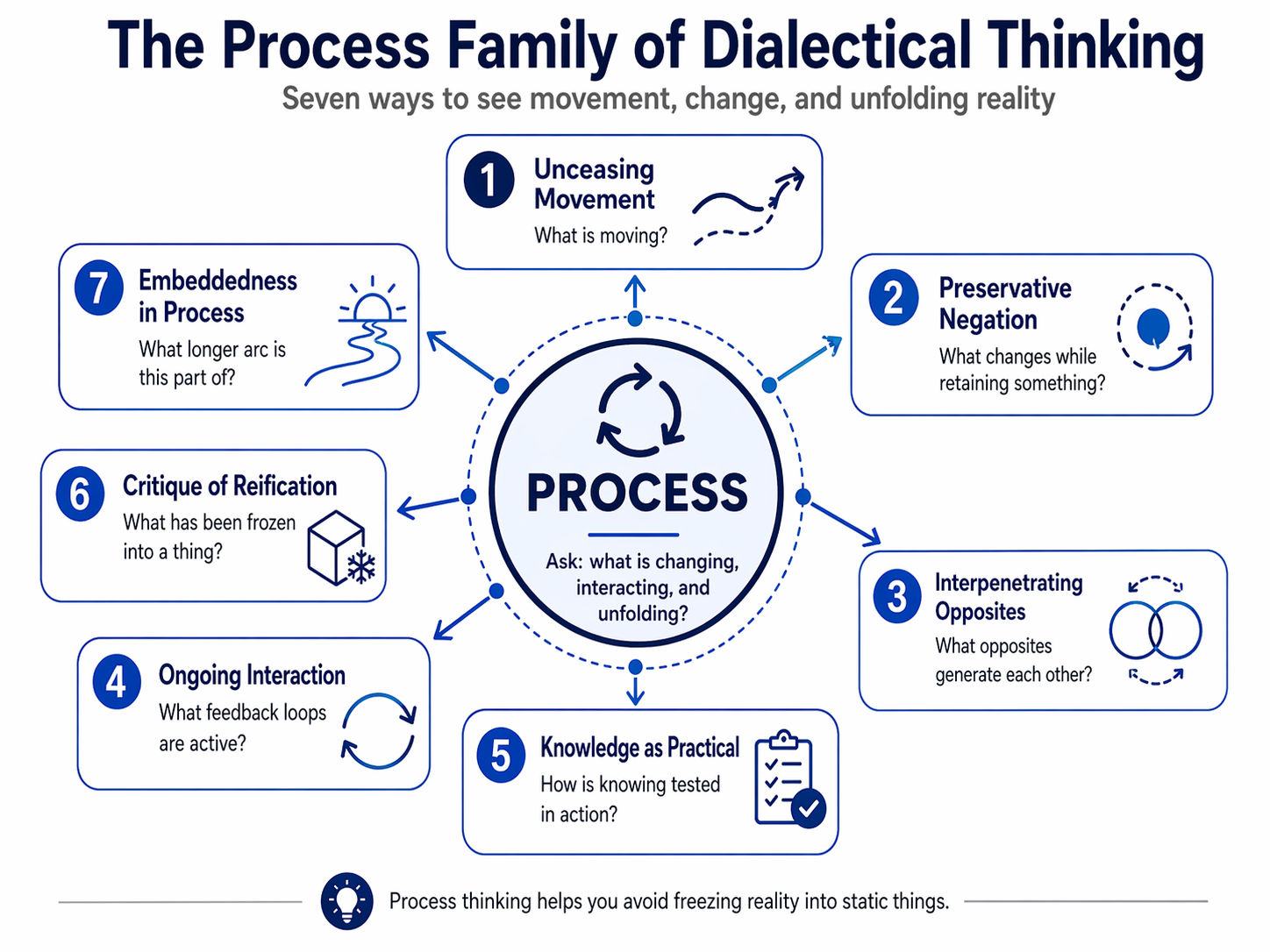
Process thought forms
Unceasing movement. What it means: nothing important is truly frozen; reality is always in some degree of motion. Why it matters: This prevents static thinking and helps you track trends, drift, and gradual change that others miss. Example: instead of saying “our friendship is bad now,” ask how it has changed month by month and what small shifts led to the present strain.
Preservative negation. What it means: when something changes, parts of the old form are canceled, parts are kept, and parts are transformed into something new. Why it matters: it helps you see development as a layered process rather than a total wipeout. Example: when a founder leaves a company, the improvisational chaos may fade, but the appetite for experimentation may survive in a more disciplined form.
Interpenetrating opposites. What it means: opposing forces often generate one another and jointly shape reality. Why it matters: This helps you think beyond fake either-or frames. Example: a teenager’s push for independence and a parent’s wish for safety may clash, yet both together are shaping the family’s next stage.
Ongoing interaction. What it means: events unfold through back-and-forth influence rather than one-way causation. Why it matters: it trains you to look for loops, not just arrows. Example: low trust reduces communication, weak communication lowers trust further, and the loop keeps feeding itself.
Knowledge as active and practical. What it means: real knowing is not just stored information; it is tested, revised, and embodied in action. Why it matters: it keeps you from mistaking verbal fluency for mastery. Example: a person can explain healthy habits beautifully yet still learn more from actually changing sleep, food, and exercise patterns for thirty days.
Critique of reification. What it means: do not mistake a moving process for a fixed thing. Why it matters: many labels harden reality too early and hide the causes underneath. Example: calling someone “a bad communicator” may hide the evolving process of stress, timing, role confusion, and past conflict that produces the communication failure.
Embeddedness in process. What it means: any moment is part of a longer arc with a past, a present, and a likely future. Why it matters: it helps you place snapshots inside timelines. Example: a single angry outburst looks different when seen as part of a six-month buildup of overwork, grief, and miscommunication.
Process vignette: A teacher says, “This class is lazy.” Process thinking reveals a sequence: the assignments became less clear, confusion rose, shame rose, participation dropped, and now the class looks apathetic. Labeling the class was easy. Seeing the process was useful.
Context thought forms
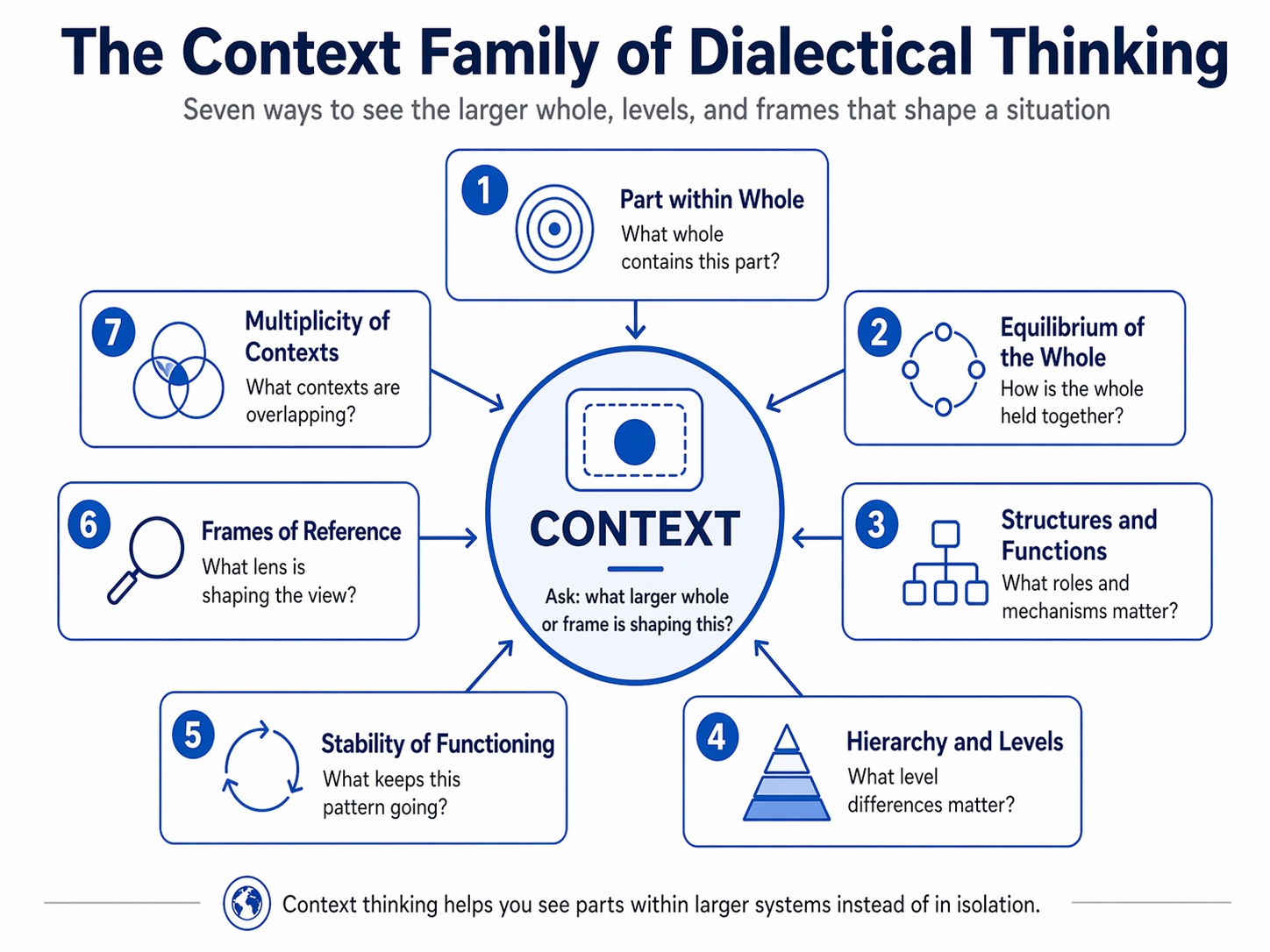
Part within whole. What it means: understand the part by locating the whole it belongs to. Why it matters: parts change meaning depending on the system they sit inside. Example: a budget cut is not just a finance issue; in a school system, it may affect morale, class size, program quality, and community trust.
Equilibrium of the whole. What it means: ask how the larger pattern is currently holding itself together. Why it matters: this reveals the forces maintaining the present state. Example: a marriage may stay “stable” not because it is healthy, but because both people avoid conflict and overfunction to preserve peace.
Structures and functions. What it means: look at the system’s roles, layers, mechanisms, and what each piece actually does. Why it matters: it helps you move from vague impressions to structural analysis. Example: in a nonprofit, the board, staff, donors, and volunteers all play different functions; confusion grows when those functions blur.
Hierarchy and levels. What it means: identify the vertical nesting or level differences that matter. Why it matters: some problems occur because people confuse levels of analysis. Example: a city traffic issue may involve the driver level, the intersection level, the neighborhood level, and the regional transit level, all at once.
Stability of functioning. What it means: examine what keeps the current arrangement going. Why it matters: if you do not know what stabilizes a pattern, your intervention may fail. Example: a workplace with chronic overtime persists because of reward systems, understaffing, and an identity story that says exhaustion equals dedication.
Frames of reference. What it means: identify the worldview, ideology, or conceptual lens shaping the analysis. Why it matters: people often disagree because they are inside different frames before the conversation even begins. Example: one person sees education mainly as job training, another as citizen formation; the policy debate changes once those frames are named.
Multiplicity of contexts. What it means: most events sit inside several contexts at once. Why it matters: this protects you from single-context blindness. Example: a teenager’s anxiety may be shaped simultaneously by family dynamics, social media, school pressure, sleep debt, biology, and broader cultural uncertainty.
Context vignette: A company blames its sales team for weak results. A more thorough contextual analysis reveals a broken pricing strategy, weak marketing support, outdated software, and a product-market mismatch. Suddenly, “sales underperformance” becomes a whole-system diagnosis rather than a scapegoating ritual.
Relationship thought forms
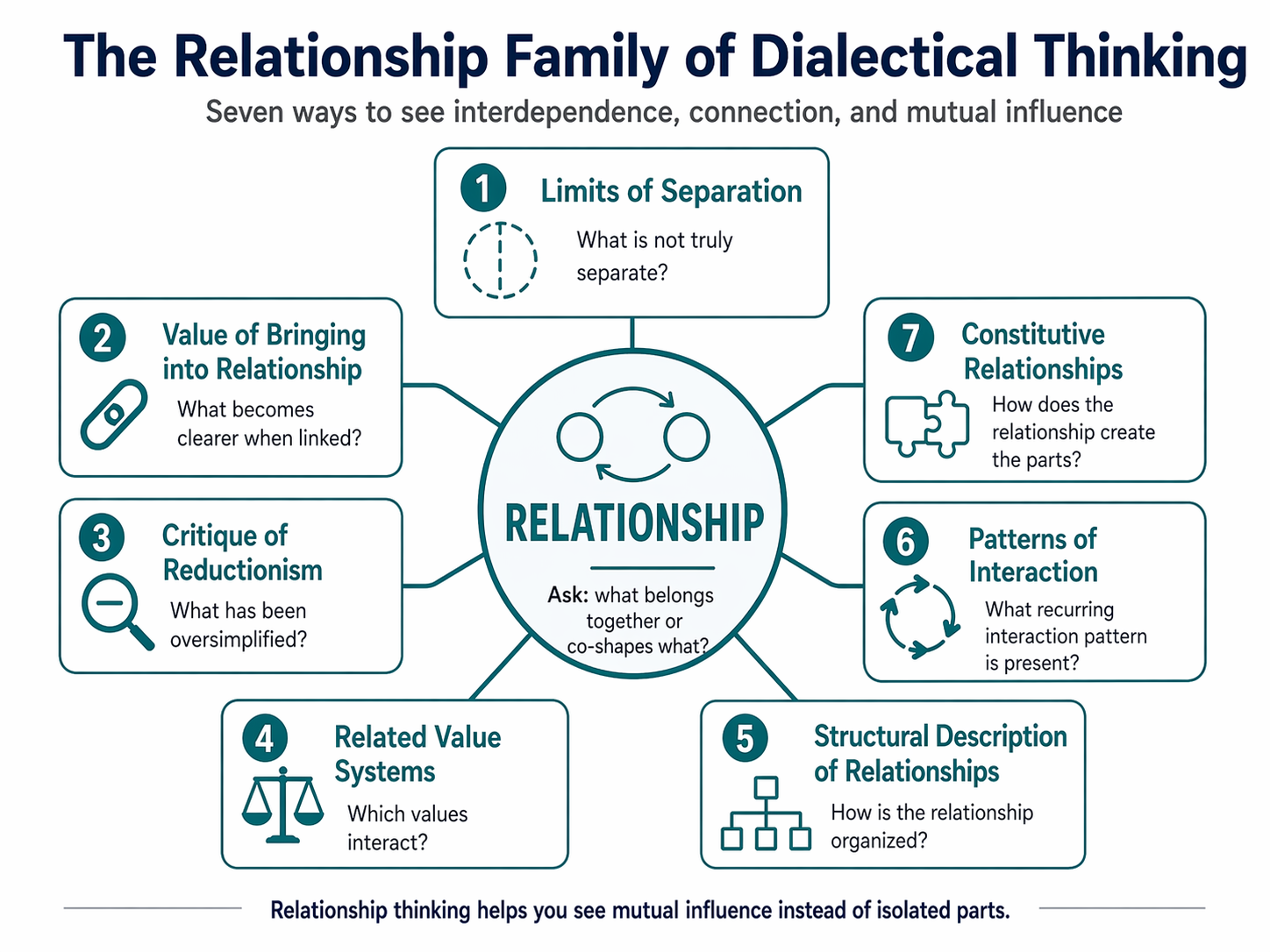
Limits of separation. What it means: some things that appear separate are not truly separable. Why it matters: it helps you detect hidden interdependence. Example: personal health and work performance are often treated separately, but sleep, stress, and cognition keep voting against that separation.
Value of bringing into relationship. What it means: understanding increases when you connect variables that are usually kept apart. Why it matters: many insights only appear through comparison or connection. Example: bringing customer complaints into relationship with employee burnout may reveal that both stem from the same workflow bottleneck.
Critique of reductionism. What it means: challenge explanations that erase shared ground, complexity, or mutual influence. Why it matters: reductionism often produces fake clarity. Example: saying a protest is “just about economics” may ignore identity, history, geography, governance, and cultural meaning.
Related value systems. What it means: values that look opposed often interact and partially depend on one another. Why it matters: this helps you think in both-and terms where appropriate. Example: freedom and responsibility are often presented as enemies, but stable freedom usually depends on some form of responsibility.
Structural description of relationships. What it means: describe how a relationship is organized, not just that it exists. Why it matters: form matters. Power, timing, dependency, and boundaries all shape outcomes. Example: two departments may “work together,” but the real structure may be one-sided dependency with poor feedback pathways.
Patterns of interaction. What it means: identify recurring mutual influences over time. Why it matters: patterns often matter more than isolated events. Example: one partner criticizes, the other withdraws, the first criticizes harder, and the loop becomes the real problem.
Constitutive relationships. What it means: sometimes the relationship itself helps create what the parts are. Why it matters: this is one of the more powerful and often overlooked thought forms. Example: a parent and teenager are not just two separate units colliding; the relationship helps shape the identities and behavior of both.
Relationship vignette: Two departments keep fighting. HR says it is a culture problem. Finance says it is a budgeting problem. Operations says it is a workflow problem. Relationship thinking says: probably all three, plus a recurring interaction loop and a structurally bad handoff process. Reality has once again refused to be one cause wide.
The Transformation thought forms
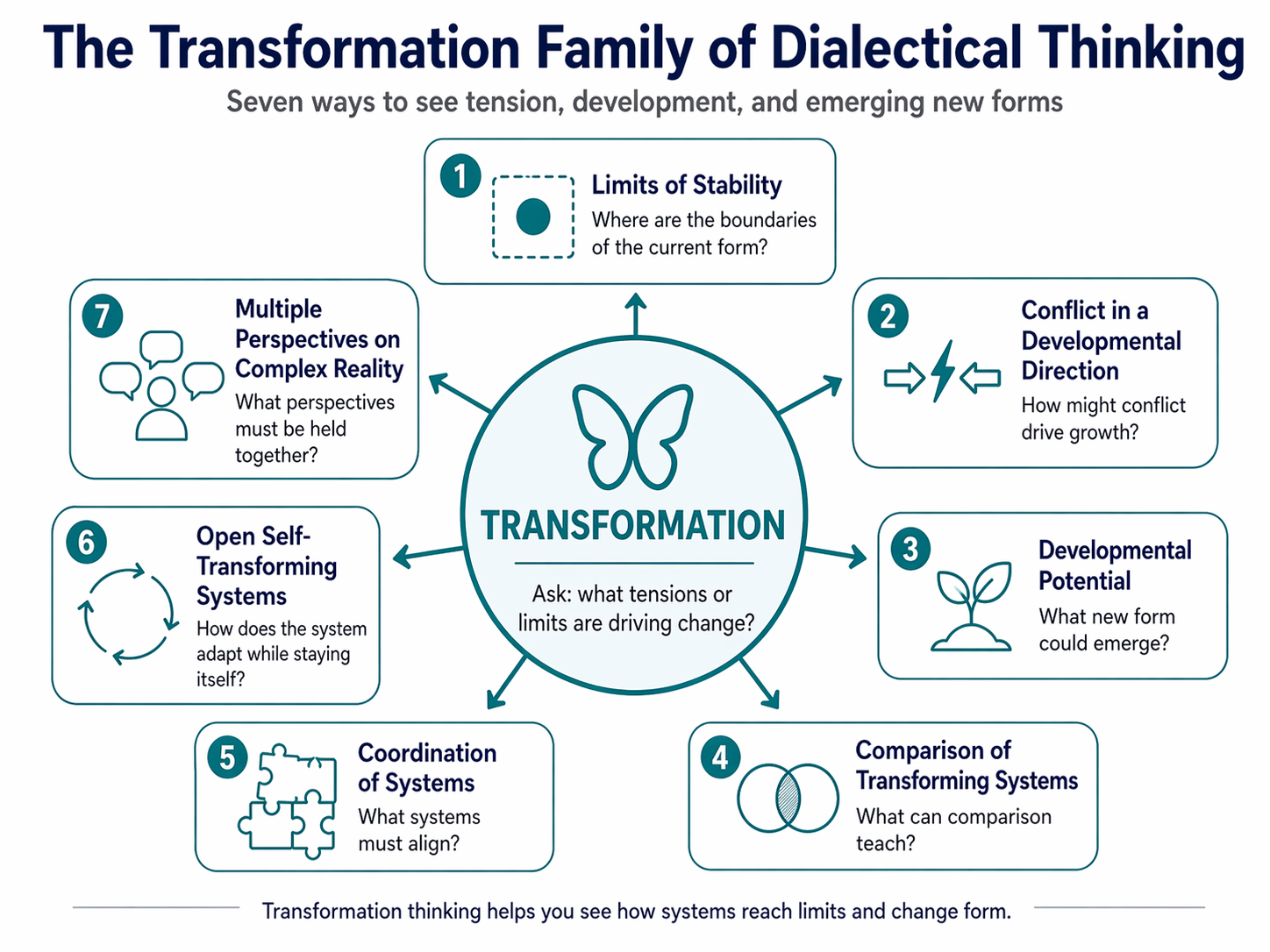
Limits of stability. What it means: every arrangement has boundaries beyond which it becomes unstable. Why it matters: it helps you detect when “business as usual” is quietly running out of road. Example: a company can keep cutting staff for efficiency only until service quality collapses and customers start leaving.
Conflict in a developmental direction. What it means: some conflicts are not merely damage; they are part of growth. Why it matters: this prevents you from treating every tension as failure. Example: a team arguing over mission may actually be maturing beyond polite vagueness into clearer purpose.
Developmental potential. What it means: ask what better, wider, or more integrated form is latent in the current situation. Why it matters: it keeps analysis from being purely diagnostic and opens the path toward design. Example: a stuck community group may have the potential to evolve from leader-dependent chaos into shared-role collaboration.
Comparison of transforming systems. What it means: compare systems in terms of adaptability, resilience, and developmental capacity. Why it matters: this helps you learn by contrast. Example: why did one school adapt well to remote learning while another fell apart? Compare their communication, trust, technology, and leadership flexibility.
Coordination of systems. What it means: examine how multiple systems can be brought into more effective alignment. Why it matters: many modern problems are failures of coordination. Example: public health requires coordination among medicine, schools, media, families, and local government, not just one heroic agency.
Open self-transforming systems. What it means: some systems preserve themselves by remaining open and changing intelligently. Why it matters: adaptability is often a survival trait. Example: a nonprofit that learns from criticism, updates methods, and keeps its mission alive through change is functioning as a more open self-transforming system.
Multiple perspectives on complex reality. What it means: several perspectives may each reveal part of the truth without exhausting the whole. Why it matters: this helps you hold complexity without collapsing into relativistic mush. Example: a housing crisis may be simultaneously about supply, wages, zoning, investment behavior, transportation, and community identity. The point is not to flatten those into one factor but to hold them together more intelligently.
Transformation vignette: A long-running community organization keeps losing younger members. The old guard says the younger people lack commitment. Transformation thinking asks a different question: is the current structure reaching its limit, and is a new form of participation trying to emerge? That question can save an institution that blame alone would slowly bury.
One last practical encouragement: you do not have to use all 28 perspectives well on day one. Start by learning the four families. Then take one real problem and ask which of the 28 seems most relevant. Over time, the forms become less like a checklist and more like a living set of perception tools. That is when the real benefits begin to compound.
Transition to Domain 4
Once you can regulate your thinking better, see more of what you are fused with, warm up perception through creative attunement, and analyze reality more dialectically, a new question appears: can you now improve the very strategies and meta-strategies by which you think, model, choose, and act? That is where Stewart enters.
Domain 4: Stewart’s recursive self-improvement and human superintelligence
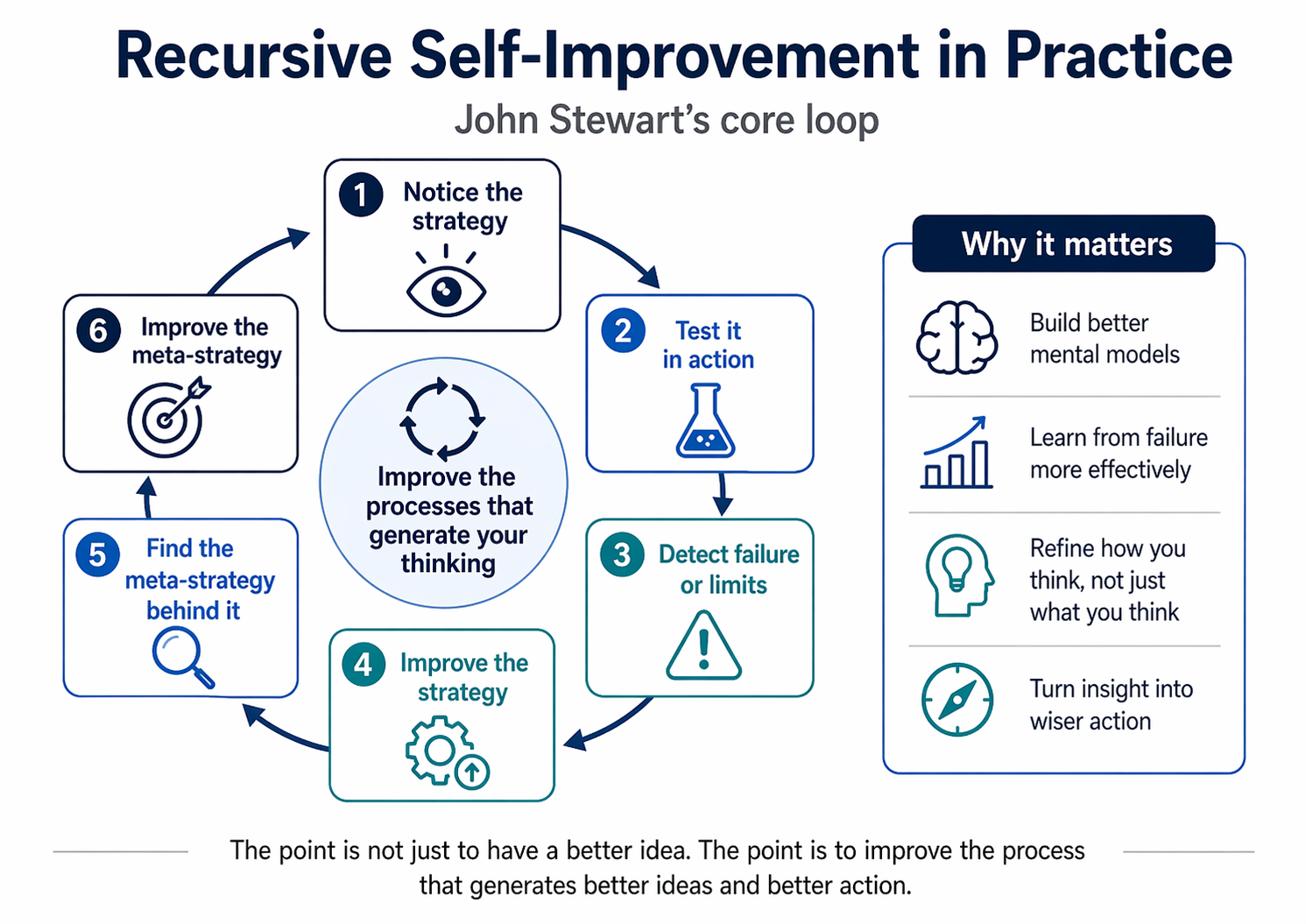
John Stewart’s most useful contribution here is his practical account of recursive self-scaffolding: the deliberate improvement of the strategies, meta-strategies, and attention processes that generate your thinking. ("Recursive" describes a process, rule, or procedure that repeats itself in a self-similar way, often calling upon itself to solve smaller instances of a problem.)
Stewart argues that the ability to construct and use strong mental models of complex phenomena is essential for managing the existential challenges facing humanity. He also argues that most people do not systematically improve the thinking processes they use to solve problems, even though they could. His book tries to make that improvement process more explicit and more trainable.
Why Domain 4 is best understood as both a capstone and an overlay
Pedagogically, it is useful to teach Stewart as a fourth domain. Conceptually, however, it also functions as an overlay across the previous three:
- It intensifies Domain 1 by making self-monitoring and self-correction more systematic and recursive.
- It deepens Domain 2 by requiring the ability to treat thought, emotion, and predisposition as object.
- It builds directly on Domain 3 because higher-order model-building depends on complex, metasystemic cognition.
The cleanest formulation is this: Stewart’s domain is a capstone practice of recursive self-improvement that depends on, integrates, and sharpens the previous three domains.
Stewart’s process in plain language
- Notice the strategy you used.
- See whether it worked or failed.
- Figure out why it failed.
- Improve the strategy.
- Generalize the improved strategy.
- Identify the meta-strategy that produced the strategy.
- Improve the meta-strategy too.
- Repeat this process recursively.
That is the heart of Domain 4: see, test, revise, recurse.
What Domain 4 depends on
- strong motivation,
- the ability to see thought as object,
- some capacity for subject-object shifts,
- some ability to build mental models,
- willingness to test and revise your own strategies repeatedly,
- and enough emotional steadiness to notice failure without defensiveness or collapse.
Present-tense awareness and dis-embedding practices
Stewart repeatedly emphasizes dis-embedding. If thoughts and emotions fully occupy awareness, you cannot examine or redesign them. Practices he highlights or strongly implies include:
- silent self-observation: observe cravings, fear, or emotional pain as sensations without instantly acting on them;
- attention to a stable bodily anchor: often the breath or another inert sensation;
- attention to attention itself: rest in the felt fact of attention rather than in the thought stream;
- portable presence: hold some awareness while moving through ordinary life so you do not immediately re-embed;
- graduated challenge: start in easier conditions, then practice under more emotionally demanding ones;
- visualization or rehearsal: if real triggers are too intense, practice with imagined scenarios first.
Mini story: A man repeatedly doom-scrolls and snacks late at night. Domain 1 helps him notice the pattern. Domain 2 shows that he is still subject to the script, “I deserve relief because the day was hard.” Domain 3 reveals the larger system: fatigue, cue loops, time pressure, stimulation habits, and unprocessed stress. Domain 4 asks the next question: What strategy is the mind running here, what meta-strategy keeps generating it, and how can both be redesigned so that behavior changes when the trigger appears?
Why mental models matter so much
For Stewart, a mental model is not merely a clever internal picture. It is a practical map that lets you compare options, anticipate consequences, and act more intelligently before consequences become more costly. A stronger model usually means fewer preventable mistakes and a better ability to act under complexity.
Simple definition: a mental model is an internal working map of how something functions.
Recursive version: you do not just use the model. You examine how you built it, what it leaves out, how it could be improved, and how the process of improving it could itself be improved.
Action matters as much as insight
This is one of Stewart’s most important points. It is not enough to develop a better strategy. You must be able to put the better strategy into action when the old one fires up. Otherwise, higher cognition remains largely theoretical.
That is why Domain 4 belongs at the end of this article. It asks for the integration of awareness, meaning-making, dialectical cognition, and embodied action. Better thought must become wiser behavior.
Stewart's Core Learning Sequence
- Dis-embed from thought and feeling. Begin by resting attention on simple, relatively neutral sensations such as the breath or bodily contact points. Each time attention is captured by thought or emotion, gently return it. The repeated return is the training.
- Strengthen nonjudgmental awareness. Re-embedding is not failure. Each time you notice it and return, you strengthen the capacity to step back from automatic thinking and feeling.
- Expand awareness into the body and emotions. Do not stay trapped in purely mental observation. Learn to sense bodily feeling, emotional tone, and inner constriction directly and without immediate reaction.
- Practice acceptance of what arises. When uncomfortable feelings arise, notice them closely as sensations and processes rather than immediately turning them into stories, judgments, or avoidance.
- Bring the practice into ordinary life. Keep part of your attention anchored in the body while speaking, walking, listening, working, and solving problems. The goal is not a special state on a meditation cushion. The goal is stable awareness in real life.
- Reintroduce agency through self-remembering. After dis-embedding and expanded awareness are established, reintroduce intention. You are not trying to become passive. You are trying to become a person who is present, awake, and able to choose action deliberately.
- Develop all three centers together. Stewart emphasizes the integration of the intellectual, emotional, and physical centers. Higher cognition is weaker if it is all head and no body or heart.
- Use that freer awareness to build better models. Once you are less captured by thought, you can more easily notice what your current model is missing and begin building richer models of complex reality.
- Practice the DMAP or DTF moves deliberately. Use Laske's quadrants and thought forms to look for missing context, overlooked processes, neglected relationships, and transformations already underway.
- Become self-scaffolding. The long-term goal is not dependence on a teacher or coach. The goal is to internalize the coaching process so you can increasingly monitor, challenge, and improve your own thinking.
Five Helpful Exercises Adapted from Stewart
1. The Thought-Return Exercise
Sit comfortably. Rest attention on the breath or another neutral sensation. Every time thought or feeling captures attention, gently return to the sensation. Do this for 5 to 10 minutes. The training is not staying blank. The training is noticing capture and returning.
2. Thought and Feeling Separation Exercise
When you feel upset, ask: What is the sensation? What is the thought-story attached to it? Separate the felt experience from the interpretation. This helps turn automatic reactions into observable data.
3. Three-Center Check-In
Before tackling a complex issue, pause and ask: What do I notice in my head? What do I notice in my heart or emotional center? What do I notice in my body or gut? Then ask: Which center am I overusing? Which am I neglecting?
4. Daily-Life Anchoring Practice
During a conversation, while walking, or while working, keep part of your attention anchored in your body while also noticing the larger environment. This reduces automatic reactivity and supports steadier observation.
5. DMAP Mind-Opener Practice
Take one real problem and ask four questions:
What larger context is shaping this?
What process is unfolding over time?
What relationships are co-shaping the outcome?
What transformation, contradiction, or reorganization is already underway?
This turns DMAP from theory into active perception.
Why Stewart Matters for Learning DMAP
Many people can memorize the names of the quadrants or even the 28 thought forms without actually becoming more dialectical. Stewart helps explain why. The learner first has to develop enough reflective distance from ordinary thought to notice what current thinking leaves out. Only then do the quadrants and thought forms become living tools rather than dead labels.
He also highlights something many intellectual training systems neglect: feelings, body states, and conditioning can hijack cognition. A person may know the right systems concepts and still fail to use them under stress because they have not learned to remain present when strong feelings arise.
Important cautions applied in the main body
Stewart is most useful in this paper as a practice-oriented guide to developmental training. His exercises for dis-embedding from thought and feeling, stabilizing awareness, integrating body and emotion, carrying attention into daily life, and gradually becoming self-scaffolding are the strongest and most transferable parts of his work.
At the same time, some caution is appropriate. His broader evolutionary worldview should not be treated as settled science. His occasional left-brain and right-brain language is better read as a rough metaphor than as a precise statement of current neuroscience. Some readers may also need to move carefully with exercises involving trauma, anxiety, or intense emotional material. Such exercises are best treated as reflective practices, not as substitutes for skilled therapeutic or medical care when those are needed.
Questions readers can use while learning DMAP
- What exactly in me is still subject and not yet object?
- Can I watch a thought without automatically believing it?
- Can I notice a feeling before it recruits a story?
- When I model a problem, what dynamic patterns am I omitting?
- Which quadrant am I underusing right now: context, process, relationship, or transformation?
- What would a skilled coach ask me that I am not yet asking myself?
- What practice will help me carry awareness into ordinary life rather than only during formal reflection?
- Am I becoming less dependent on external scaffolds and more able to self-correct?
A 90-day practice structure, not a magic staircase
The earlier version of this page included a 90-day plan. The criticism here was fair: such a plan can accidentally imply that development itself happens linearly and on schedule. It does not. So this revised version keeps the practical value of structure while clarifying the limits.
This practice structure organizes exposure, repetition, and reflection. It does not schedule developmental change. Development itself is nonlinear, uneven, domain-specific, and cannot be commanded by your calendar app.
Days 1-30: strengthen Domain 1
- Use planning, monitoring, evaluation, and adjustment on one real task each day.
- Keep a simple error log.
- Use one pause-question when emotionally triggered.
- Keep one important life problem in view and write two or three observations per week.
Days 31-60: begin supporting Domain 2 while continuing Domain 1
- Keep the error log and post-task reflections going.
- Add one subject-object journal entry per week.
- Track one recurring trigger and ask what identity, fear, or loyalty is behind it.
- Notice where you are still trying to get certainty, approval, innocence, or control.
Days 61-90: begin practicing Domain 3 while continuing Domains 1 and 2
- Take one real issue and analyze it through Process, Context, Relationship, and Transformation.
- Do not memorize all 28 at once. Start with the four families.
- Use DMAP as a scaffold on one real-life problem.
- Once a week, ask: what am I freezing, what context am I omitting, what relationships am I missing, and what contradiction is trying to develop?
Beyond 90 days: begin Domain 4 gently
- Notice a strategy that repeatedly fails.
- Rewrite the strategy.
- Identify the meta-strategy that generated it.
- Add one present-awareness or dis-embedding practice.
- Test revised action in real conditions.
- Repeat.
Again, this is a practice structure, not a promise that you will become self-transforming, dialectically fluid, and recursively self-improving by day 91. Humans do enjoy trying to turn deep development into a coupon program. Resist that urge.
What all four domains can do for your life
If these four domains begin to integrate in a healthy way, several larger benefits may emerge:
- you become easier to trust because you are less run by hidden reactivity,
- you become harder to manipulate because you can observe more of your own fears and needs,
- you become better at solving complex problems because your models widen and deepen,
- you become less trapped by rigid ideology and more capable of disciplined flexibility,
- you become more capable of wise action because you can bridge insight and implementation,
- you become more realistic without becoming cynical, and more hopeful without becoming gullible.
The broad developmental picture is this: first you learn to steer your thinking better. Then you learn to see more of the self that is doing the steering. Then you learn to think in ways that better match a changing, interdependent reality. Finally, you learn to improve the processes that generate all of the above and to act from that improvement. That is a serious upgrade in human functioning.
How DMAP is used on a real complex problem
At this point a fair question appears: what does DMAP actually look like when somebody uses it on a real, high-stakes, messy problem rather than just admiring the 28 thought forms from a safe distance? Below is a practical example drawn from Lawrence Wollersheim’s climate-analysis work at the Universe Institute and Job One for Humanity.
This example matters because it shows DMAP as a lived analytic discipline, not just a theory. It also needs one caution up front: this is not a claim that anyone who copies these steps automatically possesses full dialectical capability. As explained earlier in this article, DMAP is a scaffold, and a very good one, but a scaffold is not the same thing as structural mastery. Still, this sequence gives a grounded picture of what mature DMAP practice can feel like when working on a genuinely complex adaptive system.
The flow, in plain language, is roughly this: sense → research and stabilize → classify lightly → translate dialectically → reality-test.
Please also note that individuals differ in intellectual capacity, developmental readiness, temperament, and prior educational experience. So there will always be variation in how people learn and apply DMAP. Even so, when experienced practitioners compare notes, the broad learning and application arc is often surprisingly similar.
Step 1: clear the field and sense what is already there
I clear my mind of distractions, and I think about any intuitions or gut feelings I have about the subject matter that I am going to study and analyze. I note them down.
I note down any feelings I have about the area of study I am about to engage in, and I search for any potential pre-existing biases on the subject area. After completing that process, I list my current ideas on the subject, uninfluenced yet by what I am about to study. I also pay attention to potentially relevant fleeting images and thoughts in this highly unstructured first DMAP action.
I engage in what can be called a creative free-thinking phase based only on any previous knowledge I might have acquired related to the new subject matter I am about to analyze. In this creative free-thinking period, I might develop a conditional theory or hypothesis related to the new materials I am about to analyze. I save all these original notes for the Red Team validity checklist that I will go through at the end of the full process.
Step 2: gather and stabilize the relevant reality
Next, I review relevant existing and new climate science and published peer-reviewed research papers across all climate systems and subsystems. My initial review of climate materials exceeded 20,000 pages.
I analyze horizontally across the many systems and subsystems that comprise the climate change master system or metasystem. Most researchers work vertically within their specialty and seldom have the opportunity to analyze and solve problems horizontally across related studies from the systems and subsystems in their area.
Climate is a complex adaptive system, and to understand it sufficiently, one must closely inspect all climate systems and subsystems that are interconnected or interdependent in linear or potentially nonlinear cause-and-effect relationships. These include, for example, atmospheric water vapor, soils and forests that sequester or release carbon, Arctic Ocean ice cover, ocean acidification and heat levels, Antarctic glacier break-offs, the albedo effect, and tundra and permafrost thaw, among others.
While completing this step and the steps below, I maintain my near-daily exercise routine, which helps me observe my thoughts and view them as external objects that can be evaluated, manipulated, revised, or discarded. Elegant? Not especially. Useful? Very.
Step 3: analyze hard using logic, systems thinking, and bias screening
I take extensive notes in this first review of all relevant climate science. I look for logical errors, biases, false premises, or omissions of information that should be present but are not. I also look for climate-related patterns between and within studies that may not have been previously recognized. I even scan for areas where results might have been biased or skewed by outside funding sources or other conflicts of interest.
While also screening for my own and external biases, I immerse myself in all the information from a logical, systems-thinking, and general big-data analytical perspective. I make myself fully present to the data, without distractions. I continue to take more notes, extensively reviewing the data at the logical and systems-thinking levels. If you are not already a proficient systems-level thinker, succeeding at this and the next DMAP level will be much harder.
Step 4: re-examine the material through Laske’s 28 dialectical perspectives
Once that level of bias, logic, and systems-level analysis is over, I re-examine the situation, crisis, or problem from Laske’s 28 dialectical perspectives. These 28 perspectives offer new ways to view ongoing processes, relationships, contexts, and transformations within the data set you are evaluating.
To do this, I sometimes refer back to Laske’s helpful list of 28 dialectical questions and other tools he developed to help students systematically cover all 28 dialectical perspectives and possibilities. Sometimes some of those questions are not fully applicable to the case at hand, but using Laske’s questions in a disciplined and orderly way at this stage will surprise you again and again. New perspectives, possibilities, blind spots, and solution paths emerge with unnerving regularity.
Please note that using the 28 perspectives in a linear checklist fashion is not the ultimate goal. But it does help discipline beginners and intermediate users who have not yet internalized the 28 perspectives as a working dialectical gestalt. Once one moves beyond the checklist and begins to see the situation nonlinearly and holistically, one moves to a wholly different level of seeing and understanding reality, analysis, and problem-solving.
Step 5: deepen the analysis until the data starts talking back
Next, I flowchart out and think as deeply and fluidly as possible about how each of the 28 dialectical perspectives could affect or involve the situation, crisis, or problem, or how they might influence future consequences, timeframes, or solutions. I take plenty of notes that I can refer back to later. This is another layer of tedious, detailed thought and work. Yes, tedious. There is no glamorous shortcut here.
I still use my logical, analytical, and systems-thinking skills in this second, deeper thinking process. But in addition to those methods, I now also begin to deeply and fluidly ponder the situation from all 28 dialectical perspectives, which provide far more usable linear detail and nonlinear information about the possibilities.
In this step of deep dialectical analysis, I once again look for errors or omissions of information that should be present but are not. I also look for patterns between and within studies that may not have been previously recognized. But this time I am doing it through the 28 dialectical lenses. This broader, more dynamic perspective reveals information that is simply not available at the traditional logic or systems-theory level alone.
At this stage, the right-brain, and even some of its subconscious bandwidth, becomes more fully engaged in looking at the situation in ways that the left-brain’s linear capabilities cannot. If the practitioner cannot engage those right-brain capacities alongside left-brain analysis, they often get stuck or perform poorly. There are exercises that can help develop a better balance here, but no, sadly, reading one impressive paragraph about it does not count as doing the work.
Step 6: step away and let whole-system cognition do its part
After this extensive, tedious, dialectically driven immersion in the data and flowcharting, I step back and do something completely unrelated to the work. I stop thinking about the evaluation or being involved in it in any way whatsoever. What happens next is often remarkable.
Spontaneously and without effort, the target situation and its many dynamics will return in unique, near-complete epiphanies and whole-system cognitions, whether awake or asleep. These sudden syntheses integrate massive amounts of climate information in new or more holistic ways that I did not see earlier in the process of linear logical analysis, systems thinking, or even lower-level dialectical flowcharting.
One of the most remarkable aspects of the later stages of the DMAP process is that it can accelerate epiphany and whole-system cognition beyond what many people have previously experienced. Over time, and through repetitive use of DMAP procedures, parts of the process become more automatic, and related insights may begin appearing in other areas of life as well, especially in areas where one already knows the major components and conditions.
Step 7: Red Team the whole thing before you embarrass yourself in public
The final step is Red Team fact-checking and validation. Once I have produced a new analysis or solution using DMAP and completed all prior steps, I review my original materials, notes, and the critical facts described in the earlier steps that led to the final dialectical metasystemic analysis or solution. I review and re-verify those areas in at least two separate passes to ensure that no bias, incorrect premise, weak evidence, overstatement, or omission has quietly warped the conclusion.
This repetitive, multifactorial Red Team process often surfaces unseen errors and additional nuanced insights. It also strengthens justified confidence in earlier discoveries. In my own case it is especially important because I am dyslexic, and redundant verification is not optional window dressing. It is part of accuracy discipline.
In this final Red Team check, I return to Laske’s 28 DTF perspectives and questions to make triple sure that I have not underweighted, overweighted, or omitted any one of the 28 perspectives in analyzing the problem or the solution. The 28 perspectives offer a subtle and nuanced way of viewing situations, whether frozen in time or evolving, and omitting the relevance of any one of them can reduce the quality of the final analysis.
Because I am now relatively proficient and fluid with the 28 perspectives, this process is more spontaneous and fluid than a rigid one-perspective-at-a-time procedure. Beginners should absolutely use Laske’s prompting questions and references until that fluency develops. Another reason to verify Red Team work carefully before release is simple: original analysis often attracts resistance. If the work is disruptive, peers or competitors may challenge it hard. A proper Red Team process prepares you for those challenges and, more importantly, protects the public from your unfinished cleverness.
Helpful follow-up resources for this stage of practice:
- Universe Institute: DMAP description and application overview
- Universe Institute: recommended prerequisites for learning DMAP
- Universe Institute: lead book on the challenging DMAP learning process
- Job One for Humanity: research credibility standards
- Job One for Humanity: forecasting and rationality-method overview
Individuals who become genuinely proficient in DMAP will hold a significant advantage over those who are not skilled in dialectical metasystemic analysis and problem-solving. Today the world is driven by interacting complex adaptive systems, and DMAP is unusually well suited to those conditions. As more organizations learn what kind of complexity their leaders are actually facing, dialectical capability is likely to become a far more valued competence.
Finally, before diving into DMAP too ambitiously, review the prerequisites page linked above. Some of the most important conditions for success are surprisingly ordinary: rational discipline, emotional steadiness, patience, systems knowledge, and the willingness to do tedious work long enough for the deeper breakthroughs to arrive.
Could DMAP help spark a second enlightenment?
This idea should be framed carefully because grand historical claims can become puffery very fast. Still, there is a serious point underneath the bold language.
During the original Enlightenment, especially in the 17th and 18th centuries, breakthroughs in rational analysis, scientific methodology, and falsification transformed how humans understood and managed the world. That shift did not solve everything. Humans remain fully capable of building atrocities with excellent mathematics. But it did dramatically improve our ability to test claims, challenge superstition, and organize knowledge in ways that reshaped modern life.
Today we face a different class of challenge. Our most dangerous problems are increasingly produced by interacting complex adaptive systems: climate change, ecological overshoot, financial instability, political polarization, technological acceleration, fragile supply chains, and cascading global risks. Logic, scientific method, bias-checking, big-data analysis, and systems theory remain essential. But on their own they often do not give decision-makers enough help with contradiction, nonlinear feedbacks, changing contexts, hidden relationships, developmental tensions, and multi-system transformation.
That is where DMAP may matter historically. It does not replace earlier advances. It builds on them and extends them. In that sense, DMAP can be understood as a possible next advance in disciplined human thinking: a way of helping people examine moving reality with richer tools than formal logic alone can usually provide. If widely learned and responsibly used, it could improve the quality of leadership, strategy, research, governance, and long-range problem-solving in a world where shallow analysis is getting more expensive by the year.
Laske’s work also did something unusual in the history of adult development. He did not only discuss development abstractly. He built a more teachable bridge between adult-development research, dialectical cognition, coaching, organizational complexity, and practical analysis. In doing so, he stood on and extended contributions from earlier thinkers such as Hegel, Adorno, Michael Basseches, and Elliott Jaques. Jaques is especially important here because his work on work complexity, time-span, and cognitive maturation helped keep the conversation tied to real-world judgment and capability rather than vague declarations of “higher consciousness.”
Seen that way, DMAP is not magic and it is not a replacement for science. It is better understood as a serious candidate for a new complexity discipline suited to the actual structure of many modern problems. In the hands of leaders, analysts, scientists, policy designers, and citizens who are willing to learn it well, that could matter a great deal. If the first Enlightenment helped humanity become better at testing truth claims about the world, a more dialectical second enlightenment could help humanity become better at navigating worlds that are dynamic, entangled, and constantly transforming.
That possibility should make us hopeful, but not sleepy. A new way of thinking only changes the world if it is learned, embodied, institutionalized, and used in action. Stewart’s contribution matters here too: insight alone is not enough. Better strategy must become better behavior. Better cognition must become wiser implementation. Otherwise even the best framework remains a very elegant shelf decoration.
Used well, DMAP can improve not only public decision-making but private life. It can help a person see when a relationship conflict is really a pattern of mutual constitution, when a career problem is actually a context problem, when a stalled project is trapped by a false separation, or when a system is approaching a developmental contradiction rather than a random failure. That is why the historical claim is not merely theoretical. The practical gains can begin in ordinary life long before they show up in government or civilization. Civilizations, after all, are built out of minds. Disturbing, but true.
A broader evolutionary and philosophical possibility opened by DMAP training
This final section is intentionally separate from the main body of the paper. It is included to give John Stewart his due as an evolutionary theorist and to acknowledge a broader philosophical possibility that can arise when people train metasystemic thinking seriously. This section should be read as a philosophical and developmental reflection, not as settled science.
John Stewart is not only a writer on developmental training. He is also an evolutionary theorist whose broader work explores whether evolution shows long-range directional tendencies toward greater complexity, cooperation, evolvability, and forms of consciousness capable of becoming aware of evolution itself. In Stewart’s larger view, humanity may be entering a period in which reflective intelligence can participate more consciously in the future direction of life rather than merely remaining an accidental byproduct of blind processes.
Not everyone agrees with Stewart’s larger theories. Critics question whether evolution has a meaningful direction, whether talk of destiny or purpose goes beyond what science can support, and whether normative conclusions about humanity’s role can be derived from evolutionary history. Those are legitimate cautions, and they should remain visible.
Even so, Stewart’s larger vision has real philosophical value. It points toward the possibility that when human beings develop stronger metacognition, better subject-object separation, and a more reliable capacity to view complex adaptive systems from multiple interacting perspectives, they may naturally begin asking larger questions about life’s trajectory, human responsibility, long-term stewardship, and the future of civilization. In that sense, DMAP training can become more than a technical upgrade in analysis. It can widen the horizon from which a person perceives life, society, and consequence.
This widening of perspective is not unlike what astronauts often describe after seeing the Earth from space. The immediate frame expands. Old boundaries can feel less absolute. Interdependence becomes more visible. Fragility and possibility are seen together. A person who begins to think metasystemically can experience a cognitive version of that broadening. The world is no longer just a collection of isolated events, tribes, and short-term incentives. It begins to appear as a nested, dynamic, evolving whole in which actions reverberate across scales and across time.
That kind of perspective shift does not prove any grand metaphysical theory. But it can support deeper responsibility, wiser action, and a broader sense of identity and stewardship. It can help a person move beyond narrow self-interest, beyond static categories, and beyond fragmented decision-making. This is one reason DMAP and related training can matter far beyond academic analysis. By engaging many perspectives in the decision-making and action-taking process, it can change not only how people think, but also how they locate themselves within the larger human future.
Read in this careful way, Stewart’s broader evolutionary philosophy can serve as an invitation rather than a dogma. It invites readers to consider that as human beings become more capable of self-reflection, systems-awareness, and deliberate learning, they may also become more capable of participating constructively in the future evolution of human society and perhaps in the future flourishing of life more generally. Whether one interprets that in secular, philosophical, spiritual, or existential terms, the invitation is similar: expand awareness, deepen responsibility, and bring better thinking to the long arc of consequences.
Suggested framing sentence if you want one closing line: The practical disciplines of metacognition and DMAP may begin as tools for clearer thinking, but for some people they can also open into a much wider sense of responsibility, perspective, and participation in humanity’s future.
Frequently asked questions
1. Is this page for beginners or experts?
It is for serious beginners and intermediate readers. The language is kept as clear as possible, but the material itself is advanced. That is why the page now introduces Kegan, Basseches, Laske, Jaques, and Stewart rather than assuming prior knowledge.
2. Do I need to “master” Domain 1 before I start the others?
No. But stronger self-regulation makes the other domains easier, safer, and more honest.
3. Is Kegan’s development something I can practice directly?
Not in a simple technique-equals-growth way. Practices can support awareness and create conditions for development, but structural development is nonlinear and not fully under conscious control.
4. Is dialectical cognition just better metacognition?
No. It can enrich metacognition, but it is not reducible to self-monitoring. It is a different way of construing reality.
5. Does using DMAP prove I am thinking dialectically?
No. DMAP can support dialectical development, but method-following and deep capability are not identical.
6. Is Stewart’s “superintelligence” really a fourth stage?
Pedagogically, it can be taught as a fourth domain. Conceptually, it is better understood as a recursive capstone practice that integrates and sharpens the previous three domains.
7. Why mention age 27?
Universe Institute uses it as a practical rule of thumb for very advanced DMAP work. Mainstream neuroscience is more cautious and usually speaks of executive maturation into the mid-to-late 20s. So the wiser claim is readiness, not a magical birthday.
8. What is the fastest practical payoff?
Domain 1. Better planning, monitoring, and self-correction can improve life quickly. Domain 2 through 4 tend to move more slowly and unevenly.
9. What if the 28 thought forms feel overwhelming?
Start with Process, Context, Relationship, and Transformation. Use one real problem. Let the problem teach you why the forms matter.
10. What if I become more aware of my blind spots and feel worse for a while?
That is normal. Better seeing usually comes before better integration. The goal is not to feel impressive. It is to become more awake, more capable, and more responsible.
Glossary
- Metacognition: awareness and regulation of your own thinking.
- Self-regulation: the ability to monitor, guide, and adjust thinking, emotion, or behavior.
- Planning: deciding how to approach a task before you begin.
- Monitoring: checking how well you understand or are performing while doing a task.
- Evaluation: judging what worked and what failed after the task.
- Adjustment: changing what you do next based on what you learned.
- Subject: something you are embedded in and cannot easily step back from.
- Object: something you can observe, reflect on, and work with.
- Subject-object shift: a developmental move in which what once ran you becomes something you can examine.
- Meaning-making: the way a person organizes reality, identity, value, and interpretation.
- Socialized mind: a meaning-making structure shaped strongly by belonging, relationship, and external expectations.
- Self-authoring mind: a meaning-making structure guided more by internally generated values and standards.
- Self-transforming mind: a meaning-making structure that can examine even its own internal system and hold multiple systems in view.
- Dialectical thinking: thinking that tracks change, context, relationship, contradiction, and transformation.
- Metasystemic cognition: the ability to model and coordinate multiple systems or dimensions of a complex reality.
- DTF: Dialectical Thought Forms, the 28 thought forms used to prompt dialectical cognition.
- DMAP: Dialectical Metasystemic Analysis and Problem-Solving, a practical scaffold for complex problem analysis using dialectical lenses.
- CTF: Creative Thought Forms, Jan De Visch’s term for imaginal, embodied, symbolic, and pre-conceptual cues that can signal emerging meaning before it is fully articulated.
- Felt sense: an implicit bodily sense that something is present or important even before you can clearly explain it in words.
- CDF: Constructive Developmental Framework, Otto Laske’s broader framework for assessing social-emotional, cognitive, and psychological dimensions of development.
- Reification: treating a moving process as if it were a fixed thing.
- Complex adaptive system: a system with many interacting parts that changes over time, often nonlinearly.
- Mental model: an internal working map of how something functions.
- Recursive self-improvement: improving not only your strategies, but the meta-strategies and processes that generate them.
- Self-scaffolding: using practices, models, and feedback to progressively build higher capabilities in yourself.
- Dis-embedding: stepping out of automatic identification with a thought, emotion, or reaction so you can observe it.
- Sense-making: a term Laske uses for the cognitive line of development, especially complex and dialectical understanding.
- Meaning-making vs. sense-making: a useful distinction between how the self is structured and how reality is cognitively construed.
- Time-span of discretion: Elliott Jaques’s idea that roles differ in how far into the future people must exercise judgment and responsibility.
- Requisite organization: Jaques’s framework for matching levels of organizational work complexity with appropriate human capability.
- Self-remembering: a practice of being present to yourself while also remaining awake to what you are doing, feeling, and choosing in the moment.
- Three centers: a shorthand for the intellectual, emotional, and physical centers of experience that Stewart wants integrated rather than split apart.
- Subject-object skill: the practical ability to notice a thought, emotion, bias, or identity as something you can observe rather than something that automatically runs you.
References
How to Get Started with DMAP and DTF Training Worldwide
MIT Teaching + Learning Lab: Metacognition
Harvard Graduate School of Education: Robert Kegan
Interdevelopmental Institute: Otto Laske
Integral Leadership Review: Interview with Otto Laske
PhilArchive: John E. Stewart, Human Superintelligence
Integral World: John Stewart, Human Superintelligence, chapter excerpt
Connect & Transform: Jan De Visch profile and publications
Global Organization Design Society: Jan De Visch profile
VitalSource: Practices of Dynamic Collaboration by Jan De Visch and Otto Laske
SCiO: opening the box: systems thinking for transformative conversations
Connect & Transform: The Developmental Practitioner: Otto Laske’s Legacy on Becoming
NIMH: The Teen Brain and continuing maturation
Selected bibliography
The following books and articles are useful next-step sources for readers who want to go deeper into metacognition, adult development, dialectical cognition, DMAP, and recursive self-improvement.
Basseches, M. (1984). Dialectical Thinking and Adult Development. Norwood, NJ: Ablex.
Bhaskar, R. (1993). Dialectic: The Pulse of Freedom. London: Verso.
Jaques, E. (1976). A General Theory of Bureaucracy. New York: Halsted Press.
Kegan, R. (1982). The Evolving Self. Cambridge, MA: Harvard University Press.
Kegan, R., & Lahey, L. L. (2009). Immunity to Change. Boston, MA: Harvard Business Press.
Laske, O. E. (2015). Laske’s Dialectical Thought Form Framework. Integral Review, 11(3).
Laske, O. E. (2023). Advanced Systems-Level Problem Solving, Vols. 1-3. Cham: Springer.
Universe Institute internal links
Below are the main internal pages connected to this topic and visible from the related DMAP menu cluster. They are the most useful next steps for a reader who wants to go deeper after finishing this page.
This advanced thinking and analysis guide is also used in our internal training and as a "Red Team" validity and accuracy checklist when reviewing much of our work before publication.
- DMAP description
- Metacognition and DMAP
- DMAP/DTF training options
- DMAP training prerequisites
- About DMAP/DTF originator Otto Laske
- Best DMAP & DTF books
- Great DMAP learning book
- DTF/DMAP book for the general public
- DTF/DMAP and the Integral movement
- Evolution theory and DMAP
- Second Enlightenment and DMAP
- DMAP and DTF’s place in history
- DMAP and DTF-related papers
- Learn about the Universe Institute and its use of DMAP
Copyright Notice
“Except where otherwise noted, original content on this page and every page on the Universe Institute website is licensed under Creative Commons Attribution-NonCommercial-NoDerivatives 4.0 International. Logos, trademarks, and third-party materials are excluded.”
For all of the specific terms and exceptions of this Creative Commons license, click here.
Published works, white papers, etc., on our website belonging to other individuals or organizations are covered by their own individual copyrights and terms and should be contacted directly if you desire to use those materials.
This document was produced through a collaboration of the Universe Institute and Job One For Humanity. Lawrence Wollersheim was the lead DMAP analyst on this project. Additionally, the Universe Institute and Job One For Humanity would like to thank the DMAP teachers and proficient practitioners John Stewart, Iva Vurdelja, and Jan De Visch for their criticisms and support on earlier versions.
Do you like this page?
