
On this page
-
- Abstract
- 1. Introduction
- 2. Research Design: Integrative Theory Building
- 3. Framework Overview
- 4. The Six Layers and 20 Interacting Elements
- 5. Recurrent Causal Architecture
- 6. Comparative Plausibility Probes
- 7. Rival Explanations and Discriminating Tests
- 8. Toward an Empirical Research Program
- 9. Discussion and Implications
- 10. Positionality, Limitations, and Reflexive Appraisal
- 11. Conclusion
- Declarations
- References
- Supplementary Visual Appendix
The 10,000-Year Trap: A Six-Layer Metatheory of 20 Interacting Forces Behind Recurring Civilizational Dysfunction, Injustice, Catastrophe, and Collapse
Abstract
Purpose. Across roughly ten millennia, societies have repeatedly enlarged cooperation, knowledge, productive capacity, and institutional reach while also reproducing domination, preventable catastrophe, ecological degradation, and breakdown. This article asks why recognizably similar failure mechanisms recur across otherwise different cultures and eras.
Approach. It develops a theory-building integrative synthesis across evolutionary theory, history, archaeology, political economy, psychology, education, governance, ecology, complexity science, disaster research, and technology studies. Recurrent mechanisms are organized into six analytical layers and 20 interacting causal elements. A systems and dialectical omission audit tests process, relationship, context, and transformation; counter-cases, rival explanations, and explicit failure conditions constrain the synthesis.
Results/claims. Recurring dysfunction is most likely when power becomes separated from consequences; concentrated actors capture rules and information; injustice weakens legitimacy and learning; inherited cues or institutional proxies become decoupled from long-term outcomes; cooperation is organized at the wrong scale; ecological and fiscal margins erode; and tightly coupled technologies amplify ordinary error. The same pressures can also yield reform, adaptive transformation, authoritarian consolidation, or fragmentation.
Implications. The framework is a testable metatheoretical map, not a calibrated universal law. It specifies comparative predictions and a research program for determining when higher-order cooperation becomes durable rather than self-undermining.
Keywords: civilizational dynamics; integrative metatheory; consequence capture; systemic injustice; evolutionary mismatch; ecological overshoot; polycrisis
1. Introduction
For roughly ten millennia, human societies have repeatedly expanded large-scale cooperation while reproducing conquest, slavery, exclusion, extraction, preventable famine, ecological destruction, authoritarianism, war, and collapse. The horizon is approximate: agriculture, sedentism, urbanization, and state formation emerged at different times and in different regions, with substantial political experimentation. The claim is therefore not a single civilizational sequence but recurrence of interacting dysfunctions across diverse social forms.
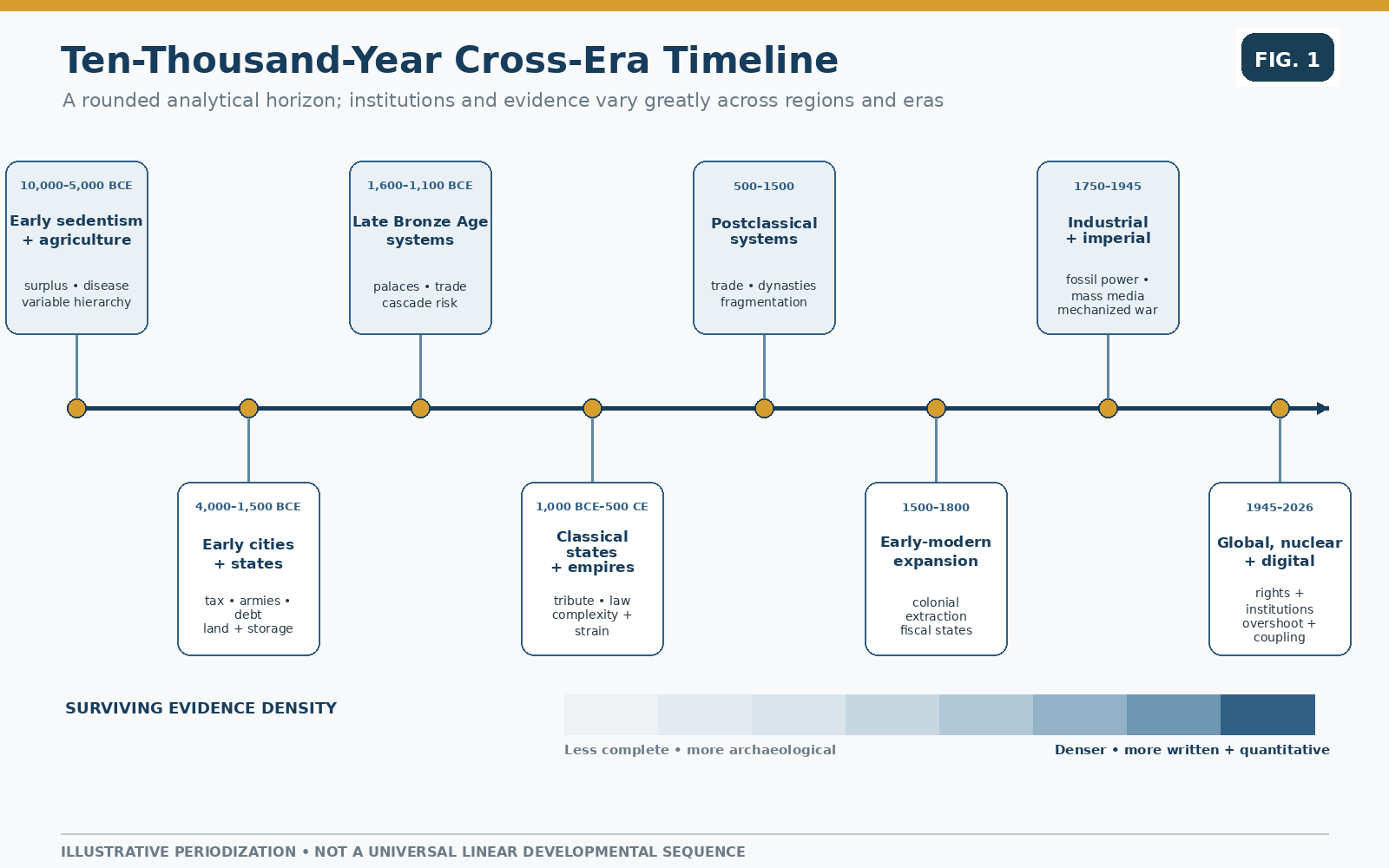
The recurrence claim requires two cautions. First, surviving records are not neutral samples of human life. Archives disproportionately preserve literate states, ruling institutions, wars, taxation, monuments, and the accounts of groups able to write, store, and protect records. Cooperative communities, informal institutions, women, subordinated populations, mobile peoples, and defeated alternatives are often less visible. Second, similar labels can conceal different mechanisms. “Empire,” “market,” “religion,” “bureaucracy,” or “democracy” names a broad family, not a constant causal unit. Cross-era comparison is therefore used here to identify recurring relational patterns, not to flatten cultures into interchangeable examples.

Two opposite errors obstruct analysis. One reduces history to moral failure by unusually vicious rulers, populations, religions, or nations. The other reduces human action to impersonal structures and treats agency, leadership, learning, and institutional design as epiphenomena. A more adequate explanation must retain both. Humans inherit mixed motives and coalitional capacities, but institutions alter which motives are rewarded, which actors gain authority, how information travels, and who bears the consequences of error (Bowles & Gintis, 2011; Henrich, 2016; North, 1990). Structure shapes agency, while repeated agency reproduces or transforms structure.
The article advances a six-layer integrative metatheory containing 20 causal elements. Its contribution is architectural rather than terminological. Most elements are established research domains: collective action, social identity, elite influence, cognitive bias, organizational defensiveness, ecological overshoot, resilience, network contagion, and technological lock-in. The proposed novelty lies in specifying how these mechanisms occupy different causal levels, reinforce one another, and generate divergent transformations. Integrative work is useful only when it does more than place disciplines beside one another like books that happen to share a shelf (Edwards, 2010; Bhaskar, 2008).
The focal object is a coupled social-ecological system rather than a civilization imagined as one person. Households, communities, organizations, markets, states, transnational networks, infrastructures, technologies, cultures, and ecosystems jointly produce the conditions being explained. The relevant boundary changes with the question. A national policy may depend on global commodity markets; a local water institution may depend on national law and regional hydrology; individual behavior may be constrained by prices, identities, and infrastructure. Causation therefore moves upward when repeated actions accumulate into institutions or planetary effects and downward when law, culture, technology, or ecological conditions alter the choices available to actors.
This boundary makes the question “dysfunctional for whom?” unavoidable. An arrangement can function efficiently for a ruling coalition, monopoly, occupying power, or extractive organization while degrading public welfare, rights, ecosystems, and future options. The framework evaluates dysfunction relative to long-term common well-being, equal moral standing, basic rights, ecological viability, truthful learning, and publicly stated institutional purposes. Responsibility remains differentiated. Actors do not possess equal power, knowledge, freedom, benefit, or capacity to resist. Structural explanation does not turn perpetrators, beneficiaries, coerced participants, bystanders, reformers, and victims into one morally undifferentiated population.
The article uses the term civilizational dysfunction for persistent, substantially preventable arrangements that impair broad human well-being, rights, ecological viability, truthful learning, and the capacity to coordinate across populations or generations. Injustice is not treated as a decorative moral afterthought. It is a structured asymmetry in voice, rights, benefits, burdens, exposure to risk, and accountability. Such asymmetries can be outcomes of power and also causal mechanisms that reduce legitimacy, suppress information, shift costs, and weaken cooperation (Crenshaw, 1989; Tilly, 1998; Young, 1990; World Bank, 2017).
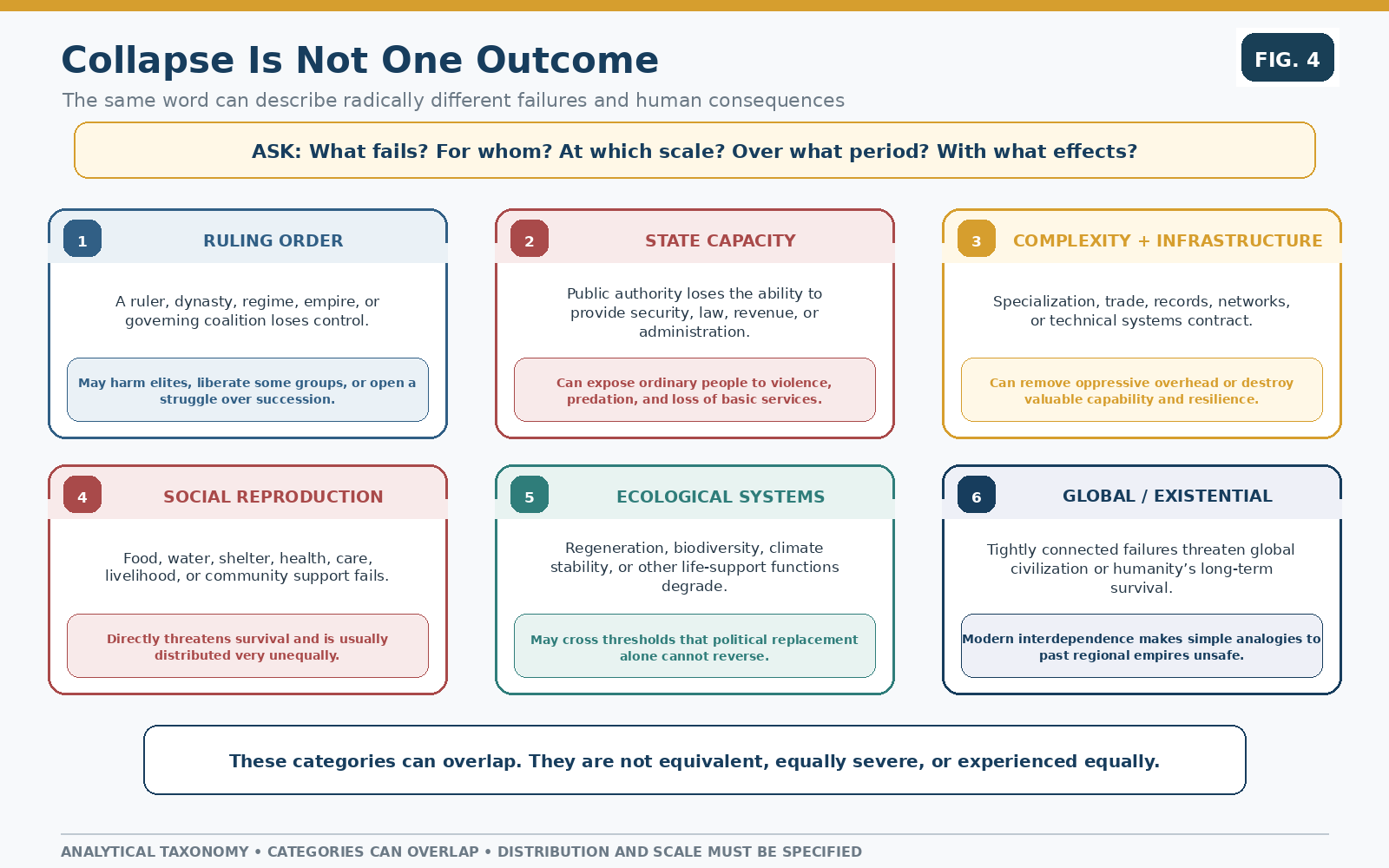
The term collapse is also disaggregated. A ruling regime may fall while communities persist; state capacity may contract while some local freedoms increase; complex infrastructure may fail while a culture survives; or ecological and life-support systems may deteriorate even while administrative institutions remain intact. At the global scale, tight interdependence can synchronize failures and reduce the availability of unaffected external refuges. Any collapse claim must therefore identify the unit, function, population, spatial scale, time horizon, and counterfactual being evaluated.
.
Many systems stagnate, simplify, collapse, or go extinct. Biological and cultural evolution can build higher-order cooperation, yet cooperation remains vulnerable unless lower-level competition and free-riding are constrained and contributors are not systematically disadvantaged (Maynard Smith & Szathmáry, 1995; Stewart, 2014). Success is evidence of fit under particular conditions, not proof of virtue or destiny.
This premise makes human mixed motives a design condition. Care, reciprocity, loyalty, ambition, fear, domination, creativity, deceit, and moral learning coexist within populations and often within the same person. Institutions do not merely restrain an otherwise fixed nature; they sort, reward, socialize, and amplify behavioral strategies. Rules designed for saints invite exploitation, while rules designed as though everyone were permanently selfish can crowd out trust and pro-social motivation (Bowles, 2008). Durable cooperation requires consequence capture, legitimate constraint, protection for contributors, and pathways through which institutions themselves can be corrected.
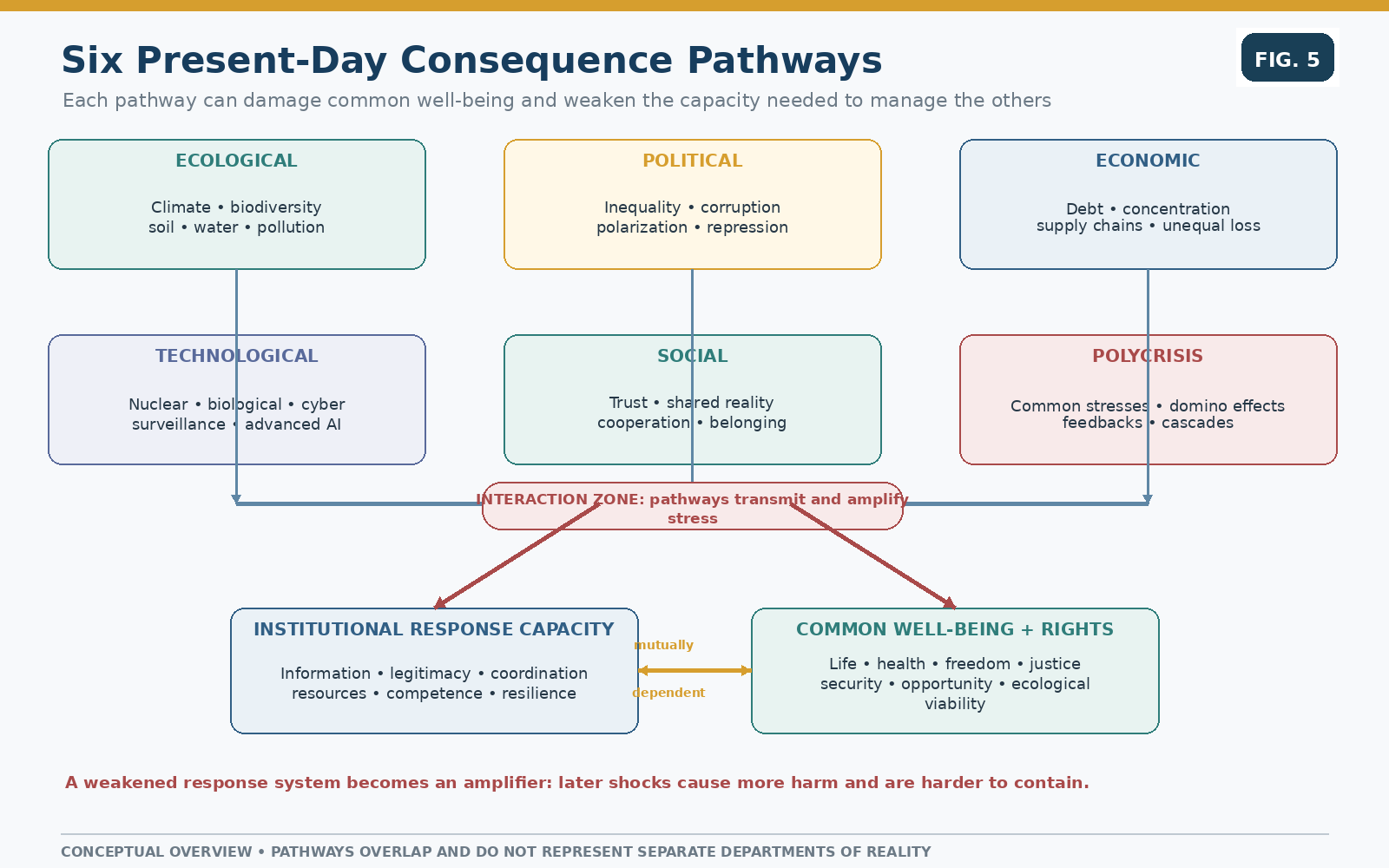
The contemporary relevance is intensified by ecological boundary transgression, climate risk, biodiversity loss, global interdependence, and accelerating technological capability (IPCC, 2023; IPBES, 2019; Richardson et al., 2023). These are not independent entries on a risk register. Common stresses, domino effects, and feedbacks can entangle food, water, energy, finance, health, migration, information, legitimacy, and conflict (Homer-Dixon et al., 2015; Lawrence et al., 2024; Gambhir et al., 2025). A framework that omits ecological destruction and resource overshoot is therefore not merely incomplete. It misstates the physical conditions under which governance must operate.
Contemporary capability increases the stakes of ordinary institutional error. A mistaken ruler in an isolated polity, a biased local market, or a brittle organization could inflict severe harm, but its reach was constrained by distance, speed, and available technology. Nuclear weapons, global finance, digital platforms, biotechnology, artificial intelligence, industrial food systems, and tightly coupled infrastructure enlarge both beneficial coordination and the radius of failure. The danger is not technology itself. It is a capability-governance gap in which deployment, concentration, and dependency grow faster than monitoring, liability, public deliberation, reversibility, and international coordination (Collingridge, 1980; Helbing, 2013).
The framework addresses four linked research questions. What recurring mechanisms reproduce preventable dysfunction across different institutional forms? How do mechanisms at different levels combine rather than merely coexist? Why do similar pressures yield reform in some cases, coercive stabilization in others, and fragmentation or breakdown elsewhere? What observations would show that the proposed architecture adds less explanatory value than simpler rivals? These questions keep diagnosis, integration, comparison, and falsification in the same analytical frame.
The central claim can be stated compactly. Moral knowledge, technical competence, and cooperative aspiration become historically durable only when institutions do not systematically reward their violation, conceal their consequences, or disable lawful correction. Where power is insulated from harm, information is punished, costs are transferred, scale is mismatched, ecological margins shrink, and tightly coupled technologies magnify error, recurring dysfunction becomes more probable. The outcome remains contingent because countervailing institutions, leadership, culture, resources, and historical accidents can interrupt the configuration.
2. Research Design: Integrative Theory Building
2.1 Design and source selection
This is a theory-building integrative review, not a systematic review or a new statistical study. The source corpus was purposively assembled across evolutionary theory, archaeology, history, political science, economics, sociology, psychology, adult development, organizational learning, education, ecology, complexity science, disaster research, risk analysis, and technology governance. Preference was given to peer-reviewed studies, major scholarly syntheses, primary historical evidence, official investigations, authoritative scientific assessments, and academic books from established presses. Search and screening procedures were not uniform across disciplines, so the article makes no claim of exhaustive coverage.
The unit of integration is the causal mechanism rather than the discipline or vocabulary. A mechanism describes how a structured relationship tends to generate an outcome under stated conditions. “Capture,” for example, can refer to regulatory influence, elite agenda control, organizational dependence, or the corruption of information channels. These are not assumed to be identical. They are combined only where the actors, resources, sequence, and predicted consequences overlap. Conversely, similar outcomes are kept separate when they arise through different pathways, such as coercive censorship, commercial attention incentives, or decentralized rumor.
Cross-disciplinary translation followed a three-question protocol. First, what is the source field actually claiming, and at what level of analysis? Second, what observable sequence or relationship would make the claim causal rather than metaphorical? Third, what would be lost by translating the concept into the shared architecture? Where translation risk remained high, the article retains disciplinary qualifiers or treats the connection as provisional. The purpose is not a frictionless universal language. It is enough conceptual interoperability to compare mechanisms without laundering disagreement into attractive diagrams.
Source selection used six practical criteria: relevance to a defined mechanism; methodological transparency; directness of support; disciplinary standing; corroboration across independent evidence; and clarity about uncertainty. Prestige did not exempt a source from criticism, and novelty did not disqualify a source when its reasoning and evidence were traceable. Foundational works were retained where they still organize active research, while later work was used to correct deterministic or overly general interpretations. The principal research cutoff was July 30, 2026, with a targeted evolutionary-trap literature update completed August 19, 2026 and dated corrections incorporated where they materially changed a claim.
Case material was selected to expose the framework to variation rather than to assemble a procession of disasters. The probes include breakdown, divergent response to a shared hazard, durable commons governance, social-ecological transformation, and successful global environmental coordination. Negative cases and alternative pathways are necessary because a framework trained only on failure will rediscover failure with impressive reliability. The cases remain illustrative rather than representative, and no frequency claim is inferred from their inclusion.
Claims involving intentional coordination were screened through a credibility ladder. Documented actions supported by primary records, official investigations, court findings, or independent corroboration are distinguished from mixed evidence, incentive-consistent but unproven inference, low-credibility extrapolation, and unfalsifiable grand conspiracy. Aligned interests, secrecy, revolving doors, and institutional dependence can produce coordinated-looking outcomes without a single command center. The analysis therefore separates confirmed action from inferred intent, states confidence, and identifies evidence that would change the classification.
Evidence was distinguished at three levels. First, component evidence directly supports a mechanism, such as motivated reasoning, collective-action failure, or cascade risk (Kunda, 1990; Ostrom, 1990; Buldyrev et al., 2010). Second, configurational evidence supports recurring combinations in historical or comparative cases. Third, architecture-level evidence concerns whether the complete six-layer model adds explanatory value beyond its components. Component literatures are often strong; the complete architecture has not been statistically validated. Treating those levels as interchangeable would create confidence by bookkeeping.
2.2 Synthesis procedure
The synthesis followed six iterative operations. First, recurrent mechanisms were extracted from each field without assuming that identical words referred to identical causal processes. Second, overlapping labels were merged and distinctions were preserved where mechanisms operated at different levels. Third, each element was assigned a primary analytical layer while cross-layer roles were recorded. Fourth, feedback loops, delays, thresholds, and path dependencies were specified. Fifth, the architecture was audited against catastrophe cases and successful or divergent responses. Sixth, propositions were reformulated so that contrary evidence could weaken, revise, or remove an element.
A seventh operation examined causal grammar. For every proposed connection, the synthesis asked whether the relation represented a material flow, information flow, authority relation, incentive effect, selection process, constraint, feedback, threshold, or interpretive mediation. This prevented an arrow from silently changing meaning between sections. An eighth operation searched for compensating mechanisms. Cases that did not produce predicted failure were examined for redundancy, legitimacy, available surplus, leadership, modularity, protected dissent, or institutional learning that could interrupt a loop.
The procedure also screened for false either-or framings. Central coordination and local knowledge, efficiency and redundancy, stability and adaptation, leadership and constraint, universal rights and contextual variation, innovation and precaution, individual development and institutional reform are genuine tensions but not automatically exclusive choices. The synthesis favors both-and designs where each function can be preserved without disguising a real tradeoff. Where resources or physical limits make simultaneous maximization impossible, the conflict is stated rather than resolved by grammar.
A dialectical metasystemic audit adapted from the process, relationship, context, and transformation emphases in dialectical thought-form work was used strictly as an omission check, not as a psychological score or empirical validation (Laske, 2023). General systems theory supplied a parallel check through stocks, flows, feedback, delays, thresholds, nested levels, equifinality, multifinality, and open-system dependence. The audit asked how each mechanism develops and reverses, what relations constitute it, how it changes across scales, and which alternative transformations are possible.
The full 28-thought-form audit is not reproduced as a separate section because it is methodological rather than evidentiary. Its useful outputs are built into the model: checks for reification, path dependence, local rationality producing higher-order harm, metric gaming, rebound effects, requisite variety, correlated failure, slow-variable/fast-trigger interaction, equifinality, multifinality, displaced costs, and functional replacement. These checks help prevent a static list from masquerading as systems analysis.
2.3 Validity criteria
Seven criteria are used to evaluate the framework. Construct clarity requires defined mechanisms and separation of causal levels. Internal coherence requires elements and loops not to contradict one another without an explicit scope condition. Correspondence requires mechanisms to match observable evidence. Comparative discrimination requires the framework to explain divergent outcomes, not only famous failures. Generativity requires novel propositions and research designs. Parsimony requires added complexity to earn its keep relative to simpler explanations. Reflexive adequacy requires disclosure of normative commitments, selection risks, and limits.
These criteria do not collapse into one score. A framework can be coherent but empirically weak, empirically rich but conceptually redundant, or practically useful while still incomplete. The model should be weakened if a simpler theory predicts outcomes as well or better; if cross-layer measures add no explanatory power; if proposed loops are absent in process traces; or if high-risk configurations repeatedly avoid dysfunction without compensating mechanisms. Breadth is not immunity from falsification. It merely offers more places to be wrong.
2.4 Scope conditions and causal stance
The framework is intended for meso- to macro-level analysis of organizations, states, intersocietal systems, and coupled social-ecological systems over medium to long time horizons. It is less suited to predicting a single person’s behavior, dating a collapse, or assigning precise effect sizes without additional operationalization. It assumes open systems, multiple causation, feedback, equifinality, multifinality, and historically contingent boundary conditions. Causes are understood as tendencies or generative mechanisms, not exceptionless laws.
Causal claims are dispositional. A mechanism can be present without producing the expected outcome because another mechanism counteracts it, the relevant threshold is not crossed, the exposure is brief, or actors learn. Equifinality means that similar outcomes may arise through different configurations; multifinality means that similar starting conditions may branch. Historical contingency is therefore not noise outside the model. It is represented through path dependence, timing, leadership, available resources, and the interaction between pressures and compensating institutions.
No element is necessary in every case, and none is sufficient by itself. A society can experience ecological stress without collapse, concentrated power without complete capture, or technological acceleration without immediate catastrophe. Conversely, several moderate mechanisms can combine into severe failure. This configurational stance is especially important because the absence of one dramatic villain does not imply the absence of a harmful causal system.
3. Framework Overview
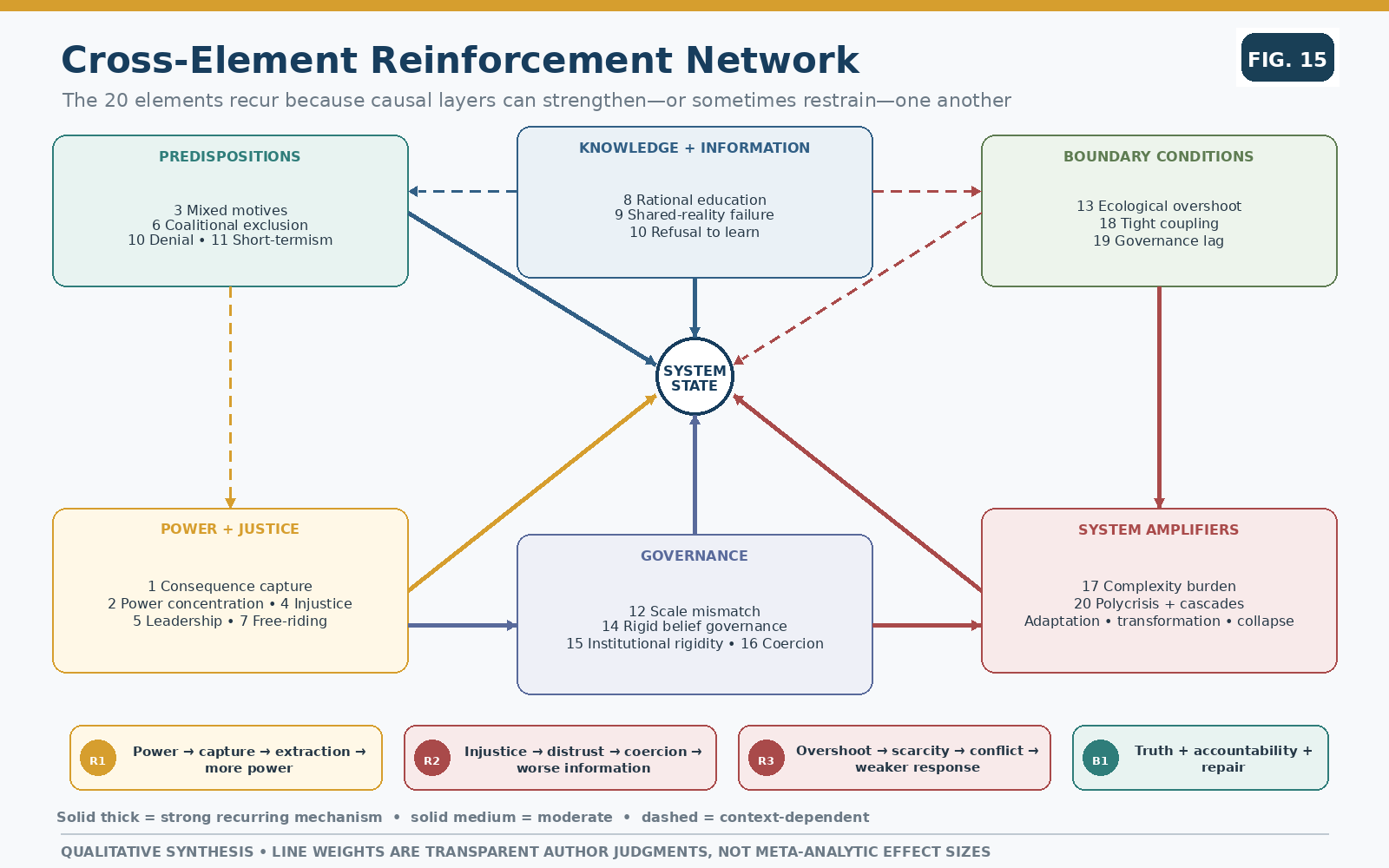
The 20 elements are grouped by primary analytical role rather than causal rank. The layers are permeable: leadership belongs to power and governance; complexity can be an institutional property and a systemic amplifier; ideology operates in information and governance; tight coupling can be a boundary condition and a transmission mechanism. The purpose of layering is to prevent categories from being treated as equivalent while preserving their interactions.
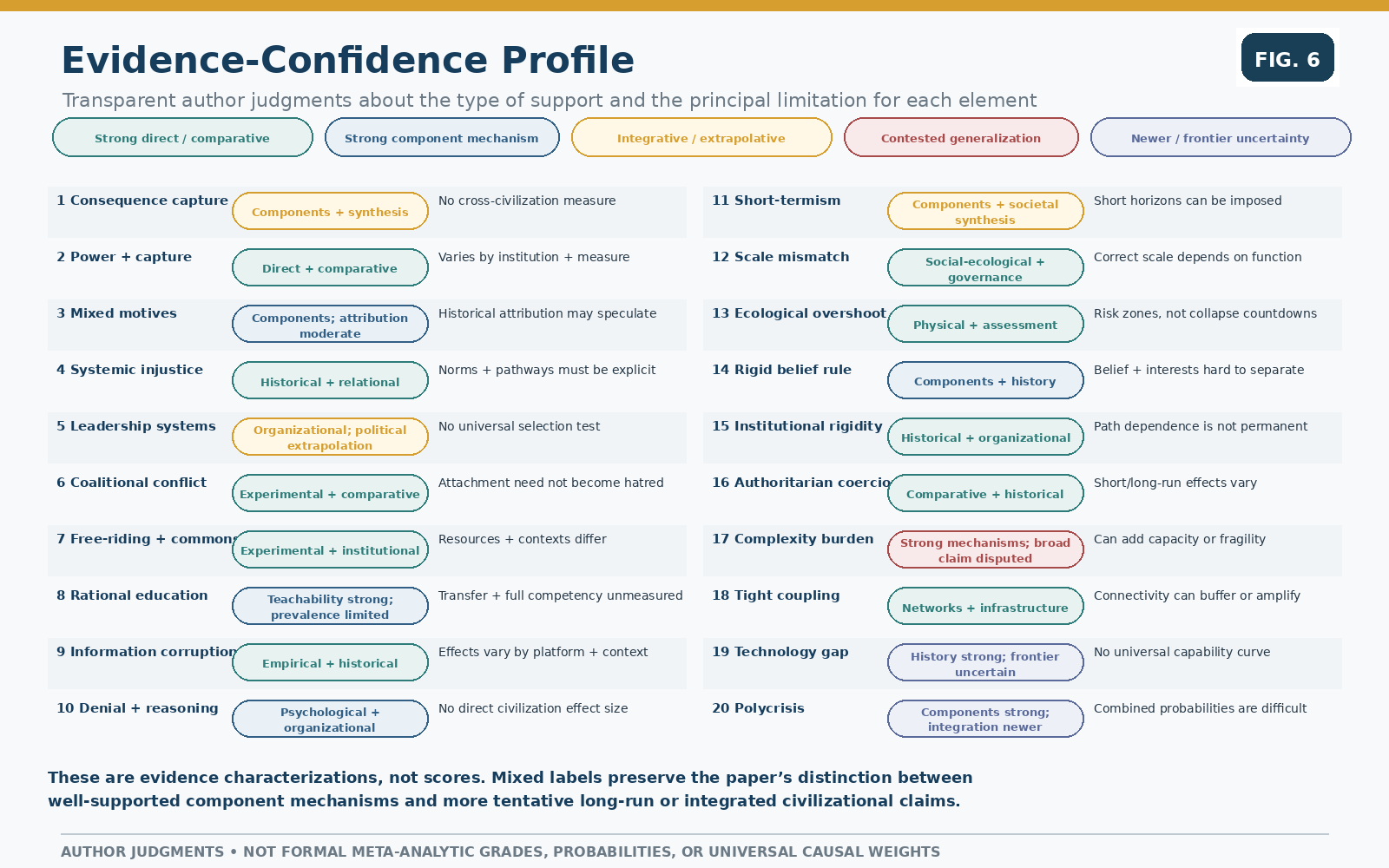
The architecture distinguishes predispositions, knowledge conditions, power relations, governance configurations, boundary conditions, and systemic amplifiers because causal depth matters. A cognitive bias is not equivalent to a law, a law is not equivalent to an energy constraint, and a network amplifier is not the same kind of cause as the decision that enters the network. Treating all 20 as a flat checklist would inflate apparent comprehensiveness while weakening explanation. The layers identify the primary analytical location of each mechanism, while cross-layer notes acknowledge that real institutions refuse to remain politely inside conceptual boxes.
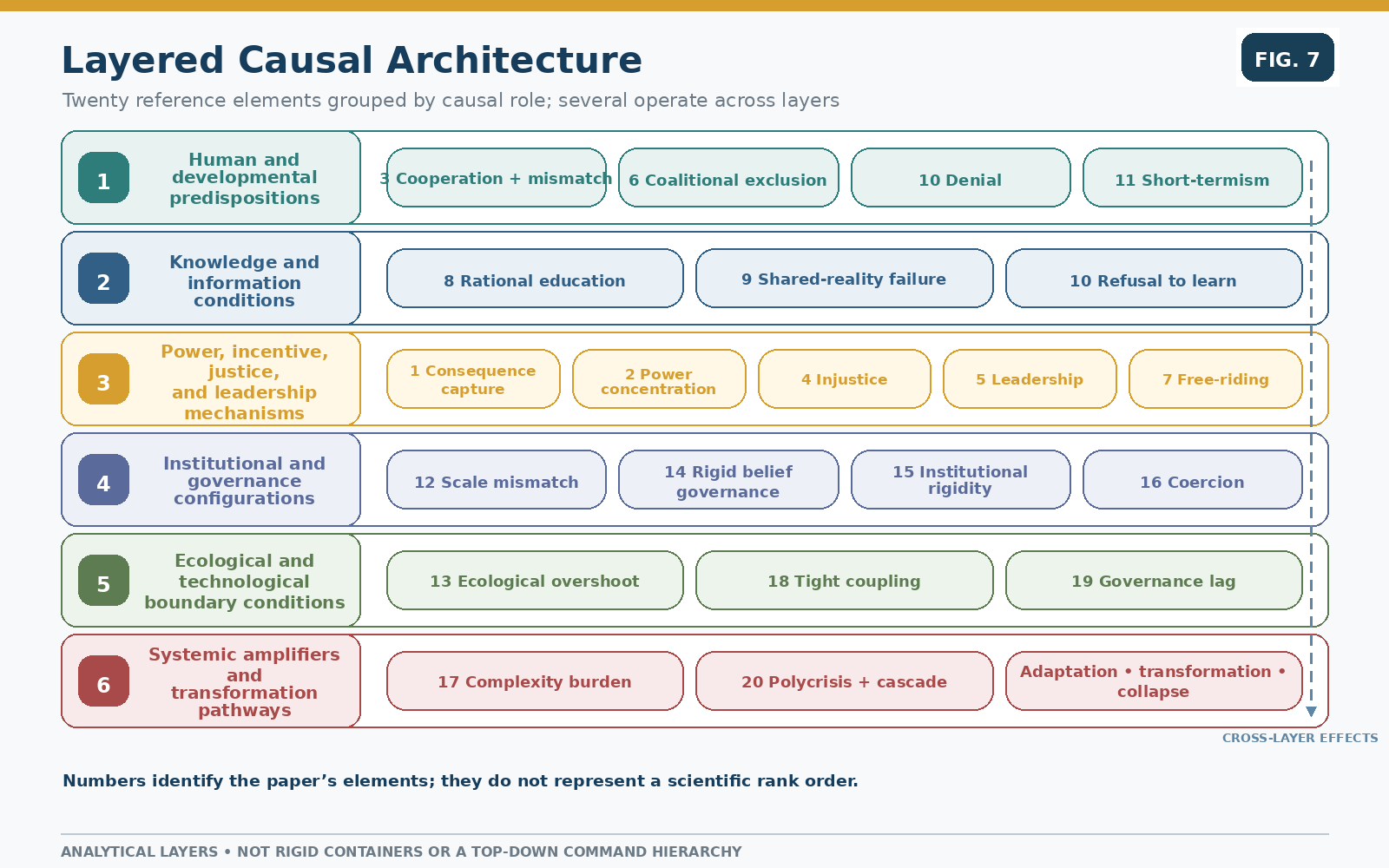
The layered causal architecture provides the primary placement used in this article. Reciprocal influence represents upward emergence and downward constraint rather than a deterministic sequence. The numbered labels remain stable throughout the article and are not a scientific rank order.
Table 2. Evidence-confidence profile for the 20 causal elements
| Element | Current confidence | Primary evidence base | Principal limitation or test |
|---|---|---|---|
| 1. Consequence capture | Strong component support | Externalities, moral hazard, principal-agent and governance research | Cross-era measurement of distance between decision, benefit, harm, and accountability |
| 2. Power concentration and capture | Strong but context-dependent | Political economy, limited-access orders, elite influence | Variation across regimes and nonstate power; causal direction |
| 3. Mixed motives, mismatch, and cue-consequence traps | Strong component support; macro translation provisional | Evolutionary cooperation, ecological-trap research, cultural learning, behavioral research | Distinguishing genuine cue-proxy decoupling from generic bad incentives |
| 4. Systemic injustice | Strong descriptive and relational support | Intersectionality, durable inequality, legitimacy research | Comparative weighting of justice mechanisms against material hazards |
| 5. Leadership ecosystem failure | Moderate to strong component support | Destructive leadership, institutional constraint, succession | Avoiding retrospective diagnosis and leader-centered overstatement |
| 6. Coalitionalism and conflict | Strong component support | Social identity and security-dilemma research | Boundary conditions for cross-cutting versus polarizing identities |
| 7. Free-riding and commons failure | Strong comparative support | Experimental cooperation and commons governance | Scaling local design principles to global and highly unequal systems |
| 8. Rational-thinking education deficit | Moderate component support | Critical-thinking instruction and adult-development research | Long-run political transfer and effects outside educational settings |
| 9. Information corruption | Strong contemporary support | Misinformation diffusion, epistemic injustice, institutional legibility | Historical comparability and rapidly changing media architectures |
| 10. Denial and blocked learning | Strong psychological; moderate organizational | Motivated reasoning and organizational learning | Measuring concealed information and counterfactual correction |
| 11. Short-termism and reflective limits | Strong component support | Bias, intertemporal choice, metacognition | Institutional interaction and culturally variable time horizons |
| 12. Scale mismatch | Strong systems and governance support | Cross-scale dynamics, polycentric governance | Specifying optimal authority across problem types |
| 13. Ecological overshoot | Strong contemporary scientific support | Climate, biodiversity, planetary-boundary assessments | Regional thresholds, timing, adaptation, and distributional mediation |
| 14. Rigid governing belief systems | Moderate integrative support | Critical realism, ideology, falsification and pluralism | Operationalization without pathologizing identity or religion |
| 15. Institutional rigidity | Strong organizational support | Path dependence, exploration-exploitation, defensive routines | Comparative measures of adaptive change versus destabilizing churn |
| 16. Security-overhead trap | Moderate configurational support | Legitimacy, coercion, information distortion, fiscal burden | Separating temporary stabilization from long-run capacity loss |
| 17. Complexity and diminishing returns | Moderate to strong historical support | Complexity-collapse and organizational systems research | Distinguishing essential from parasitic complexity |
| 18. Tight coupling and dependency | Strong systems support | Normal accidents, resilience, interdependent networks | Estimating real-world dependencies and compensating redundancy |
| 19. Capability-governance gap | Strong conceptual; rapidly growing empirical base | Technology control, AI concentration, lock-in, precaution and liability | Technology-specific thresholds, concentration effects, and governance effectiveness |
| 20. Polycrisis and cascading failure | Growing systems support | Crisis entanglement, synchronous failure, systemic-risk methods | Operational definitions, double counting, and predictive validation |
4. The Six Layers and 20 Interacting Elements
4.1 Layer 1: Evolved predispositions and reflective agency
Element 3. Evolved mixed-motive human psychology, evolutionary mismatch, and cue-consequence traps
Human beings are neither naturally selfish calculators nor naturally harmonious cooperators. Selection produced capacities for care, reciprocity, status seeking, coalition formation, punishment, imitation, deception, norm enforcement, exploration, and learning. Cultural evolution can enlarge cooperation far beyond kinship, yet the same capacities can stabilize hierarchy or violence (Bowles & Gintis, 2011; Henrich, 2016; Maynard Smith & Szathmáry, 1995). Institutions must therefore be designed for multi-motive agents rather than imaginary saints or permanently acquisitive automatons.
Evolutionary mismatch arises when capacities shaped under one recurrent environment operate under materially different conditions. Contemporary decision makers confront anonymous mass societies, global markets, bureaucratic chains, digital media, delayed planetary effects, and technologies whose consequences can be remote in time, space, and visibility. Moral intuitions calibrated to face-to-face reciprocity can therefore underweight statistical victims, future generations, ecosystem thresholds, or risks transmitted through infrastructure. Human nature is a design constraint, not a verdict: social learning, institutions, and reflective agency can redirect inherited tendencies.
A more specific subset is the evolutionary or ecological trap. Organisms normally use cues that historically correlated with beneficial outcomes; environmental change can break that correlation so that the cue remains attractive while the consequence becomes harmful (Schlaepfer et al., 2002; Robertson et al., 2013). The same causal grammar can illuminate human institutions without pretending that complex political choices are simple animal reflexes. Status, engagement, growth, quarterly performance, electoral attention, or organizational metrics can function as proxies that once tracked useful outcomes but become decoupled from long-run human or ecological value.
The term “trap” is used narrowly. A cue-consequence trap should identify the cue or proxy, its earlier adaptive context, the changed environment, repeated cue-guided behavior, a defensible outcome standard, the scale and distribution of harm, feasible alternatives, and barriers to correction. Signal-detection asymmetries also matter: missing a real threat and overreacting to a false one can carry very different costs. Without these diagnostics, “evolutionary trap” risks becoming a decorative synonym for bad incentives.
This boundary prevents conceptual inflation. Direct coercion, extraction, scarcity, warfare, or physical destruction should not be relabeled an evolutionary trap merely because they are harmful. Nor is every bad incentive an evolved mismatch. The concept adds value only where a once-informative cue or institutional proxy is demonstrably decoupled from the outcome it is treated as representing. This distinction makes the claim falsifiable and connects evolutionary reasoning to metric gaming, information systems, and institutional adaptation without reducing history to biology.
Mismatch is intensified by distance and abstraction. Consequences may be delayed for decades, dispersed across millions of people, hidden in supply chains, or imposed on future generations and nonhuman systems. Corrective institutions must make remote consequences legible, represent absent stakeholders, and prevent competitive advantage from accruing to actors most effective at hiding costs. This does not eliminate moral agency; it gives moral agency a structure in which it can survive selection.
Element 6. Coalitionalism, identity-based exclusion, and intergroup conflict
Group identity enables trust, sacrifice, mutual aid, and political mobilization. It also permits in-group favoritism, moral exclusion, scapegoating, and suppression of internal dissent (Tajfel & Turner, 1986; Jervis, 1978). Threat, humiliation, inequality, propaganda, and competition can turn ordinary categories into existential boundaries. Coalitionalism becomes especially dangerous when leaders gain from polarizing identities or when security dilemmas make defensive preparations appear offensive to others.
Coalitional dynamics operate through both bottom-up attachment and strategic activation. People seek belonging, recognition, and protection, but leaders and organizations can redraw group boundaries, magnify threat, suppress cross-cutting identities, and convert policy disagreement into moral contamination. Under insecurity, even defensive behavior can create a security dilemma in which each side interprets the other’s precautions as aggression (Jervis, 1978). The resulting feedback can make escalation rational from inside each coalition while jointly destructive.
Element 11. Short-termism, cognitive bias, and underdeveloped reflective agency
People and organizations overweight immediate, vivid, certain, and personally attributable outcomes relative to delayed, statistical, distributed, or uncertain harms. Present bias, availability, confirmation, overconfidence, sunk-cost escalation, and difficulty intuiting nonlinear change interact with election cycles, quarterly reporting, debt service, emergencies, and media attention (Kahneman, 2011; Kunda, 1990). A choice can be locally rational and systemically destructive when rewards and accountability operate on different horizons.
Reflective agency is the capacity to examine the assumptions, roles, identities, emotions, and incentives shaping one’s action. Adult-development theory suggests that the ability to coordinate competing systems of meaning varies, although developmental models should not be mistaken for universal political-selection tests (Kegan, 1994). The institutional question is not whether all decision makers can transcend bias. It is whether procedures make bias visible and correctable before consequences become irreversible.
Short-termism is often institutional before it is psychological. Election calendars, promotion systems, quarterly earnings, annual budgets, debt covenants, emergency response, and attention markets compress the time horizon even for actors who understand long-run risk. Delayed harms become politically weak because future people cannot vote, ecosystems cannot negotiate, and statistical victims are less salient than visible current costs. Bias and incentive therefore reinforce one another rather than competing as explanations.
4.2 Layer 2: Knowledge and information conditions
Element 8. Failure to provide universal education in rational, scientific, systemic, and metacognitive problem-solving
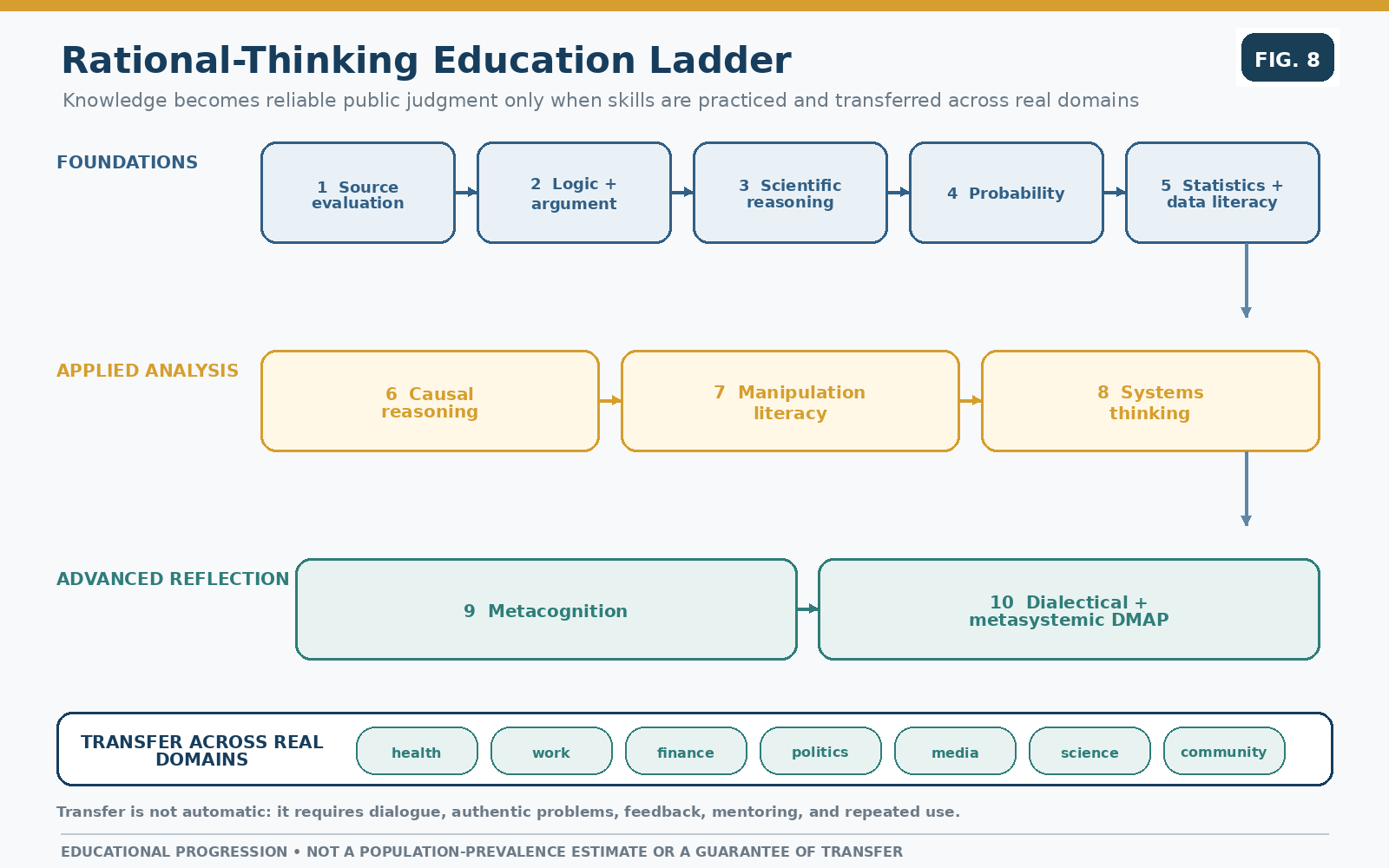
Mass education greatly expanded literacy and technical competence, but it seldom provides an integrated curriculum in source evaluation, logic, probability, causal inference, manipulation literacy, systems thinking, metacognition, and transfer to real decisions. Critical-thinking instruction can improve performance, especially when skills are explicitly taught and practiced across contexts (Abrami et al., 2015). Declarative knowledge alone is insufficient; methods become transformative only through repeated application to consequential problems.
Universal access is a governance requirement because concentrated reasoning capacity can itself be captured. Experts are vulnerable to incentives, specialization blindness, prestige hierarchies, and organizational conformity. Citizens possess local and experiential knowledge that formal models may omit, while expertise is indispensable for problems whose evidence cannot be evaluated through intuition alone. The design target is distributed epistemic competence: specialists who communicate uncertainty, institutions that integrate lived knowledge, and publics able to distinguish expertise from authority theater without treating every claim as equally plausible.
Contemporary adult-skills data illustrate why this is not merely a curricular preference. In the OECD Survey of Adult Skills (PIAAC) 2023, 32% of U.S. adults aged 16–65 scored at or below Level 1 in adaptive problem solving, with similarly substantial low-proficiency shares in literacy and numeracy (OECD, 2024). These measures do not test systems thinking, scientific judgment, or civic wisdom, and response-rate and cross-national comparability limitations matter. They are best treated as a warning about the scale of basic skill constraints, not as a ranking of citizens’ worth or a warrant for technocratic rule.
Denial is distinct from rigidity but reinforces it. Denial supplies the protective narrative; rigid institutions preserve the procedures, careers, and incentives that make the narrative useful. Correction requires both epistemic and material change. Asking people to confess while leaving the penalties, rewards, and power structure untouched is less a learning system than a ritualized invitation to self-destruction.
Denial becomes organizational when careers, budgets, legal exposure, collective identity, and institutional legitimacy depend on a preferred account. Individuals may privately recognize failure while public incentives reward silence. Reports are softened, categories are redefined, responsibility is diffused, and each layer passes reassuring information upward. The resulting organization can appear confident precisely because contrary evidence has been filtered out. Motivated reasoning is thus coupled to hierarchy and information design, not confined to private psychology (Kunda, 1990; March, 1991).
Element 14. Rigid, identity-bound, and non-falsifiable belief systems in governance
Religious and secular worldviews can motivate compassion, courage, scientific inquiry, restraint, and resistance to oppression. The identified danger is narrower: governing claims become destructive when they are insulated from evidence, equal rights, revision, or disconfirming outcomes. A belief system becomes identity-bound when criticism of a policy is experienced as betrayal of the person, group, nation, market, party, or sacred order.
Rigidity is identified by the relationship between belief and correction, not by whether the doctrine is religious, secular, traditional, or modern. Markets, states, nations, technologies, revolutions, and scientific institutions can all become sacred objects when failure is explained away indefinitely, dissenters are treated as morally contaminated, and implementation expands after disconfirmation. The risk rises when identity, livelihood, and authority depend on the doctrine’s infallibility.
4.3 Layer 3: Power, incentives, justice, and leadership
Element 1. Failure of consequence capture and incentive alignment
Consequence capture exists when decision makers experience an appropriate share of the beneficial and harmful consequences produced by their decisions. Civilizations repeatedly separate decision, benefit, harm, and accountability. Rulers can gain prestige while soldiers and civilians absorb casualties; firms can retain profits while workers, communities, taxpayers, future generations, or ecosystems bear damage; financial actors can privatize gains while public institutions socialize losses.
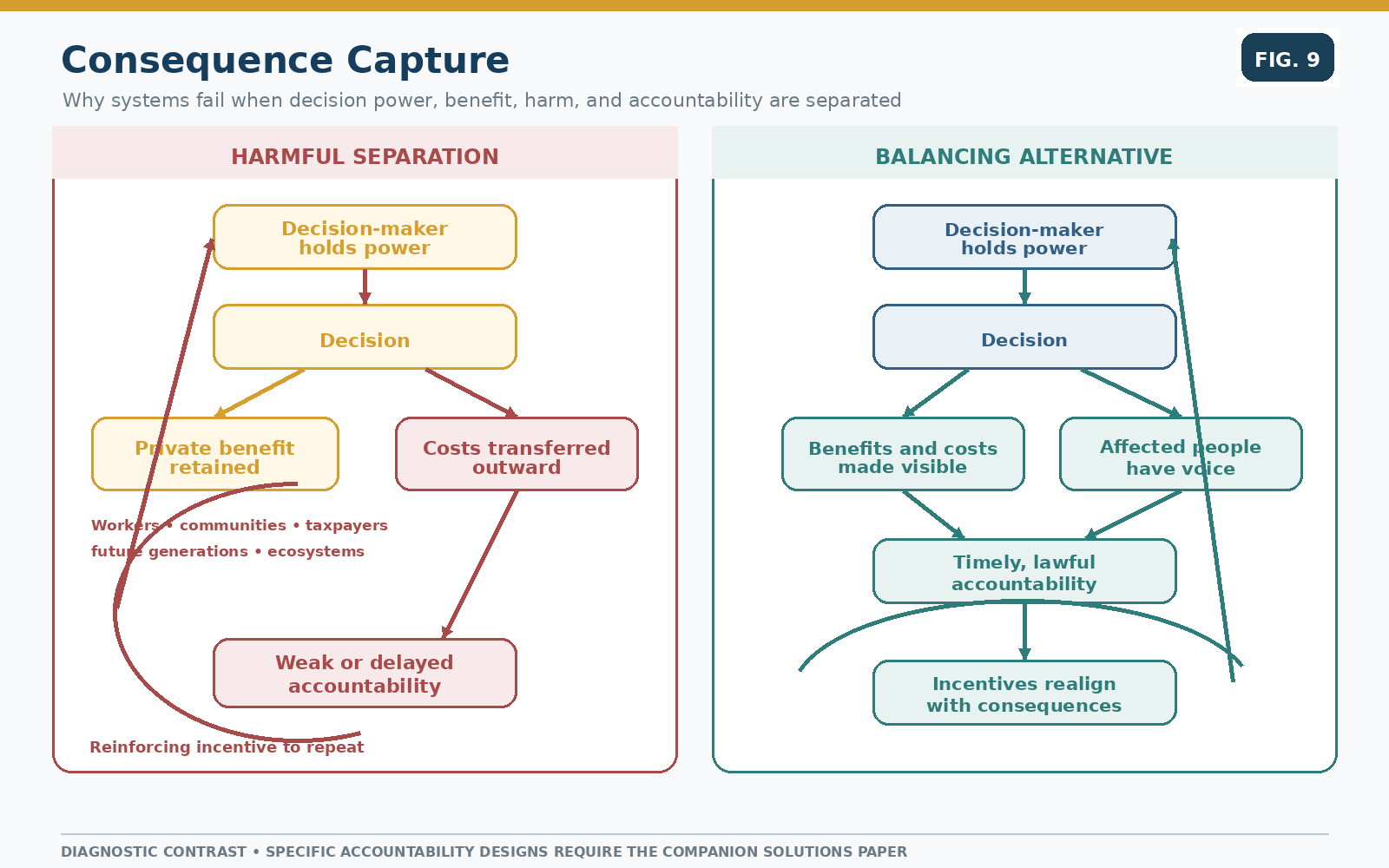
When actors keep benefits and externalize costs, destructive conduct can become individually rational even when collectively ruinous. Competitive selection may then favor organizations most willing or able to exploit the arrangement. The construct connects externalities, moral hazard, principal-agent failure, free-riding, and regulatory capture. Durable correction requires power, visibility, voice, and accountability to follow consequences rather than merely accompanying them in a policy brochure (Bowles, 2008; World Bank, 2017).
Consequence capture is not the claim that decision makers should suffer every unintended harm or that all externalities can be perfectly priced. It is a proportionality principle. As the scale, irreversibility, and asymmetry of a decision increase, the actors authorizing and benefiting from it should face stronger duties of disclosure, prevention, insurance, restitution, and lawful sanction. A complete map asks four questions: who decides, who gains, who is exposed, and who can compel correction. Large gaps among those positions are warning signs.
Element 2. Concentration of power, institutional capture, and extraction
Power concentration can solve coordination problems, mobilize resources, and protect public goods. It also enables actors to shape rules, agendas, appointments, enforcement, information, and exit conditions in their own interest. Evidence that affluent citizens and organized interests can exert disproportionate policy influence illustrates one modern pathway, although the magnitude and form vary across systems (Gilens & Page, 2014).
Capture is not synonymous with a secret central conspiracy. Much harmful coordination emerges from aligned incentives, revolving doors, dependence, legal privilege, professional norms, and selective access rather than perfect command. Limited-access orders can stabilize violence by distributing rents among powerful groups, but the same arrangement can institutionalize exclusion and block open competition (North et al., 2009). Claim hygiene therefore requires separating documented actions from inferred intent and identifying what evidence would change the inference.
Power is multidimensional. It includes command over force and law, control of capital and infrastructure, agenda setting, expertise, data, media visibility, organizational coordination, and the ability to exit while others remain dependent. Concentration in one domain can purchase influence in another, creating cumulative advantage. Capture may occur even when formal procedures continue, because the range of viable choices, appointments, evidence, and enforcement priorities has already been narrowed.
Element 4. Systemic injustice, domination, exclusion, and unequal consequence distribution
Injustice is reproduced through relationships that distribute control, dependence, exit, voice, recognition, benefit, risk, rights, and accountability. Race, class, caste, gender, citizenship, colonial status, disability, and generation can intersect so that harms are not reducible to one axis (Crenshaw, 1989; Tilly, 1998; Young, 1990). Unequal outcomes are not automatically unjust, but inequality becomes unjust when produced by coercion, inherited domination, biased procedure, avoidable deprivation, or transferred harm.
Justice is also functional governance infrastructure. People are more likely to comply with institutions they regard as legitimate and procedurally fair (Tyler, 2006). Persistent unfairness reduces trust, narrows the information available to decision makers, increases resistance or withdrawal, and makes coercion appear necessary. Injustice is therefore both an outcome and an amplifier of civilizational dysfunction.
The relational focus avoids treating injustice as a residual difference in outcomes. Domination exists where one actor can arbitrarily shape another’s options, impose risk, withhold recognition, or block exit without reciprocal accountability. Durable categorical inequalities can become embedded in housing, labor markets, citizenship, inheritance, education, policing, health, and environmental exposure, then reproduced even when explicit prejudice declines (Tilly, 1998). Intersections matter because the same rule can distribute vulnerability differently across class, race, caste, gender, disability, age, and legal status (Crenshaw, 1989).
Element 5. Failure to select, develop, constrain, and lawfully replace high-functioning leaders
Leadership matters, but leader-centered history is inadequate. Destructive outcomes arise from interactions among leaders, susceptible followers, advisers, constituencies, organizations, courts, civil services, information channels, succession rules, and enabling environments (Padilla et al., 2007). A charismatic person can be competent in one domain and impaired in judgment, integrity, empathy, reality testing, or capacity to tolerate dissent in another.
Good governance requires both capable leadership and constraints. Neither heroic-leader romanticism nor the belief that rules can make personnel irrelevant survives contact with complex institutions. Constitutional channels, independent oversight, transparent conflicts, truthful advisers, competent teams, succession planning, and lawful replacement protect societies from both bad leaders and the decay of good intentions (Acemoglu & Robinson, 2019).
Leadership quality is domain-specific and relational. Strategic intelligence does not guarantee ethical judgment; charisma does not guarantee reality testing; moral conviction does not guarantee administrative competence; and technical expertise does not guarantee the capacity to hear dissent. Retrospective diagnosis of public figures is unreliable and easily weaponized. The framework therefore evaluates observable role performance and the institutional ecosystem rather than assigning clinical labels from a distance.
Selection systems can reward campaigning, loyalty, fundraising, factional appeal, or internal survival rather than competence in office. After selection, diverse advisers, professional civil services, decision protocols, conflict disclosure, and access to disconfirming evidence can improve judgment. Independent courts, legislatures, auditors, media, professional ethics, lawful removal, and succession rules constrain failure. Leadership is therefore treated as an ecosystem of selection, support, constraint, accountability, and replacement, not as a heroic-personality variable.
Element 7. Free-riding, cheating, and failure to protect the commons
Free-riding occurs when actors accept the benefits of cooperation while avoiding a fair share of its costs. The classic tragedy of an unmanaged commons describes one possible outcome, not an iron law (Hardin, 1968). Comparative research shows that users can govern common-pool resources through clear boundaries, locally appropriate rules, participation, monitoring, graduated sanctions, conflict resolution, and nested institutions (Ostrom, 1990; Ostrom, 2009).
Cooperation requires countermeasures against persistent exploitation, but enforcement can itself become predatory. Punishment can sustain norms and also fuel domination or revenge (Fehr & Gächter, 2002). The design task is to contain free-riding while preserving proportionality, due process, legitimacy, and protection from capture. Climate stability, taxation, public health, democratic procedures, scientific knowledge, and ecological resources all present variants of this problem.
Commons failure includes more than overuse. Actors can undercontribute to maintenance, conceal extraction, corrupt monitoring, capture sanctions, export damage beyond the defined boundary, or demand exemptions while invoking a shared purpose. Large commons also contain power asymmetries absent from simplified dilemmas. A household, firm, state, and future generation do not enter climate or financial cooperation with equal capacity, responsibility, or vulnerability.
Element 16. Authoritarianism, coercion, and the security-overhead trap
When legitimacy and voluntary cooperation decline, rulers often substitute surveillance, censorship, propaganda, punishment, militarization, and force. These tools can suppress visible disorder and mobilize resources quickly. Their short-term effectiveness helps explain recurrence. Their long-term costs include falsified preferences, concealed failure, narrowed innovation, and leaders increasingly dependent on information supplied by people whose survival requires agreement.
The security-overhead trap is reinforcing: declining legitimacy produces greater coercion; coercion damages legitimacy and truthful feedback; poorer information worsens decisions and services; control then requires still more surveillance and force. The apparatus consumes fiscal, material, and human resources needed for genuine problem solving. Governance capacity itself can therefore enter overshoot when debt, security expenditure, administrative burden, and blowback exceed the surplus available to sustain them.
Coercion is not identical to state capacity. Lawful institutions require enforcement, and emergency coordination can temporarily centralize authority. The trap begins when coercion substitutes for legitimacy, reliable service, and truthful correction, while rulers treat every failure as evidence that more control is required. Surveillance and punishment can suppress visible dissent, but they also produce preference falsification, opportunistic loyalty, and upward information tailored to the ruler’s expectations. Apparent order may therefore coexist with declining situational awareness.
Security overhead includes direct fiscal cost, opportunity cost, administrative complexity, fear, innovation loss, corruption opportunities, and blowback generated by repression or external intervention. As ecological and economic surplus narrows, this apparatus competes with maintenance, health, education, adaptation, and infrastructure. A coercive system can remain stable for long periods, so the claim is not that repression causes immediate collapse. It is that control becomes progressively expensive and informationally self-undermining unless balanced by legitimacy, rights, professional restraint, independent review, and lawful exit from emergency powers.
4.4 Layer 4: Institutional and governance configurations
Element 12. Failure to organize cooperation at the appropriate scale
Problems and institutions frequently occupy different spatial, temporal, jurisdictional, and knowledge scales. Local bodies may understand conditions but lack resources; national governments may command resources but erase local variation; global problems may have no authority capable of enforcing commitments. Cross-scale governance must connect rather than simply choose between centralization and decentralization (Cash et al., 2006).
Subsidiarity without higher-order coordination can leave climate, financial contagion, migration, pandemics, and weapons risk unmanaged. Central coordination without local autonomy can produce brittle uniformity, administrative blindness, and resistance. Viable arrangements combine nested authority, polycentric experimentation, shared standards, transparent escalation, and mechanisms that prevent higher levels from capturing lower ones or local vetoes from exporting harm.
Scale matching concerns four dimensions: the spatial reach of the problem, the time horizon of consequences, the jurisdiction able to enforce decisions, and the location of relevant knowledge. These dimensions rarely align automatically. A watershed crosses municipal boundaries; a supply chain crosses states; a pandemic moves faster than legislation; a neighborhood experiences implementation details invisible to national administrators. Authority placed at only one level will therefore be either too weak, too distant, or both.
Element 15. Institutional rigidity, path dependence, organizational defensiveness, and failure to adapt
Institutions embody earlier choices in laws, infrastructure, professions, revenue streams, routines, and identities. These investments create path dependence: history changes the cost and political distribution of alternatives (North, 1990). Organizations also protect members from embarrassment or threat, filter warning information, and reinterpret failure to preserve authority. Exploitation of established competence can crowd out exploration, while perpetual novelty can destroy accumulated skill (March, 1991).
The problem is not stability itself. Reliable rights, public services, and expectations require continuity. The failure occurs when institutions cannot distinguish what must be preserved from what must change. Adaptive simplification may be necessary when returns to complexity decline, but indiscriminate dismantling can destroy medicine, infrastructure, knowledge, and lawful protection. Reform must therefore preserve legitimacy and essential capacity while removing parasitic or obsolete layers.
Path dependence is not mere attachment to tradition. Infrastructure, legal rights, professional training, revenue models, sunk capital, organizational identity, and complementary technologies make some alternatives expensive or politically threatening. Early choices can create increasing returns and constituencies that defend the path. When failure arrives, institutions may intensify the familiar strategy because competence, metrics, and legitimacy were built around it (North, 1990; March, 1991).
Adaptive institutions need memory and revisability. Constant reorganization destroys tacit knowledge, trust, and public capacity, while rigid continuity protects obsolete procedures. Useful safeguards include periodic review, sunset and renewal rules, protected experimentation, independent evaluation, scenario triggers, modular design, and preservation plans for essential functions. Adaptive simplification is especially important when returns to complexity decline. It removes rules, dependencies, or layers that no longer justify their maintenance cost while protecting medicine, knowledge, infrastructure, rights, and feedback. Indiscriminate dismantling is not simplification; it is the destruction of the capacity needed to simplify intelligently.
4.5 Layer 5: Ecological and technological boundary conditions
Element 13. Ecological degradation and resource overshoot
Human systems are open subsystems of the biosphere, dependent on energy, materials, soils, water, climate regulation, biodiversity, waste absorption, and ecological resilience. Contemporary assessments document climate risk, biodiversity decline, and multiple planetary-boundary transgressions (IPCC, 2023; IPBES, 2019; Richardson et al., 2023). These conditions do not provide a deterministic collapse clock. They narrow safe operating space, increase correlated stresses, and raise the cost of governance failure.
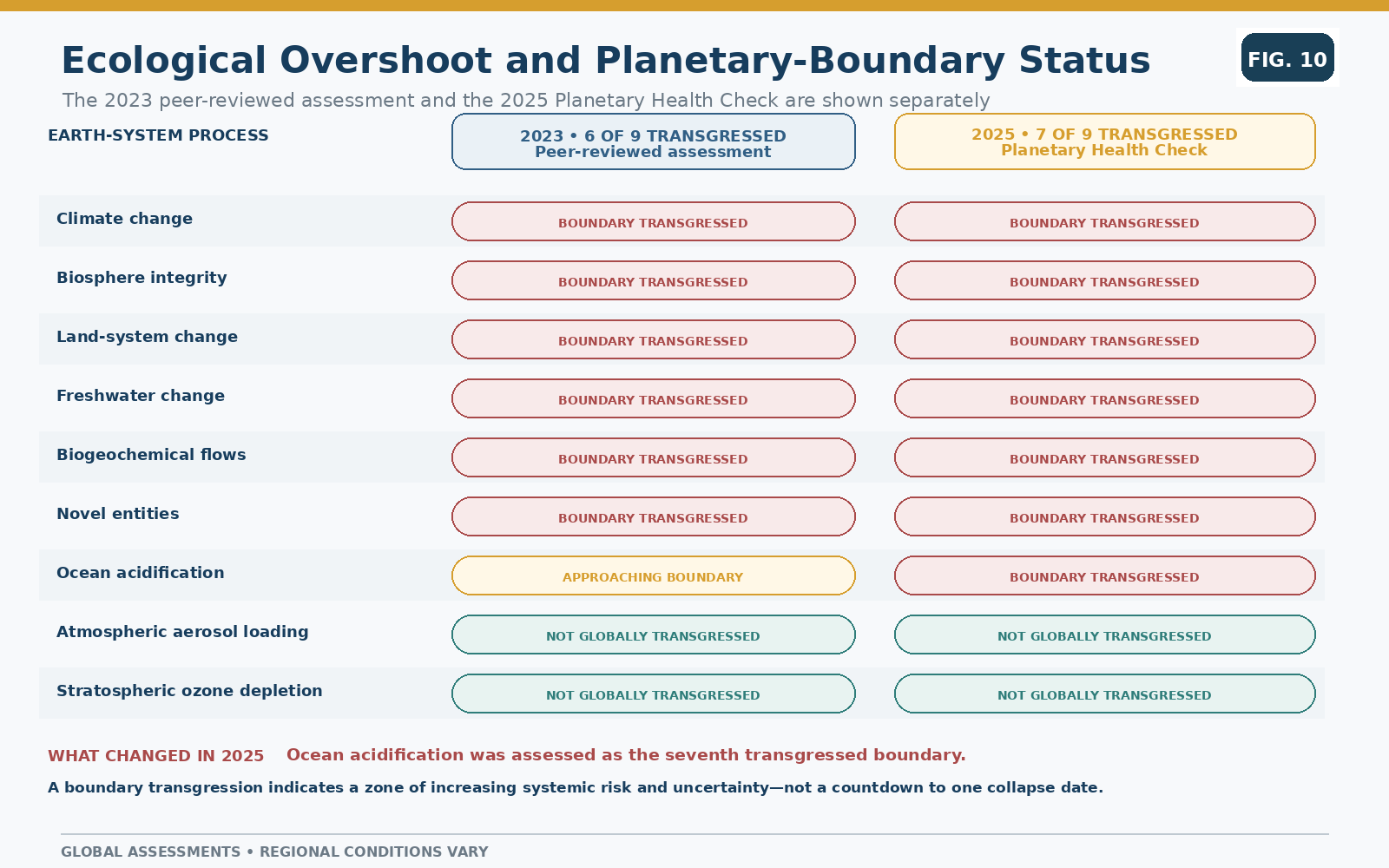
Figure 10. Ecological overshoot and planetary-boundary status. Boundary transgression is a risk condition, not a countdown clock to one predetermined collapse. Source: Original conceptual synthesis for this study.
Overshoot changes the price of every institutional choice. Ecological depletion can reduce fiscal surplus, intensify distributional conflict, undermine food and water security, increase migration, and make maintaining complex infrastructure more difficult. Governance cannot purchase unlimited complexity with declining net energy, degraded ecosystems, and debt. Ecological restoration and institutional reform are therefore coupled, not competing agendas.
Overshoot occurs when resource use, waste generation, or ecological pressure exceeds regenerative and absorptive capacity for long enough to erode the underlying stocks. Its political effects are mediated rather than automatic. Similar drought, scarcity, or climate exposure can yield cooperation, migration, innovation, repression, or conflict depending on distribution, legitimacy, infrastructure, external support, and institutional flexibility. Ecological conditions are therefore hard boundaries without being single-cause historical destinies.
The governance consequence is a shrinking option space. Degraded soils, water systems, biodiversity, climate stability, and material reserves raise maintenance costs and reduce surplus for health, education, infrastructure, adaptation, and conflict prevention; debt and security overhead can intensify the squeeze. Planning should use risk windows rather than false deadlines: 2026–2032 for acute cascade exposure and lock-in, 2033–2045 for rebuilding adaptive capacity, and 2045–2050+ for maintaining durable low-overshoot systems.
Element 19. Technology advancing faster than governance, ethics, and human development
Technology amplifies human capability faster than it necessarily improves wisdom, restraint, accountability, or coordination. The same capacity can support medicine, accessibility, forecasting, and environmental monitoring while enlarging warfare, surveillance, extraction, manipulation, cyber disruption, biological risk, and artificial-intelligence concentration. Effects depend on ownership, incentives, architecture, access, and failure modes.
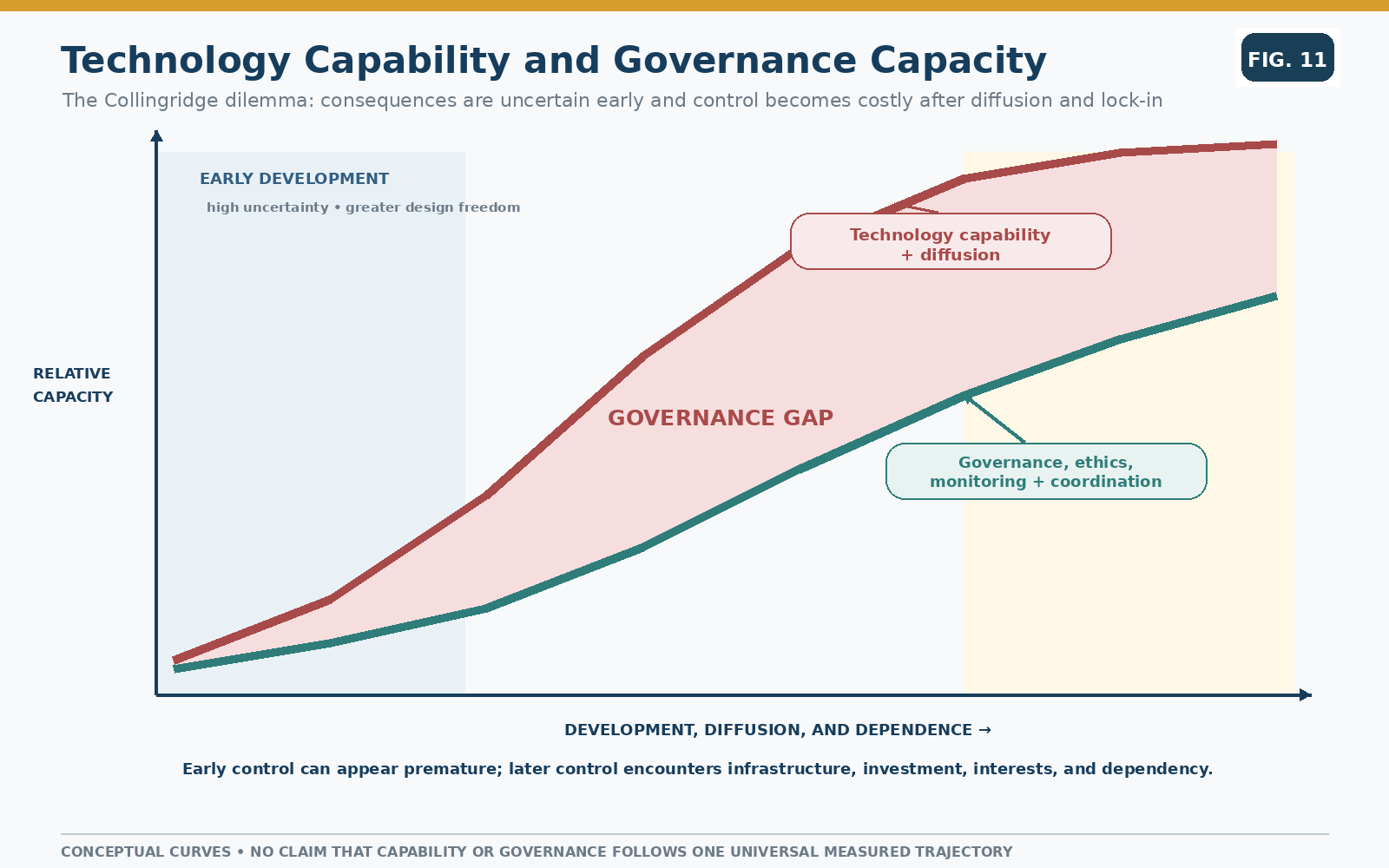
The Collingridge dilemma describes a recurrent timing problem: early consequences are uncertain and control appears premature; after diffusion, harms become clearer but infrastructure, dependency, and interests make control expensive (Collingridge, 1980). Precaution and innovation are not simple opposites. Adaptive governance requires staged deployment, monitoring, reversibility, liability, distributed expertise, and precommitted thresholds for intervention.
The capability-governance gap is greatest where a technology scales quickly, concentrates control, creates opaque dependencies, or produces irreversible harm before evidence matures. Artificial intelligence can amplify several elements simultaneously: information manipulation, surveillance, labor and wealth concentration, automated decision opacity, cyber capability, scientific acceleration, and the speed at which errors propagate. These effects are not intrinsic to one artifact. They depend on ownership, access, training data, deployment architecture, liability, and the institutions deciding what is optimized.
Current AI development also makes concentration a first-order governance variable. Stanford’s 2026 AI Index reports that industry produced more than 90% of notable frontier models in 2025 and documents concentrated dependencies in advanced computing infrastructure (Stanford Institute for Human-Centered Artificial Intelligence, 2026). This does not establish that industrial leadership is inherently harmful. It does mean that model capability, cloud access, capital, data, and political influence can become mutually reinforcing, increasing the importance of competition policy, external evaluation, incident transparency, and governance that is not financially dependent on the systems it is meant to oversee.
Governance should be matched to risk rather than divided into prohibition versus permission. Staged deployment, independent testing, incident reporting, audit access, liability, red-team exercises, security standards, reversibility, and precommitted intervention thresholds allow learning before dependency becomes total. Precaution must remain revisable, because a rigid ban can entrench incumbents or block benefits. Innovation must also remain accountable, because appeals to uncertainty can postpone control until lock-in makes it prohibitively expensive. The Collingridge dilemma is thus a timing problem that requires institutional preparation before certainty arrives (Collingridge, 1980).
4.6 Layer 6: Systemic amplifiers and transformation pathways
Element 17. Excessive complexity and diminishing returns
Complexity is a civilizational achievement. It enables law, medicine, science, infrastructure, specialization, and coordination among strangers. Yet investments in complexity can produce diminishing marginal returns as maintenance, monitoring, energy, taxation, and dependency increase (Tainter, 1988). Rules accumulate, exceptions multiply, expertise becomes scarce, accountability becomes opaque, and failures in specialized components can propagate.
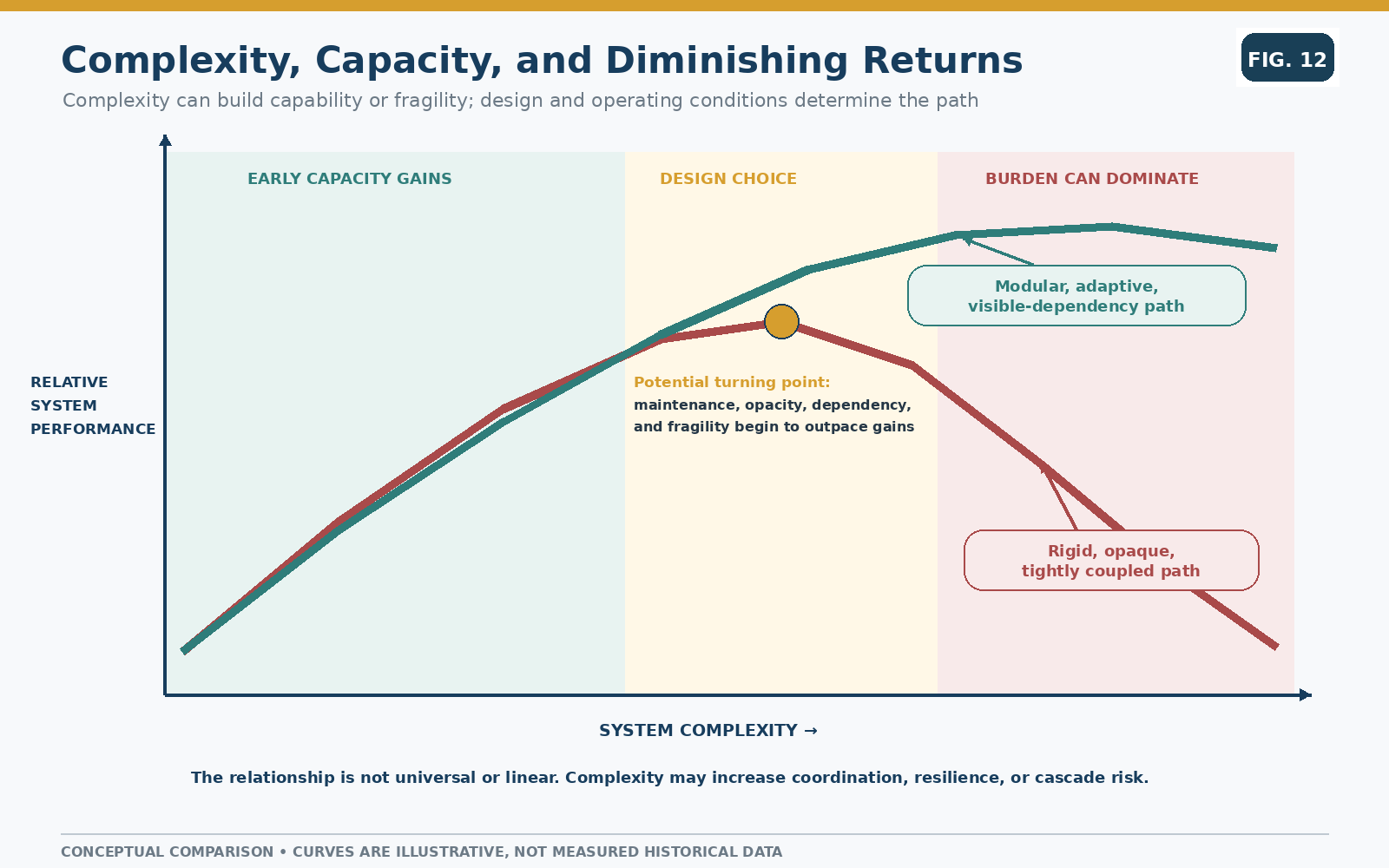
Complexity produces value when specialization, information processing, infrastructure, and coordination solve problems that simpler arrangements cannot. It becomes vulnerable when each additional layer adds more maintenance, energy use, expertise, interdependence, and opacity than usable problem-solving capacity. Diminishing returns can be hidden because organizations report gross activity while externalizing maintenance, debt, ecological drawdown, or unpaid care. Complexity may continue expanding even as net resilience falls (Tainter, 1988).
The useful contrast is not complex versus simple but generative versus parasitic complexity. Generative complexity is legible, maintainable, modular, appropriately redundant, and capable of graceful degradation. Parasitic complexity protects rents, obscures responsibility, multiplies unaccountable veto points, or creates dependencies whose maintenance costs exceed public value. Evaluation should therefore track essential capability, lifecycle cost, concentration of expertise, repairability, dependency chains, and whether simplification preserves legitimacy and core function.
Element 18. Globalization, tight coupling, dependency, and loss of resilience
Global integration enlarges markets, spreads knowledge, enables specialization, connects cultures, and supports unprecedented cooperation. It also allows shocks to travel rapidly across supply chains, financial networks, cyber systems, monocultures, and interdependent infrastructures. Connectivity can distribute risk in ordinary conditions and create pathways for contagion under stress (Perrow, 1999; Helbing, 2013; Buldyrev et al., 2010).
Efficiency often removes redundancy, inventories, local production, spare capacity, diversity, and backup systems because they appear wasteful during normal operation. Yet those reserves provide resilience when conditions depart from the model (Walker et al., 2004; Folke et al., 2010). Local self-reliance alone cannot solve global problems, but global integration without regional redundancy, visibility, and graceful degradation can convert a local failure into a systemic event.
Integration can reduce local volatility by pooling resources and connecting diverse suppliers, yet it can also synchronize systems that previously failed independently. Just-in-time production, financial leverage, monocultures, common software, shared cloud infrastructure, and concentrated logistics create efficiency under expected conditions while narrowing buffers against surprise. Interdependent networks can experience cascades in which failure in one layer disables the resources needed to restore another (Buldyrev et al., 2010; Helbing, 2013).
Resilience does not require autarky. Local self-sufficiency can be inefficient, unequal, and incapable of managing global risks. The both-and alternative combines international cooperation with regional redundancy, diversified suppliers, inventories, interoperability, transparent dependency maps, and capacity for graceful degradation. Globalization also reduces “outside options” when shocks become synchronized: there may be fewer unaffected regions able to provide refuge, credit, food, or technical assistance. The empirical question is therefore not how connected a system is in the abstract, but whether connectivity is modular, visible, substitutable, and backed by reserves appropriate to the consequence of failure (Walker et al., 2004).
Element 20. Systemic coupling, polycrisis, tail-risk neglect, and cascading failure
A polycrisis occurs when crises in multiple systems become causally entangled so that their joint effects differ from isolated harms. Common stresses can weaken several systems; domino effects transmit disruption; and intersystem feedbacks create reinforcing loops (Lawrence et al., 2024). Systemic-risk frameworks increasingly emphasize system architecture, power, vulnerable stakeholders, uncertainty, transformation, and nonhuman life (Gambhir et al., 2025).
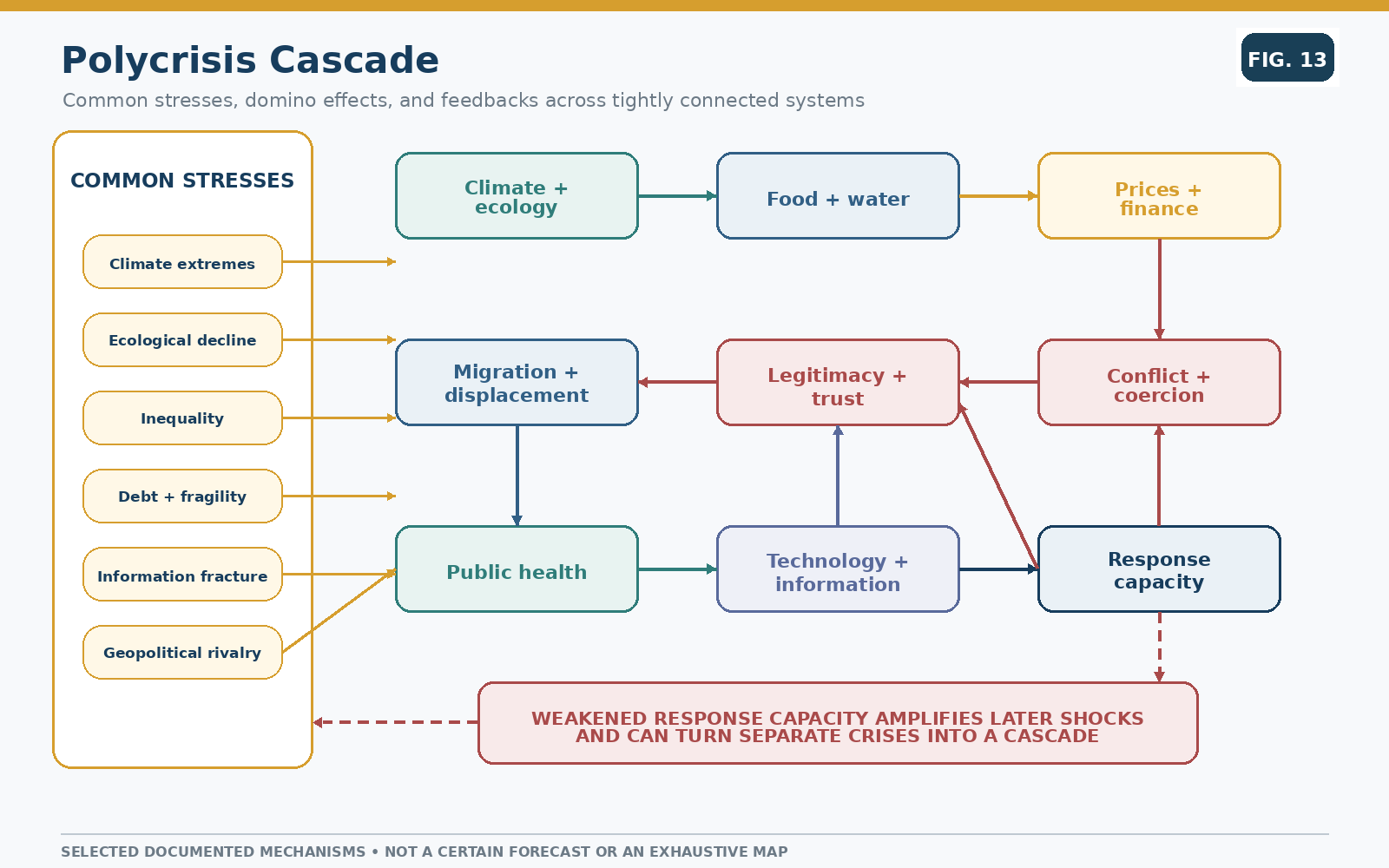
Tail risks are neglected when low estimated probability, model uncertainty, long horizons, and diffuse responsibility combine with catastrophic consequence. Tightly coupled systems can cross thresholds before linear indicators provide adequate warning (Scheffer et al., 2009; UNDRR, 2022). The framework does not predict one inevitable global collapse. It identifies conditions under which ecological, political, economic, technological, social, and security failures can amplify one another while disabling the institutions needed to respond.
Crisis entanglement can occur through common causes, domino effects, and feedback. A common ecological or financial stress can weaken several systems at once. A domino pathway carries failure from energy to communications to finance or health. Feedback occurs when social response to one crisis worsens another, as scarcity fuels conflict, conflict blocks repair, and blocked repair deepens scarcity. “Polycrisis” is useful only when the interaction changes explanation or intervention; it should not become a dramatic synonym for many bad things happening together (Lawrence et al., 2024).
Tail-risk governance must combine probability with consequence, model uncertainty, irreversibility, and recoverability. Low estimated probability does not justify neglect when the loss is catastrophic and the estimate is structurally fragile. Early-warning indicators can help, but thresholds may be crossed before signals are clear, and warning systems can be captured by the institutions they monitor (Scheffer et al., 2009). Robust responses emphasize redundancy, diversity, modularity, stress testing, transparent assumptions, emergency legitimacy, and the protection of response capacity itself. A society cannot manage a cascade if the cascade disables truthful information, fiscal flexibility, and cooperation before the technical hazard is understood.
5. Recurrent Causal Architecture
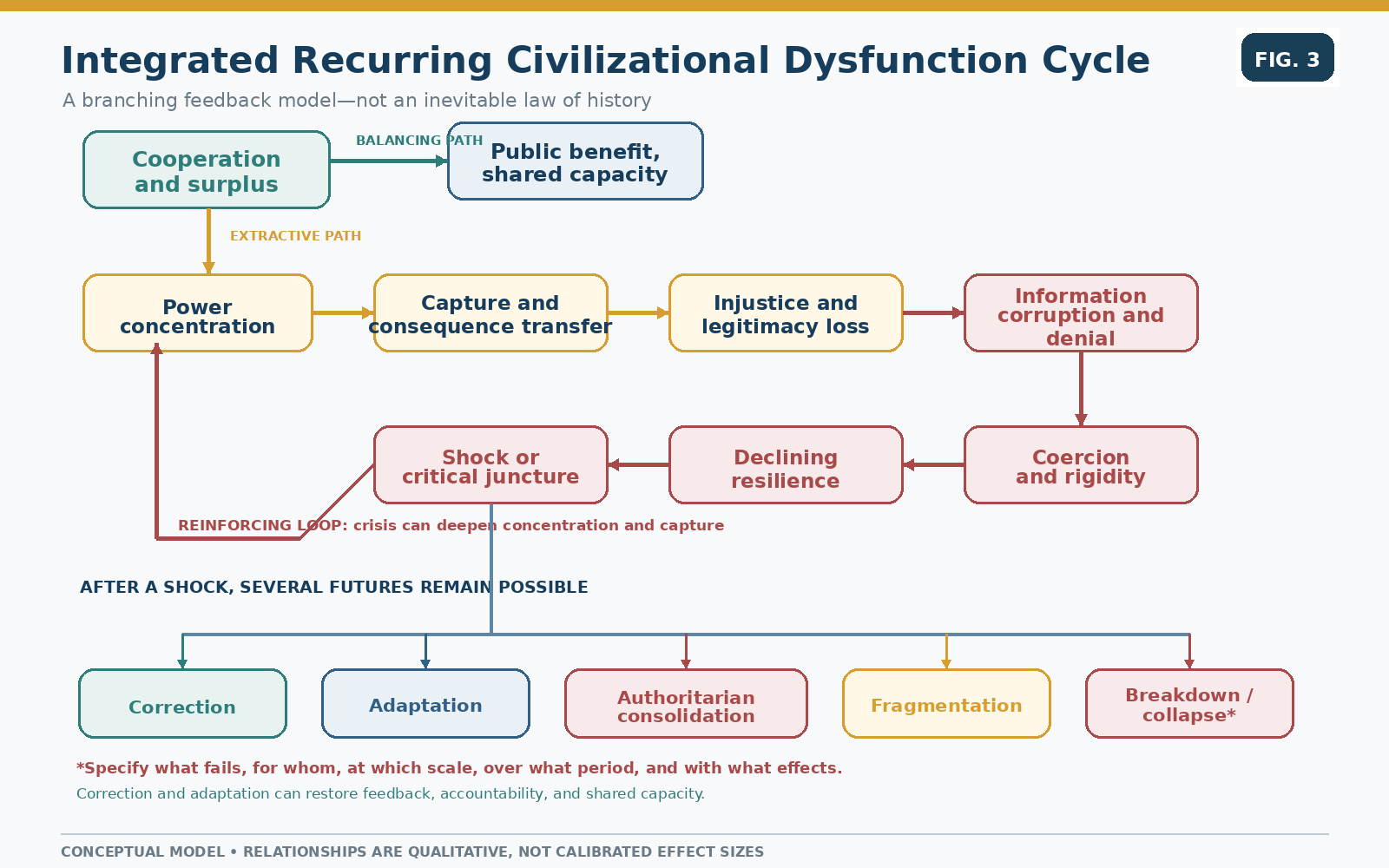
The elements become explanatory through loops and configurations. Systems thinking distinguishes stocks, flows, delays, reinforcing loops, balancing loops, thresholds, and unintended consequences (Meadows, 2008). Five recurrent loops are especially important. They are ideal types; real cases can contain several simultaneously, and feedback strength changes over time.
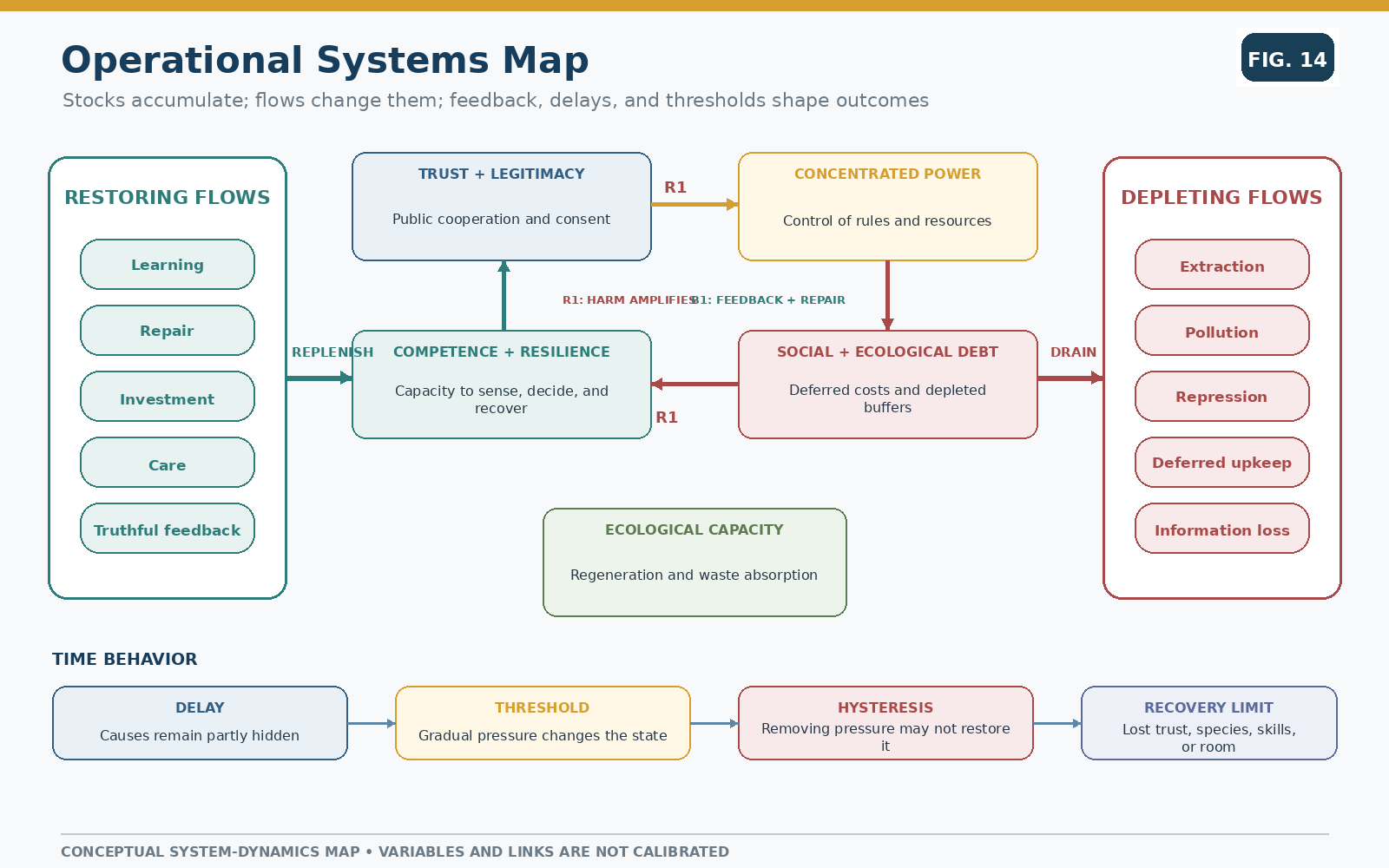
A loop is not assumed merely because two elements correlate. The proposed sequence must identify the actors, resource or information flow, temporal order, and mechanism by which an initial change feeds back into its own conditions. Loop strength can vary, reverse, or be interrupted. Balancing feedback, external support, reserves, law, leadership, or social learning may stabilize a system that otherwise contains the same elements.
The five loops below are recurrent ideal types rather than an exhaustive set. They were selected because each links several layers, has identifiable empirical traces, and helps explain persistence after the original trigger has passed. Cross-loop coupling is central. Capture can finance information corruption; information corruption can weaken legitimacy; coercion can consume resources needed for ecological repair; overshoot can intensify conflict; and technological coupling can accelerate every sequence.
5.1 Capture and extraction loop
Failed consequence capture permits concentrated actors to retain gains and transfer costs. Accumulated resources buy access, expertise, media influence, legal advantage, and organizational durability. These deepen capture, weaken enforcement, and normalize extraction. Rising inequality and exclusion reduce broad participation, while affected populations bear greater risk and possess fewer resources for correction. The loop links Elements 1, 2, 4, 7, and 9.
The loop becomes self-protective when extracted resources purchase the capacity to define legality, expertise, public meaning, or organizational survival. The affected population may know that harm is occurring yet lack standing, information, time, or coordinated power to impose correction. Because the loop transfers costs outward and forward, aggregate indicators can remain favorable while vulnerability accumulates. Disconfirming evidence would include cases in which concentrated gains and weak accountability reliably produce preventive action without countervailing norms or institutions.
5.2 Denial and blocked-learning loop
Warning information threatens identity, liability, or authority. Institutions punish messengers, narrow metrics, and defend established narratives. Poor decisions then generate further harm, but acknowledgment becomes even more costly because responsibility has grown. Denial, information corruption, rigid ideology, and organizational defensiveness reinforce one another across Elements 9, 10, 14, and 15.
The loop often exhibits escalating commitment. Early acknowledgment would be inexpensive, but each uncorrected decision creates greater liability, identity threat, and sunk cost. Later evidence is therefore filtered more aggressively. Organizational metrics may improve because the definition of success changes, not because the underlying condition does. Process tracing should look for warnings, messenger treatment, report revisions, changes in categories, and the timing of corrective authority.
5.3 Legitimacy and security-overhead loop
Unfairness, incompetence, or visible capture reduces legitimacy. Authorities substitute coercion and propaganda for voluntary compliance. Fear degrades information, services worsen, and fiscal resources move from repair to control. These failures further reduce legitimacy. The loop can stabilize an authoritarian order for a substantial period, but stability purchased through rising overhead may reduce adaptive capacity and increase the severity of eventual disruption.
This loop can produce long periods of surface stability. Coercive capacity may deter opposition, extract revenue, and coordinate emergencies. The predicted vulnerability is subtler: rising resources devoted to control, declining candor, weaker services, and a growing gap between official performance and local conditions. A balancing path is possible when lawful enforcement is paired with procedural fairness, independent review, credible service, and a route for grievances to alter policy without threatening the entire regime.
5.4 Overshoot and conflict loop
Ecological degradation and resource depletion reduce margins for distribution and maintenance. Competition intensifies; coalitional narratives mobilize blame; powerful actors protect consumption and transfer costs; governance capacity is diverted toward conflict or emergency response; and long-term restoration is delayed. The result is not ecological determinism. Similar stress can produce cooperation when legitimate institutions, trusted information, fair burden sharing, and scale-matched governance are present.
Scarcity does not mechanically create violence. Distribution and interpretation mediate it. Elites may insulate themselves, blame outsiders, militarize resource access, or suppress migration; communities may instead share risk, reduce demand, restore ecosystems, and renegotiate claims. The loop is strongest where costs are unequal, information is distrusted, authority is captured, and institutions lack flexible mechanisms for burden sharing. Ecological repair and justice therefore function as conflict prevention rather than separate policy domains.
5.5 Technology, coupling, and lock-in loop
Capabilities diffuse faster than monitoring and law. Early economic or strategic gains create dependency and political constituencies. Standardization and network effects increase coupling, while later recognition of harm encounters sunk costs and security competition. Governance delay then becomes evidence that still faster deployment is necessary. Elements 12, 15, 18, 19, and 20 combine to turn ordinary error into high-consequence systemic risk.
These loops illustrate upward and downward causation. Individual bias aggregates into institutional routines; institutions shape which beliefs and behaviors are rewarded; ecological and technological conditions constrain available strategies; and systemic outcomes feed back into individual fear, identity, and time horizon. The framework therefore rejects a false choice between changing people and changing systems. Durable change requires both, linked through institutions that make better behavior viable rather than sacrificial.
Diffusion creates users, infrastructure, data, standards, and constituencies that make reversal costly. Dependency then narrows the credibility of warnings because institutions cannot easily imagine functioning without the system. Harm may be addressed by adding further technological layers, increasing complexity and coupling. The loop is weakened by modularity, interoperability, liability, independent testing, incident disclosure, fallback capacity, and staged commitments that preserve exit before benefits and risks are fully known.
5.6 Loop interaction, thresholds, and branching transformation
The loops change one another’s parameters. Information corruption can delay recognition of overshoot; power concentration can lower the apparent cost of risk by transferring it; coercion can temporarily increase compliance while reducing future legitimacy; global coupling can turn a local governance error into a cascade. Thresholds emerge when redundancy, trust, fiscal capacity, ecological stocks, or maintenance fall below levels required for self-correction. The same measured stress can therefore be manageable in one period and destabilizing in another because the background state has changed.
Transformation is not synonymous with improvement. A crisis can open political space for learning and institutional redesign, but it can also entrench incumbents, intensify exclusion, or normalize emergency powers. The framework predicts branching rather than one cycle of inevitable collapse. Correction is more likely when warning information survives, affected populations possess voice, essential systems retain slack, leaders can be replaced lawfully, and reforms alter consequence structures rather than rhetoric alone. Authoritarian consolidation is more likely when fear rises, coercive capacity remains intact, and organized alternatives are weak. Fragmentation is more likely when central coordination fails without viable nested institutions.
These are conditional expectations, not historical rules. A single event can contain different branches for different populations: stability for a center, breakdown at a periphery, adaptation in one sector, and ecological decline across all. Comparative research should therefore code transformations at multiple levels and over sufficient time to distinguish temporary control from restored adaptive capacity.
5.7 Cross-cutting mechanisms revealed by the omission audit
The final systems and dialectical audit identified mechanisms that cut across several numbered elements and therefore should not be promoted into additional “root causes” merely to make the list longer. First, metrics can become targets. When rewards depend on a proxy, actors can improve the reported number while degrading the underlying purpose. Goal displacement and metric gaming connect information corruption, incentive design, cue-consequence traps, and organizational defensiveness. The empirical question is whether movement in the indicator remains coupled to movement in the valued outcome.
Second, local rationality can create higher-order harm. A firm minimizing inventory, an agency defending its budget, a household seeking affordable energy, or a state maximizing short-run security may behave reasonably within its local objective while collectively reducing system resilience. Rebound and risk compensation deepen this problem when efficiency or safety improvements lower perceived cost and thereby increase total use or exposure. The framework therefore asks whether a reform changes the system’s total burden or merely relocates it.
Third, viable governance requires requisite variety: the capacity of monitoring and response must be rich enough to match the variety of disturbances confronting the system. Simplification can improve legibility while also destroying the diversity needed for adaptation. Correlated failure and monoculture are the companion risk. Systems that appear diversified may share the same software, supplier, financing model, crop genotype, information source, or governing assumption and therefore fail together under one shock.
Fourth, slow variables and fast triggers must be separated. Inequality, ecological degradation, elite competition, debt, institutional distrust, demographic pressure, and maintenance deficits may accumulate for years while a drought, assassination, price shock, epidemic, military defeat, or technological disruption supplies the visible trigger. Structural-demographic theory is especially relevant here: population pressures, elite overproduction and intra-elite competition, and fiscal stress can create latent instability without mechanically determining when or how a crisis unfolds. Treating the trigger as the complete cause produces shallow history; treating slow pressure as destiny erases contingency and adaptation.
Fifth, institutions reproduce themselves through socialization, professional training, law, infrastructure, career incentives, and cultural transmission. Dysfunction can persist after original founders and motives disappear because an arrangement now performs hidden functions for people who depend on it. Reform therefore has to identify functional replacement: if a harmful institution supplies income, identity, status, coordination, security, or dispute resolution, removing it without replacing those functions can trigger resistance or create a vacuum.
Finally, systems accumulate social and ecological debt. Deferred maintenance, uncompensated injury, legitimacy loss, ecosystem drawdown, and transferred risk can make current performance look better by borrowing from future adaptive capacity. Harm can also be displaced geographically, socially, or temporally, producing apparent local success at a wider system’s expense. These mechanisms strengthen the central claim: outcomes must be evaluated across scales, affected groups, and time horizons, and apparent stability must be distinguished from burdens that have merely been moved off the balance sheet.
6. Comparative Plausibility Probes
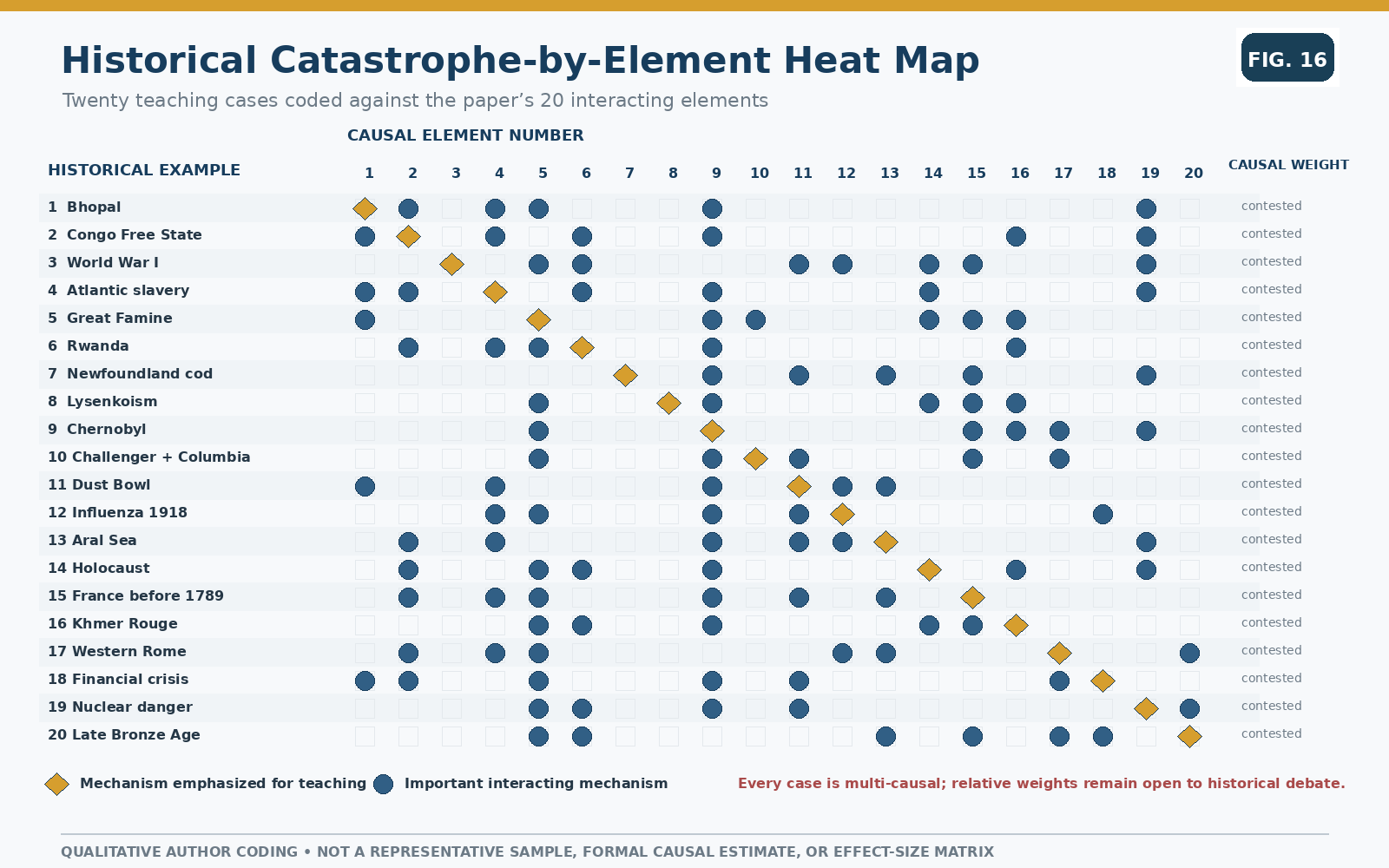
The following cases are not controlled tests and are not claimed to represent all civilizations. They are selected to examine whether the architecture can identify mechanisms in failure, explain divergent responses to a common hazard, and accommodate successful correction. A framework that only redescribes catastrophes after the fact is too hospitable to confirmation bias.
6.1 Late Bronze Age Eastern Mediterranean disruption
The disruption around the end of the Late Bronze Age involved interacting warfare, migration, political upheaval, trade interruption, environmental stress, and the breakdown of palace-centered systems; historians dispute the weight and sequence of mechanisms (Cline, 2021). The case is consistent with a configuration involving tight interdependence, elite administrative complexity, limited redundancy, resource stress, and cascading loss of specialized capacity. No single invasion, drought, or institutional flaw is sufficient.
The framework adds value only if it clarifies what to investigate: whether critical nodes lacked substitutes; whether ruling institutions transferred burdens and lost legitimacy; how information and response were constrained; and which communities reorganized successfully after palace systems contracted. It also prevents the term collapse from erasing persistence, migration, local adaptation, and unequal effects. The case supports configurational plausibility but cannot validate the 20-element architecture by itself.
6.2 Divergent municipal responses during the 1918 influenza pandemic
Analyses of United States cities found that earlier, sustained, and layered nonpharmaceutical interventions were associated with lower peak mortality and, in some analyses, lower cumulative mortality (Hatchett et al., 2007; Markel et al., 2007). The pathogen was common, but timing, public authority, information, compliance, and policy coordination varied. This divergence weakens a pure hazard-determinist explanation.
The case illustrates the interaction of shared reality, leadership, scale, legitimacy, short-term economic pressure, and institutional learning. It also shows why policy labels are insufficient. An intervention announced too late, withdrawn prematurely, or implemented without trust is not causally equivalent to the same intervention deployed early and maintained. The framework predicts that transparent communication, credible authority, fair burdens, and timely feedback should alter outcomes under a common shock.
This is a stronger discriminating probe because cities faced a related pathogen within a bounded period while varying the timing, duration, and layering of nonpharmaceutical interventions. The findings do not isolate all six layers, but they show that hazard exposure alone did not determine mortality. Information, leadership, administrative capacity, public cooperation, and the timing of collective action altered outcomes (Hatchett et al., 2007; Markel et al., 2007). A fuller test would add measures of trust, inequality, communication, and enforcement legitimacy rather than treating intervention adoption as a self-executing variable.
6.3 Durable commons governance
Comparative studies of irrigation systems, fisheries, forests, and other common-pool resources show that users sometimes avoid the tragedy predicted by open access (Ostrom, 1990; Ostrom, 2009). Success is associated with context-sensitive combinations of boundaries, participation, monitoring, proportional sanctions, conflict resolution, local knowledge, and nested organization. These cases directly contradict a universal claim that self-interest or resource rivalry inevitably produces depletion.
Within the six-layer framework, successful commons governance reconnects decisions with consequences, contains free-riding, preserves legitimacy, matches rules to scale, incorporates feedback, and adapts. It does not require the disappearance of mixed motives. It creates an institutional ecology in which contribution remains viable and persistent cheating does not obtain a structural advantage. The cases therefore function as counter-evidence to human-nature determinism and as positive evidence for consequence capture.
Commons cases are essential counterevidence to moral pessimism and to the claim that centralized privatization is the only alternative to open-access depletion. Users can develop boundaries, rules, monitoring, sanctions, conflict resolution, and nested arrangements that fit local conditions (Ostrom, 1990). Success is neither automatic nor permanent. It depends on power, fairness, ecological feedback, and the ability to resist external capture. The framework interprets these institutions as consequence-capture devices that align contribution, knowledge, authority, and accountability while preserving local agency.
6.4 Kristianstad Vattenrike wetland governance
The transformation of wetland governance in Kristianstad, Sweden, illustrates adaptive co-management linking local actors, bridging organizations, ecological knowledge, and municipal authority (Olsson et al., 2004). The case did not abolish conflict or create one final optimal design. It developed relationships and institutional capacity capable of learning across scales.
This supports the framework’s emphasis on both-and solutions: local knowledge and higher-level support; stability and experimentation; ecological protection and human use; leadership and distributed participation. It also demonstrates that transformation often depends on prepared networks and windows of opportunity rather than a single policy lever. A list of best practices detached from context would miss the relational work that made those practices possible.
The Kristianstad case illustrates transformation rather than simple resilience. New knowledge, bridging organizations, leadership, trust, and cross-scale networks altered how a degraded landscape was understood and governed (Olsson et al., 2004). It therefore activates knowledge, leadership, scale, institutional adaptation, and ecological boundary elements simultaneously. The case also warns against copying surface structures: a “bridging organization” is not effective by title. Its causal role depends on relationships, legitimacy, access to resources, and the capacity to translate among local users, experts, and public authorities.
6.5 Montreal Protocol and ozone-layer recovery
International coordination under the Montreal Protocol produced large reductions in ozone-depleting emissions, and scientific assessments report recovery attributable to those controls (World Meteorological Organization, 2022). The case is not proof that every global environmental problem is equally tractable. Ozone-depleting substances had particular industrial structures, substitutes, monitoring arrangements, and institutional histories that differ from fossil-fuel dependence.
Even with those differences, the case refutes blanket claims that states can never cooperate on a global atmospheric commons. It shows the joint importance of credible science, monitoring, adaptive amendments, finance and technology transfer, enforceable commitments, and alignment between industry transition and public protection. The framework predicts that global cooperation becomes more durable when burdens and benefits are made visible, free-riding is contained, and rules can evolve as evidence changes.
6.6 Early states, political experimentation, and non-inevitability
Early-state evidence challenges any simple progression from small egalitarian groups to permanent hierarchy. Sedentism, agriculture, urbanism, monarchy, councils, seasonal authority, mobility, and exit were combined in varied ways, and populations sometimes abandoned or avoided state centers (Graeber & Wengrow, 2021; Scott, 2017). This variation supports the framework’s non-deterministic stance. Surplus and administrative capacity created opportunities for public goods and extraction; outcomes depended on coercion, ecological conditions, legitimacy, knowledge, and the availability of alternatives.
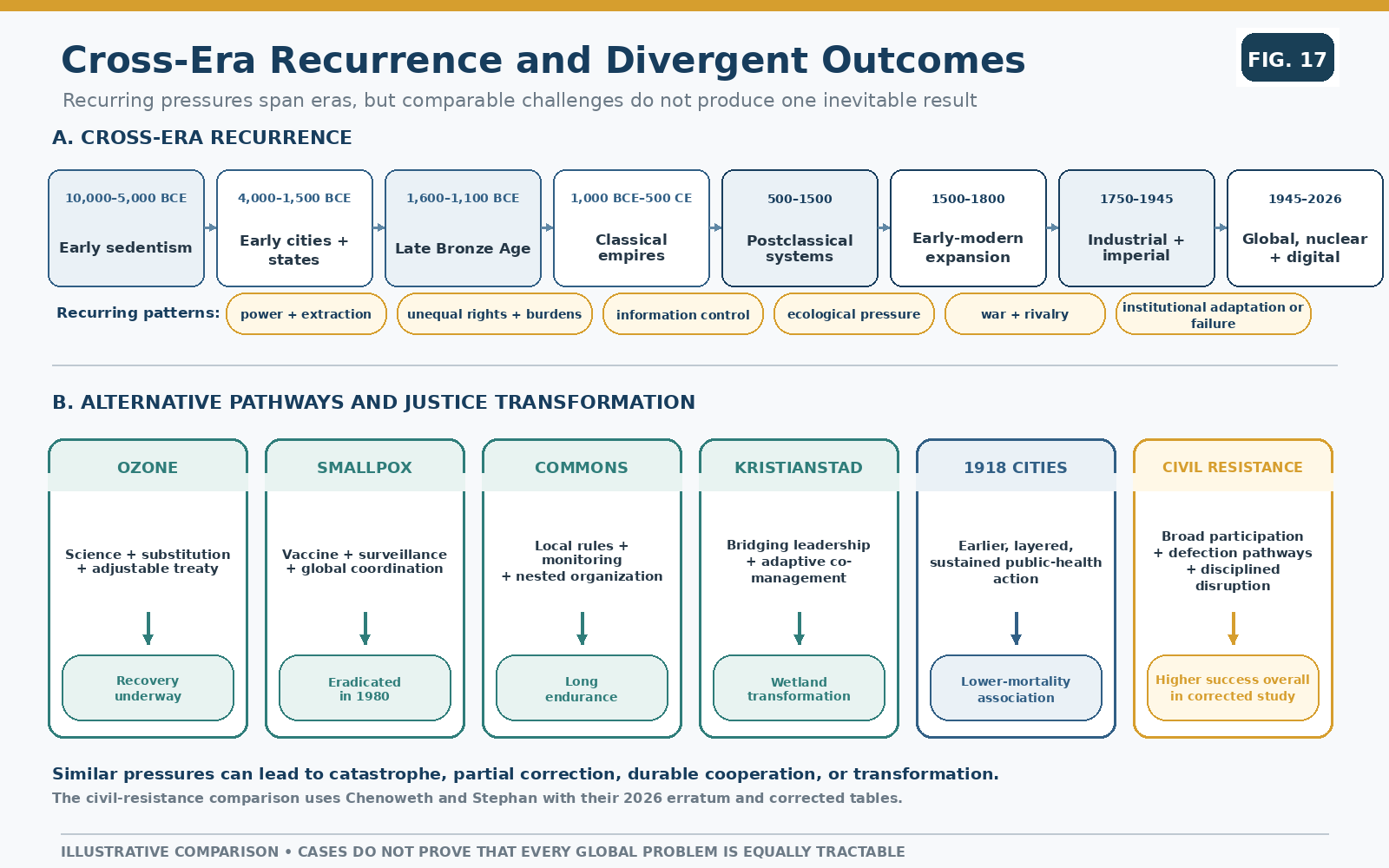
The same caution applies to ecology. Human societies are not uniformly or inevitably ecological destroyers. Long-enduring Indigenous and local institutions in many regions have maintained reciprocal, regenerative, or restrained relationships with landscapes, although no tradition should be romanticized as timeless or internally homogeneous. Such cases matter theoretically because they demonstrate branching pathways: human agency can become a keystone regenerative force when knowledge, norms, rights, feedback, and consequence structures support stewardship rather than extraction.
6.7 Tightly coupled high-risk systems and network cascades
Research on normal accidents and interdependent networks provides a modern mechanistic probe. In tightly coupled systems, interactions can outrun diagnosis, and failure in one network can disable recovery in another (Perrow, 1999; Buldyrev et al., 2010). The six-layer framework adds institutional questions: who selected the architecture, who benefited from efficiency, whether dependency was visible, how warning information was treated, and who bore the cascade. Technical coupling and consequence transfer can reinforce each other when organizations capture gains from optimization while the public absorbs low-frequency systemic losses.
The counter-case is not disconnection but resilient design. Modularity, redundancy, diverse suppliers, manual fallback, transparent dependency maps, incident reporting, and authority to halt unsafe operation can reduce cascade severity. These protections often appear wasteful during normal performance and are therefore vulnerable to competitive removal. The framework predicts underinvestment in resilience where benefits are private and dispersed future losses are socialized, unless regulation, insurance, professional standards, or affected-party power restore consequence capture.
Table 3. Comparative plausibility probes and discriminating questions
| Case or case family | Outcome variation | Mechanisms highlighted | Discriminating question |
|---|---|---|---|
| Late Bronze Age regional disruption | Regional breakdown | Interdependence, ecological stress, conflict, complexity, uneven adaptation | Do power, information, legitimacy, and local reorganization improve explanation beyond a single shock? |
| 1918 influenza municipal responses | Divergent response to shared hazard | Timing, leadership, information, public cooperation, administrative capacity | At comparable exposure, do earlier layered interventions and legitimate coordination predict lower intensity? |
| Durable commons institutions | Long-run successful cooperation | Boundaries, monitoring, participation, graduated sanctions, nested governance | Do consequence capture and anti-free-rider safeguards explain persistence better than ownership form alone? |
| Kristianstad Vattenrike | Social-ecological transformation | Knowledge integration, bridging leadership, trust, cross-scale networks | Did new relationships and feedback alter both institutions and ecosystem management? |
| Montreal Protocol | Global corrective cooperation | Science, monitoring, amendments, finance, technology transfer, enforcement | Which configuration made global atmospheric cooperation adaptive and durable? |
| Early-state variation and exit | Non-inevitable institutional pathways | Surplus, coercion, mobility, seasonal authority, political experimentation | Do alternatives and exit constrain concentration and extraction? |
| Tightly coupled high-risk systems | Cascade vulnerability and prevention | Dependency, opacity, efficiency pressure, redundancy, consequence transfer | Do modularity and accountability reduce cascades at similar technical complexity? |
7. Rival Explanations and Discriminating Tests
The framework is intentionally plural, but pluralism is not permission to absorb every criticism. Rival explanations capture real mechanisms and may outperform the six-layer architecture within defined domains. Table 4 states what each rival explains, what it risks omitting, and what evidence would discriminate between accounts.
Discrimination requires matched predictions. If fixed human nature is primary, similar institutional incentives should not produce large and durable behavioral differences. If ecology is primary, comparable hazards should produce broadly similar outcomes after material capacity is controlled. If capture is the master cause, adding information, scale, coupling, and ecological variables should contribute little. If complexity alone governs collapse, modularity, legitimacy, and justice should not substantially alter outcomes at similar complexity. These tests convert pluralism from a polite bibliography into comparative risk.
The formulations in Table 4 were authored by the investigator who proposes the six-layer framework; no scholar advocating a rival explanation independently selected the discriminating questions or scored what each position risks omitting. The table should therefore be read as a set of candidate empirical discriminators offered for independent and adversarial testing, not as a neutral arbitration already concluded in the framework's favor. Section 8 identifies adversarial collaboration with proponents of each rival explanation as a priority extension for this reason.
Table 4. Rival explanations and discriminating implications
| Rival explanation | What it captures | What it risks omitting | Discriminating question |
|---|---|---|---|
| Fixed human nature or moral failure | Recurring selfishness, aggression, tribalism, and deception | Institutional variation, cooperation, successful restraint, and changes in behavior under different incentives | Under similar populations, do rule systems and consequence structures reliably predict divergent outcomes? |
| Ecological or resource determinism | Material limits, scarcity, climate stress, and energy constraints | Distribution, legitimacy, information, technology, and cases of adaptation under comparable stress | Do societies facing similar hazards diverge according to governance, fairness, and resilience? |
| Elite domination as the master cause | Capture, extraction, agenda control, and unequal voice | Coordination dilemmas, cognition, ecology, technological hazards, and failures without coherent elite command | Do cross-layer variables improve explanation after power concentration is measured? |
| Complexity and diminishing returns | Administrative burden, maintenance costs, and collapse of specialized systems | Justice, information, legitimacy, power, and adaptive forms of complexity | Do modularity, transparency, redundancy, and legitimacy alter outcomes at similar complexity levels? |
| Cultural or ideological monocause | Meaning, identity, legitimacy, and mobilization | Material incentives, ecological boundaries, institutions, and strategic adaptation of beliefs | Do ideological effects change when consequence structures and information systems change? |
| Technology or modernization solutionism | Capacity gains, productivity, health, and communication | Lock-in, unequal consequences, capability-governance gaps, and amplification of error | Do staged deployment, liability, monitoring, and reversibility predict safer diffusion? |
| Contingency or random shock | Triggers, path dependence, and historical uniqueness | Why similar shocks produce patterned vulnerability or recurrence | Are adverse outcomes more likely where predicted configurations exist before the trigger? |
Four broad results would count against the framework. First, a simpler rival could consistently predict failure, adaptation, and distributional consequences with equal or better accuracy. Second, quantitative measures of the six layers could fail to improve out-of-sample prediction beyond hazards and income. Third, process tracing could show that proposed loops are routinely absent or causally reversed. Fourth, cases with high predicted risk could repeatedly avoid dysfunction without identifiable compensating mechanisms. The model should be revised rather than protected by adding an invisible variable after every failed prediction.
Additional element-level failure conditions are also required. An element should be merged if its indicators and causal sequence cannot be distinguished from another. It should be divided if one label predicts opposite outcomes through different mechanisms. A proposed loop should be removed if temporal evidence repeatedly shows the reverse sequence or if the same outcome occurs without the posited mediating steps. The architecture should be narrowed if it explains breakdown but cannot distinguish successful correction, because a model that labels every outcome compatible has become descriptive scenery.
Architecture-level failure would be especially clear if a preregistered, out-of-sample comparison showed that hazards, income, regime type, and a small number of established predictors matched or exceeded the six-layer model for failure, adaptation, and distributional harm. The appropriate response would be simplification, not the invention of hidden variables. A broad theory has more opportunities to be informative and more opportunities to become unfalsifiable. Both must remain visible.
Conversely, support would increase if different methods converge on several expectations: concentrated benefits and diffuse delayed costs predict underprevention; protected dissent improves correction; high coupling and low redundancy increase cascade severity; unfair burden distribution reduces legitimacy and compliance; coercive systems produce systematically distorted upward information; and scale-matched, participatory, monitored institutions sustain cooperation under pressure.
8. Toward an Empirical Research Program
Operationalization should proceed in modules rather than attempting one civilizational master index. Each element requires observable indicators, competing measures, temporal ordering, and scope conditions. Candidate measures include concentration of decision power; distance between decision makers and harmed populations; transparency and whistle-blower protection; media and information diversity; institutional trust; rule-change capacity; ecological debt; infrastructure redundancy; fiscal and security overhead; and network coupling.
Comparative historical analysis can code configurations before outcomes, distinguish triggers from slow stresses, and compare matched cases with divergent paths. Process tracing can test whether proposed mechanisms connect causes and outcomes. Network analysis can estimate dependency and cascade channels. Experiments and quasi-experiments can examine incentive alignment, information, fairness, and cooperation. Agent-based and system-dynamics models can explore thresholds and unintended effects, but models should expose assumptions rather than transform uncertainty into decorative precision.
The following propositions are intentionally general and require domain-specific refinement:
1. Where high-impact decision makers can retain benefits while transferring delayed harms, preventive action will be weaker unless affected parties possess effective voice, monitoring, and sanctioning power.
2. Where warning messengers face high personal or organizational costs, policy correction will be slower and reported performance will diverge more from underlying conditions.
3. At comparable hazard exposure, tightly coupled systems with low redundancy and opaque dependencies will experience faster and wider cascades.
4. Under resource stress, fair burden sharing and procedurally legitimate institutions will predict greater voluntary cooperation than coercion alone.
5. Technologies deployed through reversible stages with monitoring, liability, and precommitted intervention thresholds will produce fewer lock-in failures than functionally similar technologies deployed without those safeguards.
6. Institutional reforms that change leadership or rhetoric without changing consequence capture, information channels, and lawful accountability will show higher rates of relapse.
7. Adaptive simplification that preserves essential capabilities and legitimacy will outperform indiscriminate dismantling when returns to complexity decline.
8. Where governing institutions protect independent measurement and reward early correction, discrepancies between reported and underlying conditions will close faster after adverse evidence.
9. Where ecological and fiscal margins are simultaneously declining, increases in security or administrative overhead will displace maintenance and adaptation more strongly than under conditions of abundant surplus.
10. Polycentric systems with clear escalation, rights floors, and anti-capture safeguards will adapt more effectively than either fragmented localism or uniform central command when problem scale and knowledge scale differ.
11. Reforms that improve one layer while degrading another will exhibit predictable rebound: for example, technical efficiency without redundancy, decentralization without spillover control, or enforcement without legitimacy will transfer rather than resolve systemic risk.
Pre-registration and adversarial collaboration would materially improve evaluation, including retrospective, independently scored replication of the comparisons in Table 4, which were constructed by the framework's own author rather than by scholars committed to each rival position. Researchers committed to rival explanations should agree on case selection, coding rules, missing-data treatment, and failure criteria before outcomes are examined. Replication should include unsuccessful cases, non-Western institutional forms, informal governance, and populations omitted from official records. A theory of civilization tested only on famous states would reproduce the archive’s power structure while calling it a sample.
8.1 Measurement architecture
A modular measurement program should separate exposure, mechanism, outcome, and compensating capacity. Exposure includes ecological hazard, technological capability, conflict pressure, or network dependency. Mechanisms include consequence distance, concentration of power, information suppression, burden inequality, scale mismatch, rigidity, and coupling. Outcomes must be disaggregated into welfare, rights, ecological condition, state capacity, service continuity, legitimacy, and distribution. Compensating capacity includes reserves, redundancy, protected dissent, lawful succession, social trust, external assistance, and adaptive institutions.
No single score should erase this structure. Composite indices can assist comparison, but they create weighting choices and may allow strength in one dimension to cancel catastrophic weakness in another. Threshold variables should therefore remain visible. A society with high literacy and income but extreme nuclear risk, ecological dependency, or information capture cannot be treated as safely average. Measurement should report profiles, causal configurations, and uncertainty before aggregating.
8.2 Comparative designs and causal identification
Matched comparisons can examine jurisdictions exposed to similar hazards but differing in legitimacy, burden sharing, information, or redundancy. Longitudinal studies can test whether changes in consequence capture precede prevention or whether improved outcomes merely create political room for reform. Process tracing should identify decisions, warnings, institutional reactions, resource flows, and counterfactual alternatives. Natural experiments and policy discontinuities can estimate selected mechanisms, while network analysis can reveal hidden dependencies and likely cascade routes.
Simulation is useful where real experiments would be impossible or unethical, but model structure must remain auditable. Agent-based models can explore selection among cooperative and exploitative strategies; system-dynamics models can represent stocks, delays, and feedback; network models can test coupling and redundancy. Sensitivity analysis should vary assumptions, not merely parameters inside one favored structure. Models that reproduce a historical pattern after extensive tuning provide plausibility, not independent validation.
8.3 Proposition families and operational implications
The propositions can be organized into four families. The power-consequence family predicts underprevention where beneficiaries are insulated from harm and correction. The epistemic-learning family predicts delayed response where warning is costly and governing beliefs cannot be revised. The resilience-coupling family predicts larger cascades where dependencies are opaque and buffers have been optimized away. The legitimacy-adaptation family predicts more durable cooperation where burdens are fair, authority is contestable, and simplification preserves essential capability.
Each proposition requires a specified unit and counterfactual. “Warning messengers face costs” can be measured through retaliation, career loss, legal exposure, or report suppression, but the comparison must identify a plausible messenger without those costs. “Fair burden sharing” requires procedural and distributive measures relevant to the population, not an analyst’s assertion that the policy was fair. “Adaptive simplification” must be distinguished from austerity, privatization, or indiscriminate deregulation by tracking whether essential function, access, legitimacy, and error correction were preserved.
Prediction should include alternative pathways. High capture may produce neglect, symbolic compliance, selective protection, or coercive transfer rather than one outcome. High ecological stress may produce innovation or solidarity where institutions distribute burdens credibly. These branches make the propositions more difficult to test, but ignoring them would confuse conditional mechanisms with universal laws.
Reasonable data variation is not confined to statistical error. Academic career incentives, donor and state agendas, corporate secrecy, intelligence operations, propaganda, classification systems, publication bias, language access, archival survival, and changing definitions can shift estimates and apparent consensus. Analysts should report uncertainty ranges, alternative coding, source provenance, and the consequences of plausible bias. The evidentiary center of a bell curve can itself be displaced by institutions that decide what is measured and published. This possibility does not justify indiscriminate distrust; it requires stronger triangulation and transparent claim grading.
9. Discussion and Implications
The framework’s principal implication is diagnostic rather than programmatic. It does not yield one ideology or institutional template. Instead, it identifies recurrent functions that successful arrangements must somehow perform: connect consequential power to accountability; contain deliberate free-riding and capture; preserve truthful feedback and protected correction; distribute burdens in ways compatible with legitimacy and equal standing; match authority to problem scale while retaining local knowledge; maintain sufficient redundancy and requisite variety; and remain inside ecological limits. Different societies can instantiate those functions differently.
Several tensions are therefore best treated as both-and design problems rather than forced binaries: leadership and constraint, expertise and democratic accountability, local autonomy and higher-order coordination, efficiency and redundancy, stability and adaptation, innovation and precaution, individual development and institutional reform, and universal rights with context-sensitive implementation. Both-and does not mean every value can be maximized simultaneously. It means the neglected function must remain visible when a tradeoff is made.
The analysis also changes how success is judged. A system that survives by transferring harm to politically weak groups, distant regions, future generations, or ecosystems is not unambiguously successful. Nor is short-run order proof of adaptive capacity if it is purchased by suppressing information and increasing coercive overhead. Conversely, institutional simplification is not inherently decline if it removes parasitic complexity while preserving essential capability, legitimacy, redundancy, and learning. Success is conditional fit, not moral certification.
Ecological overshoot adds a hard temporal constraint. Reforms that require decades of surplus, trust, stable climate, or abundant resources may become less feasible as ecological and fiscal margins shrink. This does not validate deterministic collapse narratives or authoritarian shortcuts. It means research and policy should distinguish measures that reduce near-term irreversible and cascade risks from those whose benefits arrive only after the relevant window has closed. A useful application of the framework is therefore comparative prioritization: which intervention changes several reinforcing mechanisms at once without creating a new concentration of unaccountable power?
The article stops at this diagnostic level because prescriptions require a separate evaluation of feasibility, cost, sequence, rights, capture risk, and unintended consequences. For the present purpose, the relevant scholarly claim is narrower: durable higher-order cooperation depends not only on prosocial values or technical knowledge but on institutions that keep correction possible when interests, identities, technologies, and ecological constraints change.
10. Positionality, Limitations, and Reflexive Appraisal
The inquiry is normatively oriented toward reducing preventable suffering, protecting equal dignity and rights, constraining domination, preserving truthful correction, and maintaining ecological viability for present and future beings. These values shape the problem definition and the choice to treat injustice and ecological destruction as central rather than external. They do not determine whether particular causal claims are true. The claims remain answerable to evidence, rival explanation, and public criticism.
The principal strength and vulnerability are the same: breadth. No single researcher can possess equal expertise across archaeology, psychology, political economy, ecology, education, organizational studies, and technology governance. Purposive selection creates confirmation risk, and the absence of a uniform systematic-review protocol prevents claims of exhaustive coverage. Concepts may lose disciplinary nuance when translated into a shared architecture. Historical records are uneven, especially across early periods and marginalized populations.
The 20 elements are not measured universal coefficients. They overlap, operate at different levels, and may change relative importance by society, scale, era, and outcome. The comparative cases are plausibility probes, not a representative sample. The framework may also understate contingency, culture-specific meanings, beneficial informal institutions, nonstate governance, and the possibility that some apparent dysfunctions are adaptive from the perspective of a subgroup or shorter time horizon.
Researcher commitment is another risk. Developing an architecture over time can create identity fusion with the framework and incentives to reinterpret criticism as misunderstanding. Safeguards used here include explicit rival explanations, falsification conditions, confidence distinctions, separation of incentives from conspiracy claims, documented correction criteria, and the rule that motive does not determine validity. Independent replication and hostile-but-competent review remain necessary.
Finally, the framework may diagnose more than institutions can feasibly change under time pressure. Ecological degradation and resource overshoot can price out otherwise sensible reforms by reducing surplus, trust, and administrative capacity. This limitation increases the value of prioritization but does not validate panic, authoritarian shortcuts, or deterministic collapse claims. It requires transparent triage: preserve life-support functions, reduce irreversible risks, and avoid solutions whose control costs deepen the problem.
Several forms of omission remain plausible. The architecture may underrepresent gendered care work, colonial and racial capitalism, military organization, disease ecology, demography, urban form, and the independent causal role of culture. Some are partly represented inside existing elements, but inclusion by implication is not the same as adequate theory. Future research should test whether these domains require new elements or whether they change the operation of current ones.
The framework also risks scale slippage. Evidence about individuals can be overextended to states; organizational findings can be generalized to civilizations; global indicators can obscure local recovery. Every empirical application should state the level at which a mechanism is measured and the process connecting it to another level. Cross-level influence is expected, but it must be traced rather than assumed. The same caution applies to time: short-term compliance may be mistaken for legitimacy, temporary efficiency for resilience, and delayed ecological damage for success.
Normative commitments create both clarity and selection risk. Defining dysfunction in relation to rights, justice, common well-being, truthful learning, and ecological viability rejects a purely regime-centered standard of success. A system that survives by exporting harm is not counted as fully successful. Readers who adopt different normative criteria may classify outcomes differently. That disagreement should be explicit. It does not dissolve empirical questions about who benefits, who is harmed, what information is suppressed, and whether the arrangement remains ecologically viable.
Finally, the visual and conceptual coherence of the framework can generate false confidence. A diagram makes relationships appear cleaner than historical evidence permits. The 20 elements are not a periodic table, and the six layers are not ontological compartments. Figures are heuristic compression devices whose value depends on the text, operational definitions, and future tests. Their preservation in this expanded article is intended to maintain analytical content, not to substitute design polish for validation.
A 20-element framework can become an omnibus explanation that fits anything after the fact. The remedy is discrimination: preregistered coding where feasible, out-of-sample comparisons, explicit counterfactuals, temporal mechanism evidence, and willingness to merge or delete elements that add no explanatory value. Causal heterogeneity is another risk because elements operate at different levels and timescales. Tests should therefore ask not merely whether an element is present, but whether its timing, mechanism, interaction, and outcome contribution differ predictably across cases.
11. Conclusion
The recurrence of civilizational dysfunction across different cultures and eras is unlikely to be explained by one defective ideology, one class of leaders, one economic system, one resource shock, or one invariant human flaw. A more plausible account is configurational. Mixed human motives operate inside institutions that distribute power and consequences, shape knowledge, organize cooperation, depend on ecological and technological conditions, and become amplified through complexity and coupling.
The comparative probes show why both hazard and organization matter. Interdependence can magnify regional breakdown and also support global environmental cooperation. Central capacity can deliver public goods and also enable extraction. Identity can sustain mutual aid and also exclusion. Complexity can support medicine and law while creating maintenance burdens and hidden dependencies. These reversals are not conceptual indecision. They are evidence that causal effects depend on relation, scale, timing, and constraint.
The six-layer framework converts that diagnosis into 20 defined elements, recurrent feedback loops, cross-cutting systems mechanisms, comparative tests, rival explanations, and an empirical research program. Its central claim is conditional: moral principles and technical knowledge become historically durable only when institutions do not systematically reward their violation and disable correction. Consequence capture, truthful feedback, legitimate constraint, scale-matched cooperation, ecological viability, and adaptive capacity are therefore not separate reforms. They are mutually dependent conditions for sustained higher-order cooperation.
The practical implication is neither optimism nor fatalism. Humanity has repeatedly created institutions that restrain free-riding, distribute risk, protect rights, integrate knowledge, and repair ecosystems. It has also repeatedly allowed those achievements to be captured, hollowed out, or overwhelmed by changing scale and technology. Progressive evolution remains local, conditional, reversible, and statistically expressed in an upper envelope rather than guaranteed to every society. Cooperation survives when its countermeasures evolve as rapidly as the opportunities to exploit it.
The framework will have earned its complexity only if it improves explanation, prediction, comparison, and design relative to simpler alternatives. It should be revised wherever evidence shows redundancy, omitted mechanisms, incorrect loops, or better rival accounts. The goal is not to defend a monument of twenty causes. It is to build a sufficiently accurate map before tightly coupled societies discover, once again, that confidence is not the same substance as resilience.
Declarations
Ethics approval and consent to participate. Not applicable. This theoretical article reports no research involving human participants or animals and uses no identifiable private data.
Competing interests. The author developed the framework examined in this article and therefore has an intellectual commitment to it; the reflexive safeguards and limitations are described in Section 10. This commitment bears most directly on Table 4, where rival explanations are formulated and their discriminating implications assessed by the same author who developed the framework under evaluation, with no independent proponent of a rival explanation participating in that comparison; readers and reviewers should weigh Table 4 as proposed tests rather than settled adjudication. No financial competing interest is reported. Identifying institutional details are supplied on the separate title page.
Funding. The work received no dedicated governmental, corporate, political-party, or foundation grant. Organizational support and small individual donations are described on the separate title page supplied to the editors.
Generative-AI assistance. Generative-AI tools were used as assistive tools for source discovery, drafting, reorganization, copyediting, citation cross-checking, figure development, and adversarial review. No AI system is listed as an author. The human author remains fully responsible for the final manuscript, including verification of consequential factual claims and cited sources.
Preprint/public working paper. A public working-paper version exists. Identifying details are supplied to the editors on the separate title page and in the submission portal but are omitted here to preserve double-blind review.
Data and code availability. No new empirical dataset or analytical code was produced for this theoretical synthesis. The framework, source-selection logic, comparative cases, propositions, tables, and figures are contained in the article and accompanying submission files. A visual-preservation crosswalk documents how the analytical content of the public working-paper figures was consolidated for journal review. Additional working materials can be supplied to editors on request and linked after review without compromising anonymization.
Permissions. All figures and Tables 1–4 are original to this submission or original author-created visualizations from the underlying working paper; no third-party figures or substantial reproduced text are included. Separate high-resolution figure files are supplied for the figures used in the manuscript, and the full visual archive is available to the editors. No third-party figures, tables, or substantial reproduced text are included.
References
Abrami, P. C., Bernard, R. M., Borokhovski, E., Waddington, D. I., Wade, C. A., & Persson, T. (2015). Strategies for teaching students to think critically: A meta-analysis. Review of Educational Research, 85(2), 275–314. https://doi.org/10.3102/0034654314551063
Acemoglu, D., & Robinson, J. A. (2019). The narrow corridor: States, societies, and the fate of liberty. Penguin Press.
Bhaskar, R. (2008). A realist theory of science. Verso.
Bowles, S. (2008). Policies designed for self-interested citizens may undermine “the moral sentiments”: Evidence from economic experiments. Science, 320(5883), 1605–1609. https://doi.org/10.1126/science.1152110
Bowles, S., & Gintis, H. (2011). A cooperative species: Human reciprocity and its evolution. Princeton University Press.
Buldyrev, S. V., Parshani, R., Paul, G., Stanley, H. E., & Havlin, S. (2010). Catastrophic cascade of failures in interdependent networks. Nature, 464, 1025–1028. https://doi.org/10.1038/nature08932
Cash, D. W., Adger, W. N., Berkes, F., Garden, P., Lebel, L., Olsson, P., Pritchard, L., & Young, O. (2006). Scale and cross-scale dynamics: Governance and information in a multilevel world. Ecology and Society, 11(2), Article 8. https://doi.org/10.5751/ES-01759-110208
Cline, E. H. (2021). 1177 B.C.: The year civilization collapsed (Rev. and updated ed.). Princeton University Press.
Collingridge, D. (1980). The social control of technology. St. Martin’s Press.
Crenshaw, K. (1989). Demarginalizing the intersection of race and sex: A Black feminist critique of antidiscrimination doctrine, feminist theory and antiracist politics. University of Chicago Legal Forum, 1989(1), 139–167.
Edwards, M. G. (2010). Organizational transformation for sustainability: An integral metatheory. Routledge.
Fehr, E., & Gächter, S. (2002). Altruistic punishment in humans. Nature, 415, 137–140. https://doi.org/10.1038/415137a
Folke, C., Carpenter, S. R., Walker, B., Scheffer, M., Chapin, T., & Rockström, J. (2010). Resilience thinking: Integrating resilience, adaptability and transformability. Ecology and Society, 15(4), Article 20. https://doi.org/10.5751/ES-03610-150420
Fricker, M. (2007). Epistemic injustice: Power and the ethics of knowing. Oxford University Press.
Gambhir, A., Albert, M. J., Doe, S. S. P., Donges, J. F., Farajalla, N., Giatti, L. L., Gundimeda, H., Hendel-Blackford, S., Homer-Dixon, T., Hoyer, D., Adan, S., Jacome-Polit, D., Kemp, L., Korowicz, D., Kovacic, Z., Kwakkel, J., Laybourn, L., Lempert, R., Mahamoud, A., . . . Richardson, R. (2025). A systemic risk assessment methodological framework for the global polycrisis. Nature Communications, 16, Article 7382. https://doi.org/10.1038/s41467-025-62029-w
Gilens, M., & Page, B. I. (2014). Testing theories of American politics: Elites, interest groups, and average citizens. Perspectives on Politics, 12(3), 564–581. https://doi.org/10.1017/S1537592714001595
Graeber, D., & Wengrow, D. (2021). The dawn of everything: A new history of humanity. Farrar, Straus and Giroux.
Hardin, G. (1968). The tragedy of the commons. Science, 162(3859), 1243–1248. https://doi.org/10.1126/science.162.3859.1243
Hatchett, R. J., Mecher, C. E., & Lipsitch, M. (2007). Public health interventions and epidemic intensity during the 1918 influenza pandemic. Proceedings of the National Academy of Sciences, 104(18), 7582–7587. https://doi.org/10.1073/pnas.0610941104
Helbing, D. (2013). Globally networked risks and how to respond. Nature, 497, 51–59. https://doi.org/10.1038/nature12047
Henrich, J. (2016). The secret of our success: How culture is driving human evolution, domesticating our species, and making us smarter. Princeton University Press.
Homer-Dixon, T., Walker, B., Biggs, R., Crépin, A.-S., Folke, C., Lambin, E. F., Peterson, G. D., Rockström, J., Scheffer, M., Steffen, W., & Troell, M. (2015). Synchronous failure: The emerging causal architecture of global crisis. Ecology and Society, 20(3), Article 6. https://doi.org/10.5751/ES-07681-200306
Intergovernmental Panel on Climate Change. (2023). Climate change 2023: Synthesis report. https://doi.org/10.59327/IPCC/AR6-9789291691647
Intergovernmental Science-Policy Platform on Biodiversity and Ecosystem Services. (2019). Global assessment report on biodiversity and ecosystem services. IPBES Secretariat. https://doi.org/10.5281/zenodo.3831673
Jervis, R. (1978). Cooperation under the security dilemma. World Politics, 30(2), 167–214. https://doi.org/10.2307/2009958
Kahneman, D. (2011). Thinking, fast and slow. Farrar, Straus and Giroux.
Kegan, R. (1994). In over our heads: The mental demands of modern life. Harvard University Press.
Kunda, Z. (1990). The case for motivated reasoning. Psychological Bulletin, 108(3), 480–498. https://doi.org/10.1037/0033-2909.108.3.480
Laske, O. (2023). Advanced systems-level problem solving: Volume 3: Manual of dialectical thought forms. Springer. https://doi.org/10.1007/978-3-031-40339-2
Lawrence, M., Homer-Dixon, T., Janzwood, S., Rockström, J., Renn, O., & Donges, J. F. (2024). Global polycrisis: The causal mechanisms of crisis entanglement. Global Sustainability, 7, Article e6. https://doi.org/10.1017/sus.2024.1
March, J. G. (1991). Exploration and exploitation in organizational learning. Organization Science, 2(1), 71–87. https://doi.org/10.1287/orsc.2.1.71
Markel, H., Lipman, H. B., Navarro, J. A., Sloan, A., Michalsen, J. R., Stern, A. M., & Cetron, M. S. (2007). Nonpharmaceutical interventions implemented by US cities during the 1918–1919 influenza pandemic. JAMA, 298(6), 644–654. https://doi.org/10.1001/jama.298.6.644
Maynard Smith, J., & Szathmáry, E. (1995). The major transitions in evolution. Oxford University Press.
Meadows, D. H. (2008). Thinking in systems: A primer. Chelsea Green Publishing.
Nord, M., Altman, D., Fernandes, T., Good God, A., & Lindberg, S. I. (2026). Democracy Report 2026: Unraveling the democratic era? V-Dem Institute, University of Gothenburg.
North, D. C. (1990). Institutions, institutional change and economic performance. Cambridge University Press.
North, D. C., Wallis, J. J., & Weingast, B. R. (2009). Violence and social orders: A conceptual framework for interpreting recorded human history. Cambridge University Press.
Olsson, P., Folke, C., & Hahn, T. (2004). Social-ecological transformation for ecosystem management: The development of adaptive co-management of a wetland landscape in southern Sweden. Ecology and Society, 9(4), Article 2. https://doi.org/10.5751/ES-00683-090402
Organisation for Economic Co-operation and Development. (2024). Survey of Adult Skills 2023: United States country note. OECD Publishing.
Ostrom, E. (1990). Governing the commons: The evolution of institutions for collective action. Cambridge University Press. https://doi.org/10.1017/CBO9780511807763
Ostrom, E. (2009). A general framework for analyzing sustainability of social-ecological systems. Science, 325(5939), 419–422. https://doi.org/10.1126/science.1172133
Padilla, A., Hogan, R., & Kaiser, R. B. (2007). The toxic triangle: Destructive leaders, susceptible followers, and conducive environments. The Leadership Quarterly, 18(3), 176–194. https://doi.org/10.1016/j.leaqua.2007.03.001
Perrow, C. (1999). Normal accidents: Living with high-risk technologies (Updated ed.). Princeton University Press.
Potsdam Institute for Climate Impact Research. (2025). Planetary Health Check 2025: A scientific assessment of the state of the planet. https://doi.org/10.48485/pik.2025.017
Richardson, K., Steffen, W., Lucht, W., Bendtsen, J., Cornell, S. E., Donges, J. F., Drüke, M., Fetzer, I., Bala, G., von Bloh, W., Feulner, G., Fiedler, S., Gerten, D., Gleeson, T., Hofmann, M., Huiskamp, W., Kummu, M., Mohan, C., Nogués-Bravo, D., . . . Rockström, J. (2023). Earth beyond six of nine planetary boundaries. Science Advances, 9(37), Article eadh2458. https://doi.org/10.1126/sciadv.adh2458
Robertson, B. A., Rehage, J. S., & Sih, A. (2013). Ecological novelty and the emergence of evolutionary traps. Trends in Ecology & Evolution, 28(9), 552–560. https://doi.org/10.1016/j.tree.2013.04.004
Scheffer, M., Bascompte, J., Brock, W. A., Brovkin, V., Carpenter, S. R., Dakos, V., Held, H., van Nes, E. H., Rietkerk, M., & Sugihara, G. (2009). Early-warning signals for critical transitions. Nature, 461, 53–59. https://doi.org/10.1038/nature08227
Schlaepfer, M. A., Runge, M. C., & Sherman, P. W. (2002). Ecological and evolutionary traps. Trends in Ecology & Evolution, 17(10), 474–480. https://doi.org/10.1016/S0169-5347(02)02580-6
Scott, J. C. (1998). Seeing like a state: How certain schemes to improve the human condition have failed. Yale University Press.
Scott, J. C. (2017). Against the grain: A deep history of the earliest states. Yale University Press.
Stanford Institute for Human-Centered Artificial Intelligence. (2026). AI Index Report 2026. Stanford University.
Stewart, J. E. (2014). The direction of evolution: The rise of cooperative organization. BioSystems, 123, 27–36. https://doi.org/10.1016/j.biosystems.2014.05.006
Tainter, J. A. (1988). The collapse of complex societies. Cambridge University Press.
Tajfel, H., & Turner, J. C. (1986). The social identity theory of intergroup behavior. In S. Worchel & W. G. Austin (Eds.), Psychology of intergroup relations (pp. 7–24). Nelson-Hall.
Tilly, C. (1998). Durable inequality. University of California Press.
Tyler, T. R. (2006). Why people obey the law (2nd ed.). Princeton University Press.
United Nations Office for Disaster Risk Reduction. (2022). Global assessment report on disaster risk reduction 2022: Our world at risk. United Nations.
Vosoughi, S., Roy, D., & Aral, S. (2018). The spread of true and false news online. Science, 359(6380), 1146–1151. https://doi.org/10.1126/science.aap9559
Walker, B., Holling, C. S., Carpenter, S. R., & Kinzig, A. (2004). Resilience, adaptability and transformability in social-ecological systems. Ecology and Society, 9(2), Article 5. https://doi.org/10.5751/ES-00650-090205
World Bank. (2017). World development report 2017: Governance and the law. https://doi.org/10.1596/978-1-4648-0950-7
World Meteorological Organization. (2022). Scientific assessment of ozone depletion: 2022 (GAW Report No. 278).
Young, I. M. (1990). Justice and the politics of difference. Princeton University Press.
Supplementary Visual Appendix
The following original visualizations are retained to preserve the complete analytical visual set. Figures 1–17 appear in the main body in the order first encountered by the reader. Figures 18–22 comprise this supplementary visual appendix and continue the same sequential numbering. These supplementary figures may be supplied separately at editorial discretion.
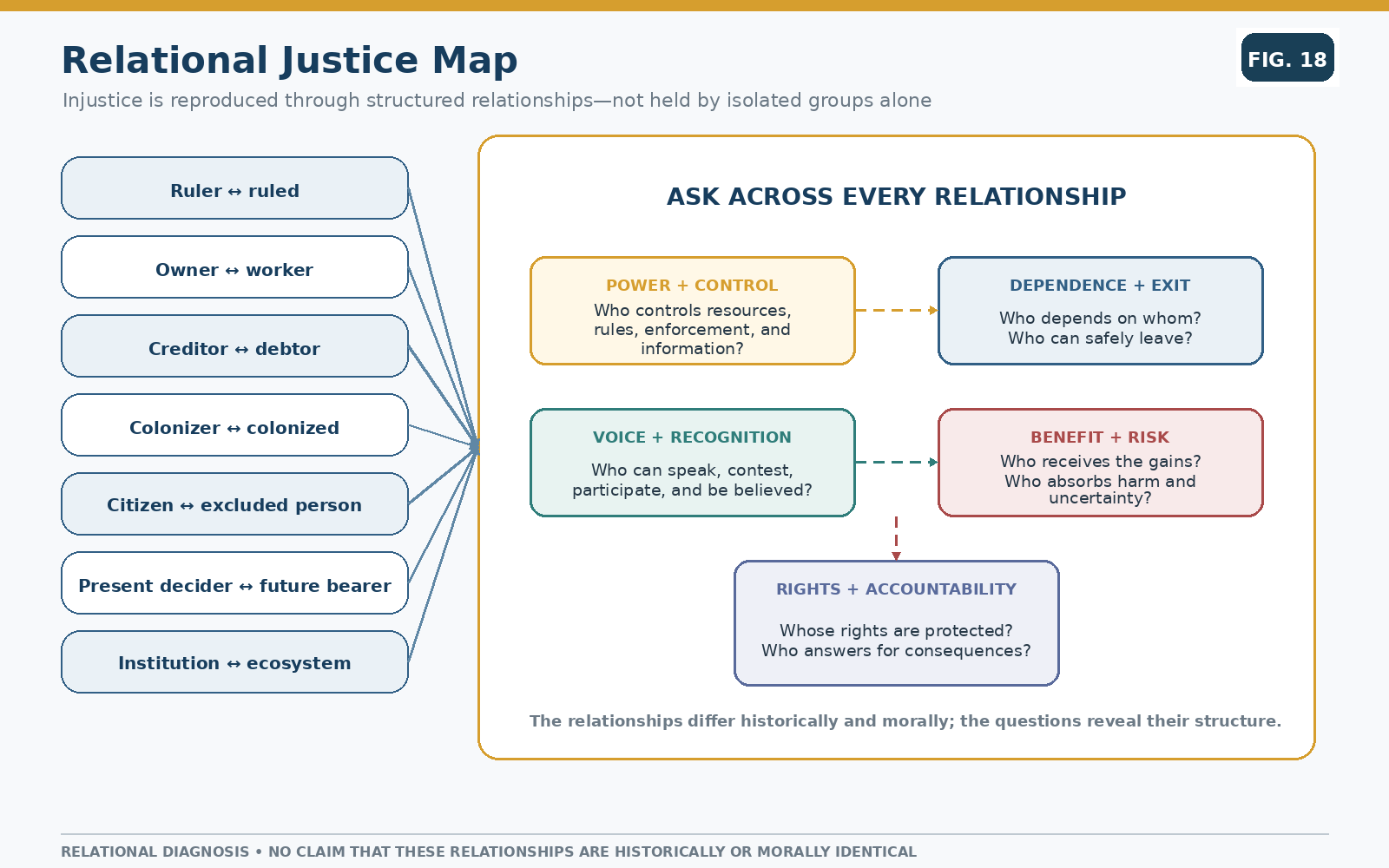
Figure 18. Relational justice map. Justice is evaluated across voice, rights, benefits, burdens, recognition, consequences, and accountability. Source: Original conceptual synthesis for this study.
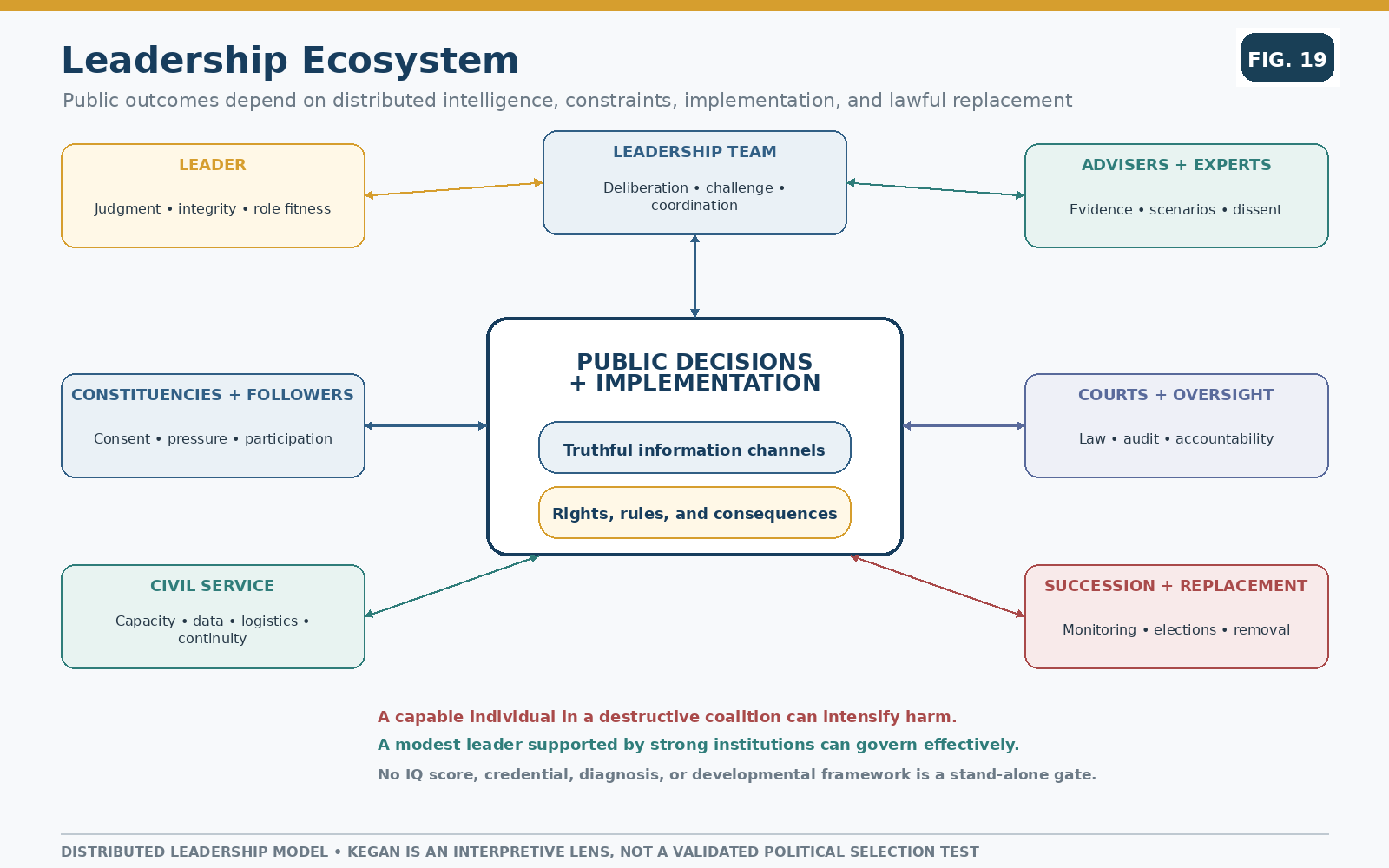
Figure 19. Leadership ecosystem. Outcomes emerge from selection, development, advisers, followers, civic service, oversight, succession, and lawful replacement. Source: Original conceptual synthesis for this study
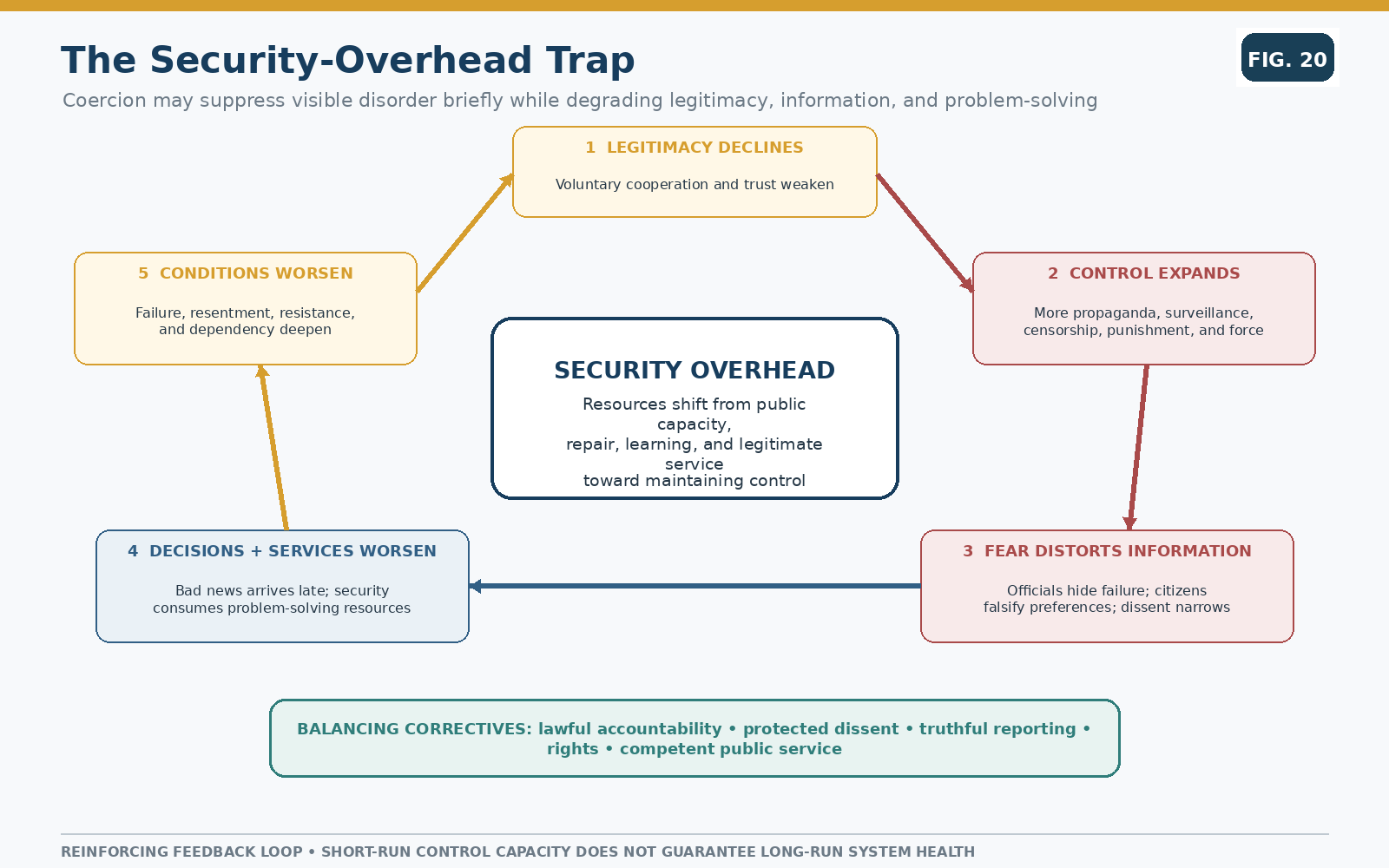
Figure 20. Security-overhead trap: declining legitimacy can increase coercive expenditure and information distortion, further weakening legitimacy and adaptive capacity. Source: Original conceptual synthesis for this study.
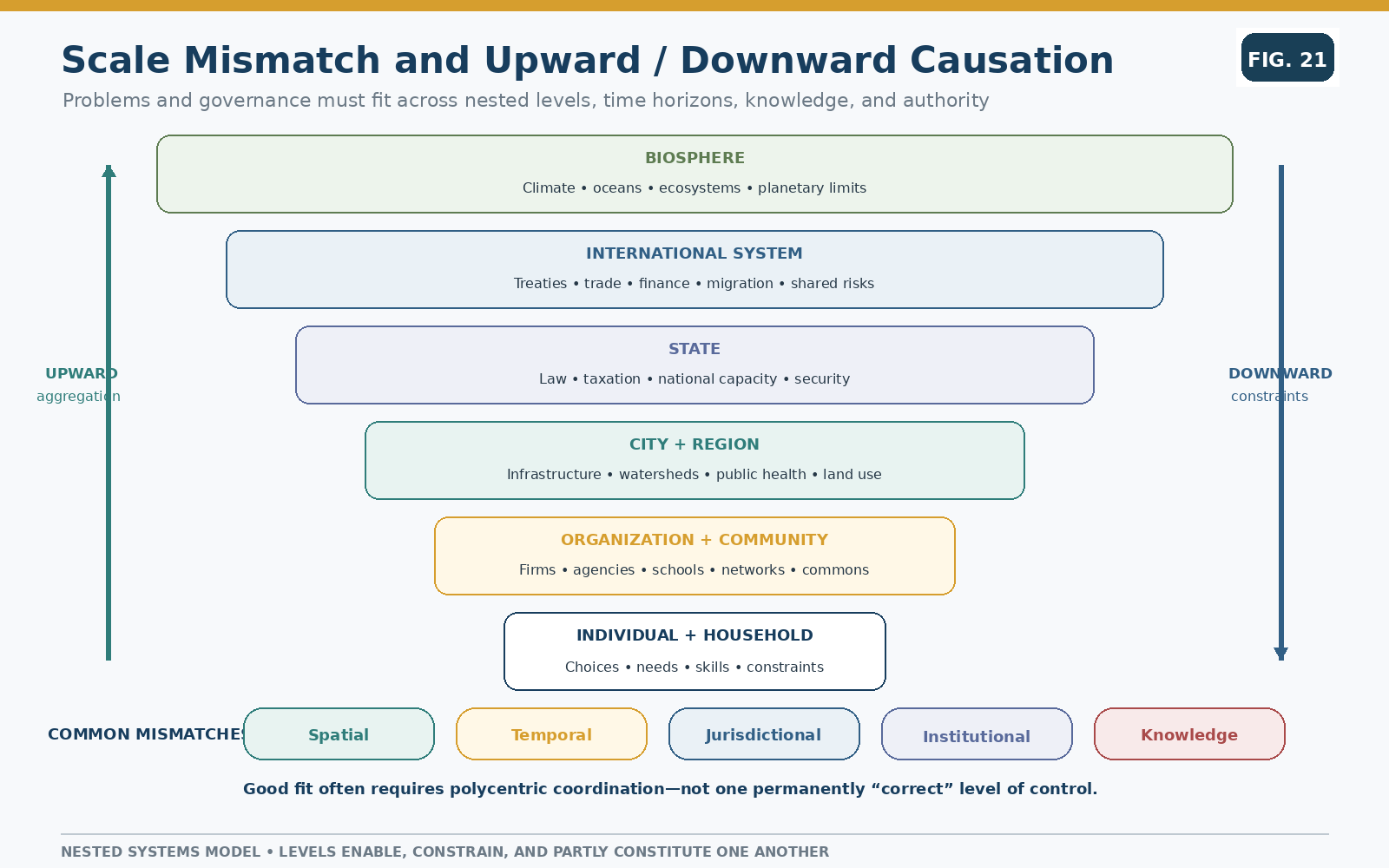
Figure 21. Scale mismatch and upward/downward causation. Problems, knowledge, authority, and consequences can occupy different levels. Source: Original conceptual synthesis for this study.
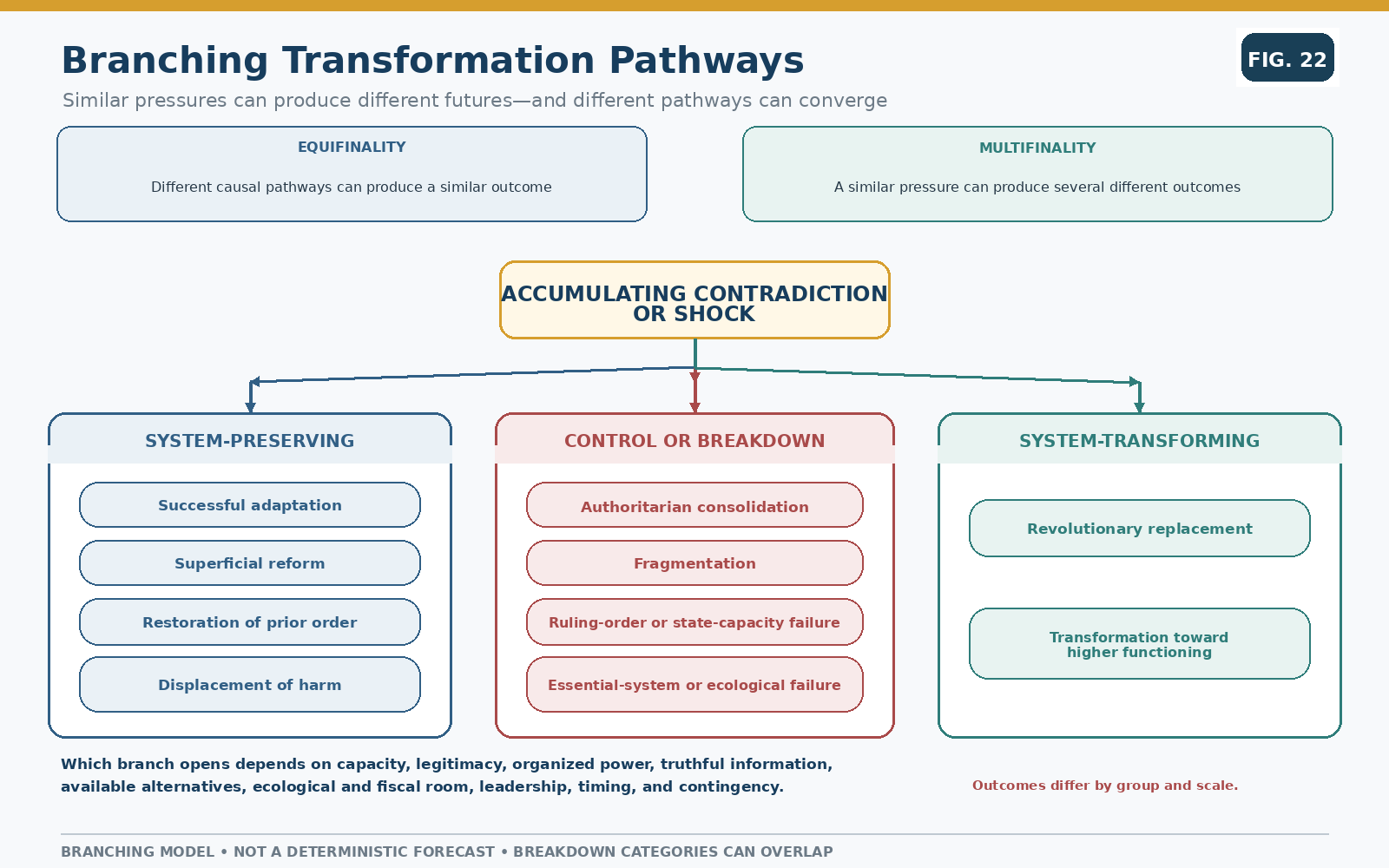
Figure 22. Branching transformation pathways. Similar pressures can yield reform, adaptive transformation, authoritarian consolidation, fragmentation, or breakdown. Source: Original conceptual synthesis for this study.
Do you like this page?
