
The Great Reckoning is the Universe Institute's name for the prolonged historical period in which humanity increasingly has to confront the accumulated consequences of interacting ecological, climatic, economic, political, technological, and social stresses that can no longer be indefinitely postponed, externalized, financed, concealed, or shifted onto other people and future generations.
It is not a prediction of one dramatic event. It is a framework for understanding a difficult transition already unfolding unevenly across regions and systems.
The central idea is simple: humanity faces many serious problems, but the greatest danger often comes from how those problems interact. Climate disruption can worsen food and water insecurity. Economic stress can weaken governments. Political conflict can block adaptation. Information disorder can make collective action harder. Technological change can improve resilience in one area while increasing risk or concentrating power in another.
The Great Reckoning framework asks us to look at those relationships rather than treating each crisis as an isolated headline.
This page does not claim that collapse is inevitable, that every crisis has one cause, that every nation will experience the same future, or that human history moves toward a predetermined outcome. Different regions and institutions can decline, adapt, reform, recover, simplify, innovate, or fail at different times. Human choices still matter.

The purpose of studying the Great Reckoning is not despair. It is earlier recognition, better analysis, wiser preparation, and greater capacity to reduce preventable harm while protecting the possibility of better futures.
For the Universe Institute's detailed analysis of the interacting global crises, see The Global Polycrisis. For deeper analysis of recurring civilization-level causes, see The 10,000-Year Trap. These two articles and white papers help to inform the positions and ideas you find on this page.
On This Page
- 1. Working Definition
- 2. What Is Established, Emerging, and Hypothetical?
- 3. Related Terms and Frameworks
- 4. Major Drivers of the Great Reckoning
- 5. Why the Crises Compound
- 6. Deeper Civilizational Causes
- 7. Planning Windows, Not Prophecies
- 8. The Great Reckoning Is Not the Same as Collapse
- 9. What Can Still Be Done?
- 10. Where the Four Websites Fit
- 11. AI Prompts for Testing the Framework
- 12. Frequently Asked Questions
- 13. Glossary
- 14. Bibliography and Further Reading
- 15. Where This Leads
1. Working Definition of the Great Reckoning
The Great Reckoning is the Universe Institute's working name for an extended transition in which the accumulated consequences of ecological overshoot, climate destabilization, biodiversity loss, pollution, resource pressures, institutional dysfunction, inequality, geopolitical conflict, economic fragility, information disorder, technological disruption, and other systemic stresses increasingly have to be confronted together.
Some of these pressures are global. Others are regional or local. Some unfold gradually. Others can cross thresholds and change rapidly. Some are strongly established by scientific evidence. Others remain uncertain in timing, magnitude, or interaction.
The key claim is therefore not that one master cause explains everything. It is that multiple large systems are increasingly interconnected, and disturbances can propagate among them through shared causes, feedback loops, cascading failures, institutional responses, and behavioral reactions.

Why call this a "reckoning"?
We use the word in its ordinary sense: an honest accounting. A reckoning occurs when deferred consequences become difficult to ignore and past assumptions have to be tested against reality.
In this framework, the Great Reckoning is not punishment, destiny, or a supernatural event. It is a human label for a period of intensified consequence, adjustment, learning, conflict, adaptation, and possible institutional transformation.
A crucial qualification
The Great Reckoning is not synonymous with human extinction or universal civilizational collapse. Serious disruption can coexist with successful adaptation. A political system can weaken while local communities remain functional. One industry can contract while another expands. Some societies may reform earlier than others. New technologies can solve selected problems while creating new risks elsewhere.
The future is path-dependent, uneven, and influenced by decisions made at many levels.
2. What Is Established, Emerging, and Hypothetical?
The Universe Institute distinguishes different levels of confidence. That distinction matters because civilization-scale analysis becomes useless very quickly if every concern is presented with the same certainty.
Established or strongly supported
Strong evidence supports ongoing anthropogenic climate change, biodiversity loss, many forms of pollution, growing exposure of infrastructure and populations to climate hazards, significant inequality within and among societies, the existence of geopolitical conflict and technological disruption, and the ability of failures in connected systems to propagate beyond their original domain.
Emerging and actively researched
Researchers increasingly examine polycrisis, systemic risk, cascading failure, compound hazards, interacting tipping processes, institutional fragility, information-system degradation, and the ways ecological, economic, political, and technological stresses may reinforce one another. The strength, direction, and timing of particular interactions remain active research questions.
Universe Institute analytical hypotheses
The Great Reckoning itself is an integrative interpretive framework developed by the Universe Institute. It is not a scientific term with one universally accepted academic definition.
Likewise, the Institute's synthesis linking today's polycrisis with the recurring causal patterns analyzed in The 10,000-Year Trap should be treated as a research framework to be tested, criticized, revised, and compared with alternatives.
Precautionary planning judgments
When consequences could be severe, decision-makers often cannot wait for perfect certainty. Precautionary planning asks a different question: What actions remain sensible across several plausible futures? Robust responses such as resilience, redundancy, better information, ecological protection, diversified supply, honest risk communication, and adaptive institutions can be valuable even when exact timing is uncertain.
3. Related Terms and Frameworks
The Great Reckoning overlaps with several concepts used by researchers, institutions, and systems thinkers. They are related, but they are not interchangeable synonyms. Each emphasizes a different aspect of the larger problem.
| Term | What it emphasizes | Relationship to the Great Reckoning |
|---|---|---|
| Global polycrisis | Multiple crises that interact across systems and can amplify one another. | Describes a major part of the interacting risk environment occurring during the Great Reckoning. |
| Metacrisis | Deeper cultural, cognitive, institutional, technological, and value problems that may repeatedly generate crises. | Offers possible explanations for why societies reproduce dangerous conditions. |
| Ecological overshoot | Human demand exceeding ecological regenerative and absorptive capacity. | A major biophysical driver and boundary condition. |
| Triple planetary crisis | Climate change, nature/biodiversity loss, and pollution. | Identifies three critical environmental dimensions, but is narrower than the full framework. |
| Planetary boundaries | Earth-system processes whose disruption can increase risks to planetary stability. | Provides a scientific framework for understanding important ecological limits and systemic risk. |
| Great Acceleration | The rapid post-1950 expansion of population, production, consumption, energy use, and environmental impacts. | Describes historical acceleration behind several present pressures. |
| Great Simplification | Potential contraction of material and energy throughput and societal complexity. | Describes one possible dimension or response pathway, not the whole Great Reckoning. |
| Great Unraveling | Deterioration of ecological, social, economic, or institutional systems. | Describes one possible breakdown trajectory. |
| Systemic or civilizational crisis | Risks affecting interconnected institutions and basic societal functions rather than one sector. | Provides established systems and historical language for part of the scale being examined. |
| Permacrisis | A prolonged condition of repeated or overlapping crises. | Describes the experience of persistent crisis but says less about underlying mechanisms. |
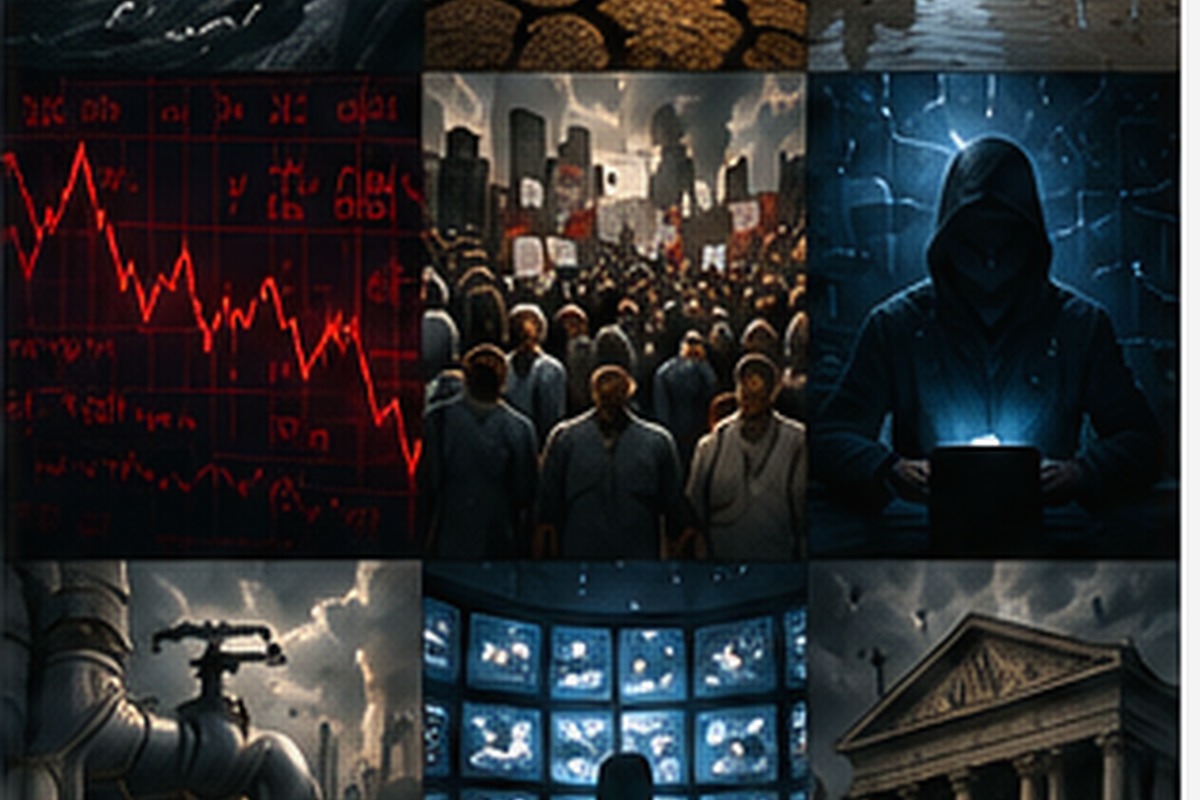
4. Major Drivers of the Great Reckoning
No single list can capture every relevant force. The categories below are a practical synthesis of major interacting pressures rather than a claim that each has equal weight everywhere.
Ecological overshoot and ecosystem degradation
Human economies depend on functioning ecological systems. Soil fertility, freshwater, forests, fisheries, biodiversity, stable climate conditions, and biogeochemical cycles are not optional scenery around the economy. They are parts of the larger system within which economic activity occurs.

Climate destabilization
Human-caused climate change increases risks from heat, drought, wildfire, heavy precipitation, coastal flooding, ecosystem disruption, crop stress, infrastructure damage, health impacts, and displacement. These impacts can then interact with economic, political, and social vulnerabilities.
Resource, infrastructure, and energy constraints
Modern societies depend on large flows of energy, materials, water, food, transportation, communications, and infrastructure. Resource quality, geopolitical concentration, aging infrastructure, maintenance costs, and ecological limits can increase the cost and fragility of sustaining complex systems.
Institutional dysfunction and capture
Institutions can become less adaptive when concentrated interests can capture benefits while shifting costs onto the public, future generations, ecosystems, or less powerful groups. Rules that reward short-term extraction while dispersing long-term consequences can make collectively damaging behavior locally rational.
Economic and financial fragility
Debt dependence, financial leverage, unequal exposure to shocks, concentrated ownership, fragile supply chains, insurance retreat, and high infrastructure costs can translate physical disruptions into broader economic and political stress.
Information disorder and declining shared reality
Misinformation, propaganda, manipulation, fragmented media systems, algorithmic incentives, distrust, and deliberate attacks on credible institutions can reduce a society's ability to identify threats, deliberate honestly, and coordinate responses.
Geopolitical rivalry and conflict
War, strategic competition, sanctions, arms races, displacement, and security dilemmas can divert resources from adaptation and undermine cooperation precisely when cross-border coordination becomes more important.
Rapid technological change
Artificial intelligence, biotechnology, cyber systems, autonomous systems, surveillance, and other technologies can expand human capabilities while also creating new failure modes, security risks, concentration of power, labor disruption, and possibilities for misuse.

Climate change is therefore central, but the Great Reckoning is more than climate change. For detailed climate science, risk, preparation, adaptation, and migration planning, the four-site system directs readers to Job One for Humanity.
5. Why the Crises Compound: A Systems View
A list of separate problems can hide the most important feature of a polycrisis: relationships can change outcomes.
For example, climate impacts can reduce agricultural output. Food-price shocks can increase household hardship and political instability. Political instability can weaken long-term environmental policy. Weak policy can permit additional ecological damage. Economic stress can reduce public investment in resilience. Information manipulation can make agreement on corrective action even harder.
The resulting system contains feedbacks, delays, thresholds, bottlenecks, adaptations, unintended consequences, and conflicts among different levels of organization.

Why linear thinking fails
Complex adaptive systems do not behave like simple machines. Interventions can have delayed effects. A solution in one sector can create problems in another. Institutions adapt to reforms. People change behavior in response to incentives. Feedback can accelerate or dampen change.
How DMAP is used
The Universe Institute uses Dialectical Metasystemic Analysis and Problem-solving (DMAP) to supplement conventional systems analysis. DMAP examines relationships, contexts, processes, transformations, contradictions, and interactions among levels of a system. It is designed to help analysts avoid false either/or choices and simplistic single-cause explanations.
DMAP is an analytical method, not a substitute for domain expertise, empirical evidence, peer review, or uncertainty analysis.
The governance-complexity problem
Ecological overshoot is not the only form of overshoot worth examining. Governments and institutions can accumulate obligations, maintenance backlogs, debt, administrative complexity, security costs, and control systems faster than available social and economic capacity can reliably support them.
When the returns from added complexity fall, societies may face a choice between adaptive simplification and simplification imposed by breakdown.
6. Deeper Civilizational Causes: The 10,000-Year Trap
The Great Reckoning describes a present and emerging historical condition. It does not by itself explain why human societies repeatedly create conditions of dysfunction, injustice, ecological damage, concentrated power, and failure to correct foreseeable risks.
That deeper question is addressed in the Universe Institute's 10,000-Year Trap research.
That project analyzes 20 interacting causal forces across six layers, including mixed human motives, failures of reasoning and shared reality, concentrated power and unequal consequence distribution, institutional rigidity and scale mismatch, ecological and technological boundary conditions, and complexity and polycrisis.
The 20-force framework is an interdisciplinary synthesis and remains open to criticism and revision. Its value is not that it claims 20 previously unknown causes. Its value is that it tries to place many well-studied causes into one interacting systems model and ask how they reinforce or reduce one another.

Why this matters
If today's crises are partly generated by recurring structural causes, solving only the visible symptoms may produce temporary relief while allowing the underlying patterns to return in new forms.
That is why the Great Reckoning page links downward into causal research rather than pretending a memorable label is itself an explanation. Humanity already has enough slogans. The shortage is reliable diagnosis.
7. Planning Windows, Not Prophecies
The Universe Institute uses broad planning horizons to organize preparedness and research. These are not precise forecasts and should not be treated as consensus scientific dates for global collapse. Different hazards operate on different clocks, and credible analysts can disagree about timing, severity, regional exposure, and adaptation capacity.
| Planning horizon | What to watch | General planning emphasis |
|---|---|---|
| 2026-2032 | Rapidly changing climate risks, insurance and infrastructure stress, food and water volatility in vulnerable regions, geopolitical fragmentation, AI disruption, disaster costs, and institutional capacity. | Reduce avoidable drivers, improve early warning, strengthen household/community resilience, protect infrastructure, improve risk literacy, and begin relocation planning where local risk already warrants it. |
| 2033-2045 | Potential compounding of climate impacts, ecological degradation, migration pressures, fiscal strain, resource constraints, technological disruption, and political instability. | Deep adaptation, resilient food/water/energy systems, regional cooperation, institutional reform, knowledge preservation, and protection against capture and cascading failure. |
| 2045-2050+ | Longer-run consequences of cumulative warming, ecosystem loss, infrastructure choices, demographic change, technological development, and whether institutions improved their adaptive capacity. | Preserve adaptive capacity, restore ecosystems, maintain critical knowledge and services, revise institutions as conditions change, and expand approaches shown to work. |
These horizons are best understood as precautionary planning containers. The correct action depends on the hazard, location, evidence, stakes, and reversibility of the decision.
8. The Great Reckoning Is Not the Same as Collapse
Collapse research is relevant to the Great Reckoning, but the two concepts are not identical.
Societies under stress can experience mixtures of:
- adaptation;
- institutional reform;
- technological substitution;
- migration;
- decentralization or recentralization;
- authoritarian responses;
- cooperation;
- simplification;
- regional or sectoral failure;
- recovery and regeneration;
- and, in some cases, partial or severe collapse.
Historical collapse is rarely uniform. State capacity may fall while households, cities, religious institutions, businesses, scientific traditions, or local communities retain some functions. One region may deteriorate while another gains population or resources.

The both-and principle
The Universe Institute deliberately tests false either/or choices. Under systemic stress, good responses may require:
- mitigation and adaptation;
- technology and conservation;
- local resilience and higher-level coordination;
- preserving valuable complexity and simplifying brittle or low-value complexity;
- individual preparation and institutional reform.
Different contexts will require different combinations.
9. What Can Still Be Done?
The practical purpose of the Great Reckoning framework is to improve decisions under uncertainty.
1. Reduce avoidable drivers
Reduce greenhouse-gas emissions, ecological destruction, pollution, preventable resource waste, and institutional incentives that reward the transfer of costs onto others.
2. Prepare for consequences that can no longer be completely avoided
Strengthen food, water, energy, health, housing, disaster, infrastructure, financial, and migration resilience. The details of climate preparation belong primarily at Job One for Humanity.
3. Improve collective intelligence
Strengthen evidence evaluation, probabilistic reasoning, systems thinking, dialectical thinking, scientific literacy, misinformation resistance, metacognition, and decision-making under uncertainty.
4. Align power with consequences
Institutions work better when actors cannot routinely privatize gains while transferring large costs to the public, ecosystems, or future generations. Accountability, transparency, auditability, lawful correction, and anti-capture safeguards matter.
5. Protect shared commons
Atmosphere, freshwater, soils, biodiversity, oceans, public institutions, knowledge systems, and information environments require forms of governance capable of protecting long-term shared value.
6. Build resilience at several scales
Households, neighborhoods, cities, regions, nations, and international institutions solve different parts of the problem. No single scale can substitute for all others.
7. Preserve what is worth preserving
Resilience is not merely survival. Societies must decide which capabilities, freedoms, knowledge, cultural achievements, institutions, ecosystems, and forms of cooperation should be protected during periods of stress.
8. Remove or redesign structures that repeatedly recreate harm
The deepest reforms target recurring causes rather than endlessly treating symptoms. This is where the Institute's polycrisis and 10,000-Year Trap research intersect.
Practical hope is not confidence that everything will work out. It is disciplined action to reduce preventable harm and enlarge the range of good futures that remain possible.
10. Where the Four Websites Fit
The Great Reckoning is intentionally housed at the Universe Institute because its primary task is diagnosis, evidence, systems analysis, causal investigation, uncertainty, and solution research.
Universe Institute: Understanding
What appears to be happening, why is it happening, and how can we think about it more accurately?
The Institute is the canonical home for the Great Reckoning, the global polycrisis, the 10,000-Year Trap research, DMAP, Limited Progressive Evolution, Limited Evolutionary Normativity, and related rational-thinking and systems-analysis work.
Job One for Humanity: Preparation
What should individuals, families, communities, and institutions do about accelerating climate risk?
Job One focuses on climate science, risk, adaptation, resilience, preparation, and migration where necessary.
Way of the Universe: Orientation and constructive possibility
Given what we know, how might we live, act, and build better possibilities?
Way of the Universe is the home for practical philosophy, Right Actions and Right Attitudes, Planetary Citizenship, Universe Citizenship, the Universe Constitution and Declaration, and the constructive civilizational vision we call the Great Rebirth within Our Next Bold Adventure.
FACTNet: Participation and coordination
How do the organizations and participants work together?
FACTNet is the organizational, administrative, fundraising, marketing, and participation hub for the wider four-site effort and the authoritative home of the Evolutioneer identity.
Universe Spirit: Meaning
How might people explore meaning, awe, consciousness, spirituality, and existential resilience?
Universe Spirit addresses those questions without turning them into scientific claims made by the Universe Institute.
This division reduces duplication. Each major concept has one authoritative home, while the other sites provide short summaries and links when that concept is relevant.
11. AI Prompts for Testing the Great Reckoning Framework
AI can help with comparison, criticism, synthesis, and generating research questions. It should not be treated as an oracle or as a substitute for checking primary sources.
Prompt 1: Evidence audit
Analyze the Great Reckoning framework using current research on polycrisis, ecological overshoot, climate risk, biodiversity loss, resource constraints, governance failure, economic fragility, information disorder, and technological disruption. Separate well-established evidence, emerging evidence, disputed claims, and speculation. Cite high-quality sources.
Prompt 2: Red-team challenge
Red-team the claim that humanity is entering a prolonged period of systemic reckoning. Find the strongest evidence against the thesis, identify historical counterexamples, distinguish global from regional evidence, and state what observations would substantially weaken or falsify the framework.
Prompt 3: Systems map
Map causal and non-causal relationships among climate change, biodiversity loss, food insecurity, migration, inequality, political instability, misinformation, geopolitical conflict, technological disruption, and public-finance stress. Clearly distinguish causal edges from correlations or shared drivers. Identify leverage points that could reduce several risks at once.
Prompt 4: Local application
Apply the Great Reckoning framework to my city, region, organization, or industry. Identify major external dependencies, critical vulnerabilities, costs that are being shifted onto others, uncertainties, plausible cascading failures, adaptive capacities, and low-regret resilience measures.
Prompt 5: Competing explanations
Compare the Great Reckoning framework with polycrisis, metacrisis, planetary boundaries, ecological overshoot, resilience theory, structural-demographic theory, and civilizational collapse research. Show where they overlap, where they differ, and what each explains better or worse.
12. Frequently Asked Questions
Is the Great Reckoning another word for the polycrisis?
No. Polycrisis describes interacting crises whose combined behavior cannot be understood well by studying each crisis in isolation. The Great Reckoning is the Universe Institute's broader historical-transition framework for the period in which interacting crises, deeper causes, ecological constraints, and accumulated consequences increasingly have to be confronted.
Is the Great Reckoning the same as the metacrisis?
No. Metacrisis usually points toward deeper cultural, cognitive, institutional, technological, and value-generating structures behind multiple crises. That can help explain parts of the Great Reckoning, but the Reckoning framework also includes physical hazards, ecological limits, economic stresses, institutional responses, adaptation, and recovery.
Does the Great Reckoning mean civilization will collapse?
No. Collapse is one possible outcome for some systems or regions under sufficiently severe stress. Reform, resilience, adaptation, simplification, innovation, migration, cooperation, regeneration, and partial recovery are also possible. The framework is deliberately multi-pathway.
Is the Great Reckoning scientifically proven?
No, not as a single named scientific theory. Many components of the framework are strongly supported by established research, while other interactions remain uncertain or contested. "Great Reckoning" is the Universe Institute's synthesis and interpretive framework for organizing those findings and testing their relationships.
Why focus so much on interactions?
Because interconnected systems can transmit shocks. The failure of one system can increase stress on another, and feedback loops can amplify consequences. A risk assessment that ignores those relationships may underestimate total vulnerability.
Why is climate change central but not the whole framework?
Climate change affects food, water, health, ecosystems, infrastructure, insurance, migration, public finance, and security. But those systems are also influenced by governance, inequality, technological change, conflict, demographics, information quality, and many other forces. Climate is therefore both a major crisis and a major amplifier.
Why examine events going back roughly 10,000 years?
The Institute's 10,000-Year Trap research asks whether recurring patterns associated with large-scale settled societies, surplus accumulation, hierarchy, concentrated power, coordination problems, institutional rigidity, and ecological pressure help explain why different civilizations repeatedly reproduce forms of injustice and breakdown. The date is approximate and the causal interpretation remains open to revision.
Are the dates on this page predictions?
No. They are planning horizons used to organize research and precaution. Individual hazards have their own evidence-based timelines, and regional outcomes can differ sharply.
What is the relationship between the Great Reckoning and the Great Rebirth?
The Great Reckoning is mainly diagnostic: understanding interacting risks, causes, consequences, and response options. The Great Rebirth is a constructive and philosophical concept developed at Way of the Universe within the broader positive frame of Our Next Bold Adventure. They can overlap in time. Constructive institutions can emerge while other systems are under stress.
Does the Great Reckoning imply that evolution or history inevitably progresses?
No. Universe Institute uses the concept of Limited Progressive Evolution: some systems under some conditions show increases in cooperation, coordination, adaptability, information processing, cumulative learning, resilience, or integration. Other systems regress, fragment, maladapt, collapse, or disappear. There is no claim that evolution as a whole, human history as a whole, or the universe as a whole inevitably progresses.
Does evidence about evolution tell us what humanity morally ought to do?
Not by itself. Facts do not automatically create moral obligations. The Institute's concept of Limited Evolutionary Normativity begins with explicit human values, goals, or needs, then asks whether reliable evolutionary or systems evidence identifies conditions necessary to protect them. Any practical conclusion remains conditional, contestable, and revisable and must consider competing values, harms, alternatives, uncertainty, and system levels.
What can an individual do with this information?
Improve risk literacy, reduce avoidable vulnerabilities, strengthen useful relationships, prepare for locally relevant hazards, support reliable institutions and information, improve your own reasoning, and participate in constructive collective action. Detailed climate preparation belongs at Job One; practical philosophy and the positive civilizational vision belong at Way of the Universe.
Is this framework partisan?
No. The analytical questions are about evidence, causal mechanisms, institutional performance, risks, uncertainty, and possible solutions. Specific policy choices can involve legitimate disagreements about values, costs, benefits, rights, tradeoffs, and implementation.
13. Glossary
Adaptive capacity: The ability of a person, organization, community, or system to adjust to changing conditions while preserving important functions.
Adaptive simplification: Deliberately reducing costly, brittle, or low-value complexity while preserving functions necessary for wellbeing, freedom, knowledge, coordination, resilience, and ecological stewardship.
Cascade or cascading failure: A process in which disruption in one system causes or amplifies disruption in connected systems.
Complex adaptive system: A system made of interacting agents or components that learn, adapt, and influence one another, producing behavior that cannot always be predicted by examining the parts separately.
Consequence capture: The degree to which decision-makers experience the significant consequences of their decisions rather than shifting those consequences onto other people, future generations, institutions, or ecosystems.
DMAP: Dialectical Metasystemic Analysis and Problem-solving, the Universe Institute's adaptation of dialectical/metasystemic reasoning for analyzing complex adaptive problems through relationships, contexts, processes, transformations, tensions, and system levels.
Ecological overshoot: Human demand on ecosystems exceeding their regenerative or absorptive capacity over time.
Externality: A cost or benefit of an activity that falls on people or systems not fully represented in the decision that created it.
Feedback loop: A chain of cause and effect in which a change eventually influences its own future direction. Reinforcing feedback amplifies change; balancing feedback counteracts it.
Great Reckoning: The Universe Institute's term for the prolonged historical period in which accumulated and interacting ecological, climatic, economic, political, technological, and social consequences increasingly have to be confronted.
Limited Evolutionary Normativity: A framework for using reliable evolutionary or systems facts to inform conditional practical "oughts" only after explicit values, goals, needs, causal evidence, competing values, harms, alternatives, system levels, and uncertainty are considered.
Limited Progressive Evolution: A descriptive framework examining conditional and reversible patterns such as cooperation, coordination, adaptability, cumulative learning, information processing, integration, resilience, and conflict regulation, alongside regression, fragmentation, maladaptation, excessive competition, collapse, and extinction.
Metacrisis: A family of frameworks emphasizing deeper cultural, cognitive, institutional, technological, and value-generating structures that may produce or intensify many surface crises.
Nonlinear change: Change in which effects are not proportional to causes. Small additional pressures can sometimes produce large changes near thresholds.
Planetary boundaries: A scientific framework identifying major Earth-system processes and boundaries associated with maintaining relatively stable planetary conditions for human societies.
Polycrisis: A condition in which multiple crises interact so that their combined effects, causes, or solutions differ from what would be expected if each crisis were analyzed independently.
Precautionary planning: Preparing for serious plausible risks even when uncertainty prevents precise prediction, especially when delays or irreversible losses could make later action much more difficult.
Red team: A structured attempt to challenge an analysis by seeking contrary evidence, alternative explanations, hidden assumptions, failure modes, unintended consequences, and conditions that would falsify or weaken its conclusions.
Resilience: The capacity of a system to absorb disruption, preserve critical functions, recover, and adapt.
Systemic risk: Risk that can impair the functioning of an entire interconnected system rather than remaining limited to one component.
Tipping point: A threshold beyond which a system may shift substantially in state or behavior, sometimes through self-reinforcing processes.
14. Bibliography and Further Reading
The sources below provide background for the major scientific and analytical frameworks discussed on this page. Inclusion does not mean every source endorses the Universe Institute's Great Reckoning synthesis.
Universe Institute research
- Universe Institute. The Global Polycrisis.
- Universe Institute. The 10,000-Year Trap: The 20 Interacting Causal Forces Behind Recurring Human and Civilization-Level Dysfunctionality, Injustice, Catastrophe, and Collapse.
- Universe Institute. Journal Version of The 10,000-Year Trap.
- Universe Institute. Metacognition, DMAP, and rational problem-solving.
Climate and Earth-system science
- Intergovernmental Panel on Climate Change. AR6 Synthesis Report.
- United Nations Environment Programme / International Resource Panel. Global Resources Outlook 2024.
- United Nations Environment Programme. Climate and environmental assessments.
- Stockholm Resilience Centre. Planetary Boundaries.
- Global Footprint Network. Ecological Footprint.
Polycrisis, systemic risk, resilience, and collapse
- Cascade Institute. Research on global systemic risk and polycrisis.
- Lawrence, M., Janzwood, S., and Homer-Dixon, T. Research on causal mechanisms of global polycrisis.
- Scheffer, M. et al. (2009). Early-warning signals for critical transitions. Nature, 461, 53-59.
- Tainter, J. A. (1988). The Collapse of Complex Societies. Cambridge University Press.
- Diamond, J. (2005). Collapse: How Societies Choose to Fail or Succeed. Viking.
- Holling, C. S. (1973). Resilience and stability of ecological systems. Annual Review of Ecology and Systematics, 4, 1-23.
Related public frameworks
- Club of Rome. Planetary emergency and systems-change work.
- The Great Simplification / Institute for the Study of Energy & Our Future.
- Great Transition Initiative.
- Post Carbon Institute.
Important source note
Some sources above are peer-reviewed scientific literature or major scientific assessments. Others are interdisciplinary research organizations, books, or public frameworks. They should not be treated as equal forms of evidence. The Great Reckoning synthesis should be revised as stronger evidence, better models, and credible criticism become available.
15. Where This Leads
Diagnosis matters because action without diagnosis can solve the wrong problem, shift harm somewhere else, or make a complex system more brittle.
But diagnosis is not the destination.
The Universe Institute's role is to investigate the Great Reckoning: its evidence, interacting systems, deeper causes, uncertainties, risks, and possible leverage points. From here, readers can follow the path most relevant to them:
- Understand the interacting crises: Explore the Global Polycrisis.
- Investigate the deeper recurring causes: Read The 10,000-Year Trap.
- Prepare for climate consequences: Continue to Job One for Humanity.
- Explore the constructive civilizational vision: Continue to the Great Rebirth / Our Next Bold Adventure at Way of the Universe.
- Participate in the wider four-site effort: Continue to FACTNet.

Face Reality Without Surrendering Agency
The Great Reckoning is not useful because it gives a dramatic name to the future. It is useful only if it helps us see connected risks earlier, distinguish causes from symptoms, identify uncertainty honestly, make better decisions, preserve what matters, and reduce preventable suffering.
The future is not guaranteed to improve. It is also not finished.
Do you like this page?
